
The Rubin Observatory is making new discoveries — and generating new puzzles — even before its scientific mission begins. In a set of images gathered as part of an engineering test of its Legacy Survey of Space and Time (LSST) Camera, astronomers have found two main-belt asteroids, each nearly a kilometer across, that rotate once every two minutes. A few such fast spinners have been discovered among the near-Earth object population before, but Rubin’s discoveries are much larger and more distant.
Dmitrii Vavilov (University of Washington) presented Rubin’s asteroid discoveries at the 57th Lunar and Planetary Science Conference in The Woodlands, Texas on March 16th. The announcement is just a tiny taste of the eventual asteroid smorgasbord anticipated from the 10-year all-sky LSST survey, expected to begin later this year, and a clue to the existence of whole undiscovered families of asteroids.
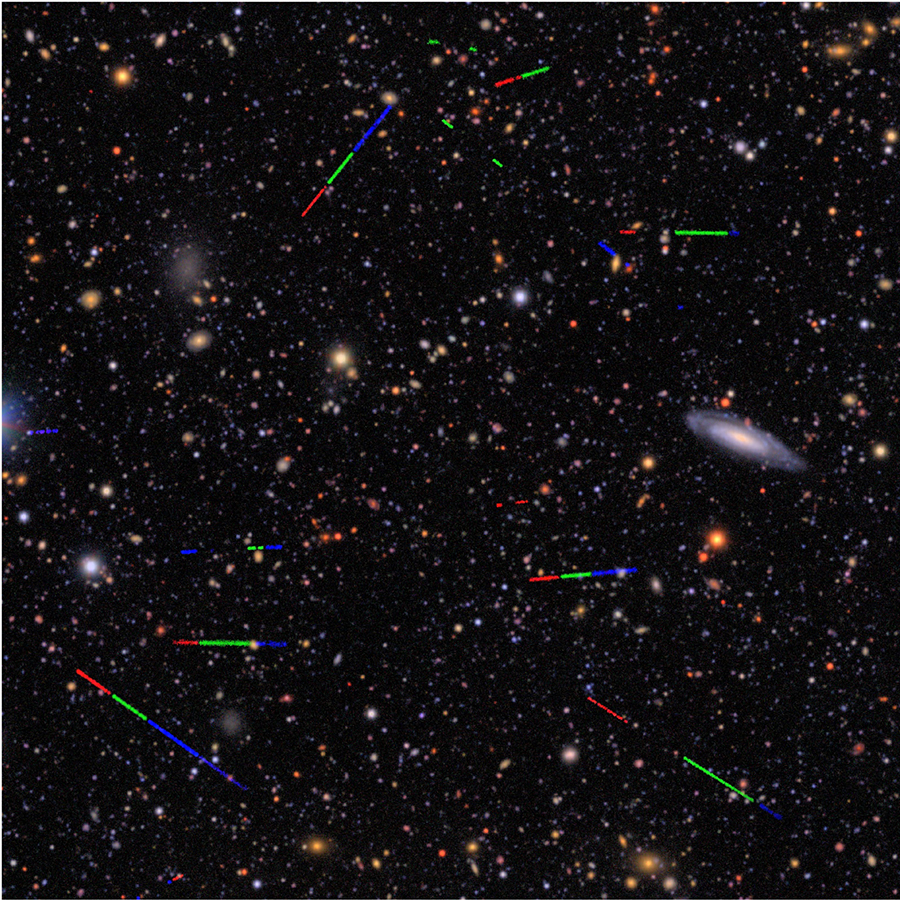
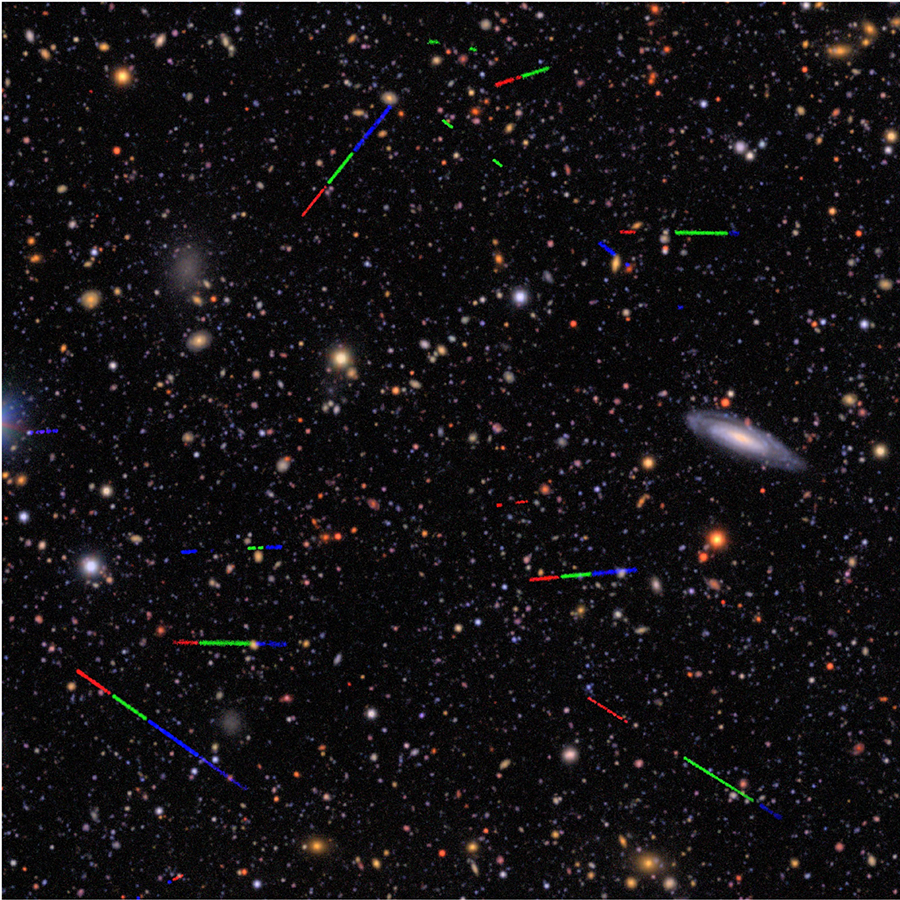
While the Rubin Observatory’s construction is complete, it’s still undergoing a series of increasingly complicated tests of every part of its system. One such test, conducted over nine nights in April and May 2025, produced 1,185 images that covered much of the Virgo galaxy cluster through three visible-wavelength filters. Individual images had a limiting magnitude of around 24, similar to the sensitivity of PAN-STARRS. But when all the images were co-added together, the test yielded a depth of magnitude 26.5, ten times fainter. The co-added color image, containing 10 million galaxies, was published last June as Rubin’s “First Look” image.
In addition to galaxies, that image contains 343,760 unique observations of objects within the solar system, whose movement between exposures created colorful tracks. The tracks document 2,100 moving objects, of which 1,900 were previously undiscovered.
NSF / DOE /Vera C. Rubin Observatory
S. Greenstreet et al. / Astrophysical Journal Letters 2026
You only need a handful of observations of a moving object to figure out its orbit, and most of these asteroids were imaged more than 100 times within a span of a few hours. The high number of images also meant it was possible to look for variability in the objects’ brightness as they rotated. An elongated body will present alternately larger and smaller faces to the viewer as it spins, dimming and brightening twice per rotation.
Vasilov explained that the processing pipeline is new and the data in need of cleaning up, but his team’s initial attempt at pulling light curves out of the data produced 76 reliable rotation periods. All but three are main-belt asteroids. A surprising number (16) were “superfast” rotators, with rotation periods under 2.2 hours, and three were “ultrafast,” completing rotations in under 5 minutes. The standout is 2025 MN45, “a record-breaking object, definitely the fastest one of its size,” Vavilov said. “If you take into account its elongation, it’s close to one kilometer.”
Why do rotation speed and size matter? If an asteroid is a loosely collected pile of rubble, like near-Earth asteroids Bennu, Ryugu, and Dimorphos-Didymos, the shape represents a balance between gravity and centrifugal acceleration. Rocky rubble-pile asteroids larger than 150 meters across can’t spin any faster than once every 2.2 hours or loose bits of asteroid will drift right off the surface. Objects with rotation periods faster than 2.2 hours must either be made of denser stuff than a typical asteroid or have more internal cohesion than a rocky rubble pile does, or both.
The small fast spinners previously discovered among near-Earth objects could be truck-sized solid chunks of rock, fragments broken off a once-larger body by a destructive collision. Or they could theoretically contain lots of relatively sticky clay minerals, which would help hold them together. But Rubin’s discoveries, 2025 MN45 and 2025 MK41, are so large that even a clay composition wouldn’t be strong enough to counteract their spin. 2025 MN45 is spinning at a rate very close to the strength limit for solid, unfractured rock.
“Probably it’s one big piece of a solid rock or even metal,” said Vavilov. “They’re not supposed to rotate that fast, but yet they do.”
The idea of an asteroid nearly a kilometer across spinning once every two minutes as a single solid chunk clearly flummoxed the audience at LPSC. “How does that get created?” asked session chair Casey Lisse (Johns Hopkins University Applied Physics Laboratory). “Did it start from a 100-kilometer rubble pile which had really big chunks in it? Can a collision actually kick off that big a piece?”
Thinking aloud, he continued, “In order to have this strength, it might have to be an object that literally was melted through and through and then slowly recrystallized. It has to be single, very strong, as opposed to just a random association of little pieces of rock.”
One ultra-fast spinner in a large survey could have some unusual composition or history, but for three of 76 to be ultrafast rotators, “it seems like this has to be common, and I don’t think we can have specialized compositions for this if he’s finding such a high frequency of these guys,” remarked asteroid astronomer Bill Bottke (Southwest Research Institute). New theories will be required to explain how the solar system makes so many large, cohesive objects and spins them so fast.
It’s a puzzle for sure, but the good news is that the Rubin Observatory will produce the data needed to solve it. The same test images demonstrated that a single night of observations can produce not only orbits and light curves but also colors of solar system objects. Color is a clue to their compositions. Together, these data will help astronomers link asteroids to families that originated in past collisional events, enriching our understanding of the solar system’s history. Vavilov concluded: “I think it’s pretty exciting, and we’re waiting for next 10 years of observations.”
As a postscript, Vavilov mentioned that he wouldn’t have found the ultrafast rotators without help from an unexpected quarter. He had shared his excitement about discovering an object with a 13-minute rotation period over dinner with his wife. “She just asked, ‘Are there some that are faster rotating?’ I tried explaining that no, it would be crazy, and she just said, ‘Oh, did you check?’ I realized I didn’t, so I decided to check, and the result – well, two hours before the submission of the paper, we discovered the two ultrafast rotating asteroids. Sometimes nice ideas come from, not astronomers, not even scientists, but makeup artists, like in this case.”
