
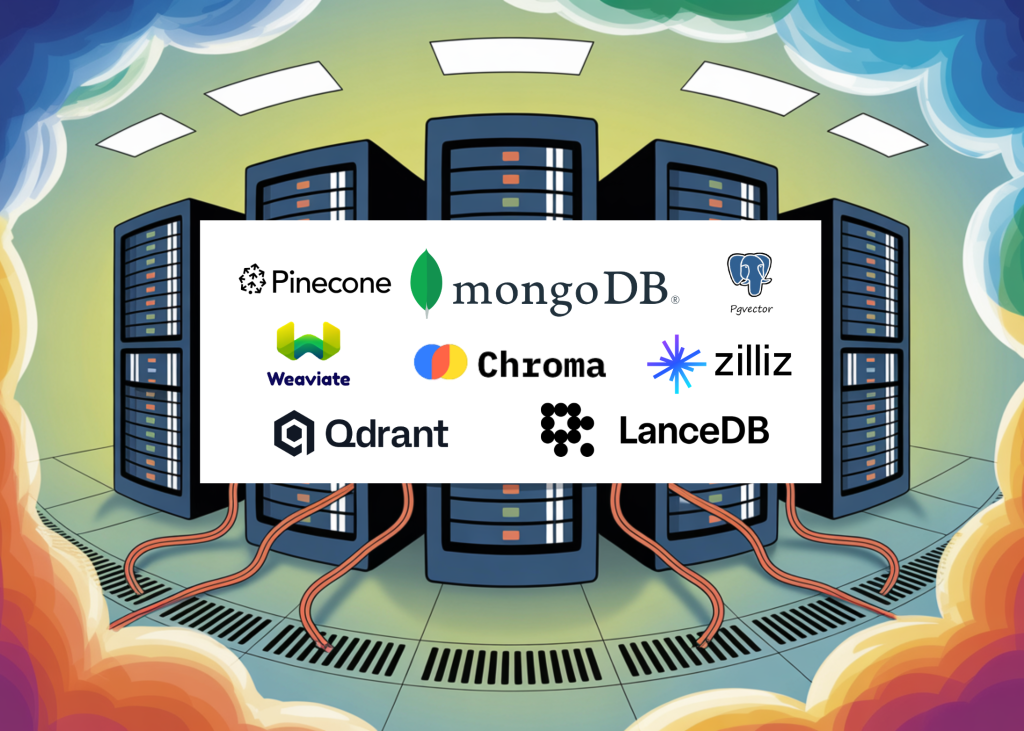
Vector databases have graduated from experimental tooling to mission-critical infrastructure. In 2026, vector databases serve as the core retrieval layer for RAG pipelines, semantic search systems, and agentic AI workflows — and choosing the wrong one has real cost and performance consequences. This guide breaks down the top vector databases available today, covering architecture, performance, pricing, and the right use cases for each.
Why Vector Databases Matter More Than Ever in 2026
The shift is structural. As LLMs become standard in enterprise software, the need to store, index, and retrieve high-dimensional embeddings at scale has become unavoidable. RAG (Retrieval-Augmented Generation) has become one of the dominant architectures for grounding LLM outputs in private or real-time data, and many production RAG systems use vector databases as a core retrieval layer. The question is no longer whether you need a vector database — it is which one fits your infrastructure, scale, and budget.
MARKTECHPOST · UPDATED MAY 2026 · 9 DATABASES REVIEWED · FACT-CHECKED AGAINST PRIMARY SOURCES
▸ Best Managed, Zero-Ops Vector DB
Pricing
Free / $20 / $50 / $500 min
CEO (Sep 2025)
Ash Ashutosh
Strongest fully managed option for low operational overhead. New Builder tier ($20/mo) added 2026. Nexus & KnowQL launched May 2026 Launch Week.
▸ Best for Billion-Scale Deployments
Pricing
OSS free / Zilliz managed
GitHub Stars
40,000+ (Dec 2025)
Engine
Cardinal (10x vs HNSW)
Go-to for billion-scale with GPU acceleration. Zilliz Cloud’s Cardinal engine delivers up to 10x throughput and 3x faster index builds vs OSS alternatives.
▸ Best Price-Performance Ratio
Free Tier
1GB RAM / 4GB disk (no CC)
Series B (Mar 2026)
$50M led by AVP
Engineers’ choice. Composable vector search: dense + sparse + filters + custom scoring in one query. Rust-native. Self-host handles millions of vectors at $30–50/mo.
▸ Best for Hybrid Search
Flex (Oct 2025)
$45/mo min (retired $25)
Search
BM25 + dense + filters
Hybrid search champion. Processes BM25, vector similarity, and metadata filters simultaneously in one query. Note: $25/mo pricing is retired since Oct 2025.
▸ Best for PostgreSQL-Native Teams
Pricing
Free (open source)
If you’re on PostgreSQL and under 10M vectors, add pgvector before adding a new database. Vectors and relational data in the same transaction, zero new infrastructure.
▸ Best for MongoDB-Native Teams
Free Tier
M0 (512MB, forever)
Flex Cap
$0–$30/mo (GA Feb 2025)
Dedicated
From ~$57/mo (M10)
Indexing
HNSW, up to 4096 dims
Zero data sprawl — vectors, JSON docs, and metadata in one collection. Automated Embedding (Voyage AI) enables one-click semantic search. Integrates with LangChain & LlamaIndex natively.
▸ Best for LLM-Native Dev & Prototyping
OSS
Free (embedded / server)
Cloud Starter
$0/mo + usage
Cloud Team
$250/mo + usage
Fastest path from zero to working vector search. Runs in-process or as client-server. Not optimized for extreme production scale — purpose-built for LLM application scaffolding.
▸ Best for Serverless & Multimodal Retrieval
Pricing
OSS free / Cloud & Enterprise
Storage
S3, GCS (file-based)
Format
Lance columnar (on-disk)
Modalities
Text, images, structured
Sits directly on object storage — no always-on server. AWS-validated for serverless stacks at billion-vector scale. Strong multimodal support for cross-modal retrieval pipelines.
▸ Best for Research & Custom Pipelines
Pricing
Free (open source)
Type
Library, not a database
Indexes
IVF, HNSW, PQ, IVFPQ
A library, not a database — no persistence, query API, or operational tooling. The foundation many production systems build on. For ML researchers and custom similarity search pipelines.
Comparison at a Glance
| Database | Type | Best Scale | Managed | Pricing Start | Key Strength |
|---|---|---|---|---|---|
| Pinecone | SaaS | Billions | Yes | Free / $20 / $50 min | Zero-ops, agentic AI |
| Milvus / Zilliz | OSS + Cloud | 100B+ vectors | Optional | OSS free / Zilliz mgd | GPU acceleration, scale |
| Qdrant | OSS + Cloud | Up to 50M | Optional | Free tier (1GB RAM) | Price-perf, composability |
| Weaviate | OSS + Cloud | Large | Optional | $45 Flex min | Native hybrid search |
| pgvector | PG Extension | Millions | Via PG | Free | PostgreSQL unification |
| MongoDB Atlas | Managed SaaS | Millions | Yes | M0 free / Flex $0–$30 | Doc + vector in one DB |
| Chroma | OSS + Cloud | Small–Med | Yes | OSS free / Cloud $0+ | Developer experience |
| LanceDB | OSS + Cloud | Small–Large | Yes | OSS free | Serverless / multimodal |
| Faiss | Library | Any (custom) | No | Free | Research, GPU search |
How to Choose in 2026
EDITOR’S ECOSYSTEM PICK
Already running MongoDB? You don’t need a second database.
Atlas Vector Search keeps operational data, metadata, and vector embeddings in one collection — no sync lag, no dual-write, no extra billing envelope. Automated Embedding via Voyage AI adds one-click semantic search. Flex tier caps at $30/month. M0 free tier available with no credit card.
Free TierM0 (512MB, forever)
Flex Cap$0 – $30 / month
IndexingHNSW, up to 4096 dims
IntegrationsLangChain, LlamaIndex, Semantic Kernel
Already on PostgreSQL with <10M vectors?
→ pgvector — no new infra
Building a RAG prototype or internal tool?
→ Chroma — ship fast
Need semantic + keyword + filter in one query?
→ Weaviate — native hybrid search
Budget-conscious, need production performance?
→ Qdrant — self-host on VPS
Enterprise scale, no DevOps bandwidth?
→ Pinecone — pay for simplicity
Serverless or object-storage-native stack?
→ LanceDB — S3-native
Custom research or similarity pipeline?
→ Faiss — library, not a DB
Pinecone — Well Managed, Zero-Ops Vector Database
Type: Fully managed SaaS | Built in: Proprietary Rust engine | Best for: Startups and enterprises prioritizing speed-to-market
Pinecone remains one of the strongest fully managed options for teams that want low operational overhead. Its serverless architecture allows developers to store billions of vectors without provisioning a single server, with strong multi-tenant isolation and high-availability SLAs.
In 2025–2026, Pinecone optimized its serverless architecture to meet growing demand for large-scale agentic workloads. Key capabilities include Pinecone Inference (hosted embedding and reranking models integrated into the pipeline), Pinecone Assistant for production-grade chat and agent applications, Dedicated Read Nodes (DRN) for read-heavy workloads, and native full-text search in public preview. BYOC (Bring Your Own Cloud) — now in public preview on AWS, GCP, and Azure — runs the data plane inside the customer’s own cloud account. Pinecone also launched Nexus and KnowQL in early access as part of its May 2026 Launch Week.
Pricing: Pinecone has four tiers: Starter (free), Builder ($20/month flat), Standard ($50/month minimum usage), and Enterprise ($500/month minimum usage). The Builder tier is new in 2026, targeting solo developers and small teams. At production scale, costs can climb significantly — but the zero-DevOps overhead justifies it for teams without dedicated infrastructure engineers.
Milvus / Zilliz Cloud — Best for Billion-Scale Deployments
Type: Open-source + managed cloud (Zilliz) | Best for: Massive datasets, high-ingestion workloads
Milvus is the dominant open-source choice for billion-scale deployments. Its managed counterpart, Zilliz Cloud, uses Cardinal — a proprietary vector search engine that Zilliz says delivers up to 10x higher query throughput and 3x faster index building compared to open-source HNSW-based alternatives — with native integration with streaming data platforms like Kafka and Spark.
Milvus is designed for efficient vector embedding and similarity searches, supporting GPU acceleration, distributed querying, and efficient indexing. It is highly configurable and supports a range of indexing methods such as IVF, HNSW, and PQ, allowing users to balance accuracy and speed according to their needs. The database offers excellent scalability with efficient index storage and shard management.
In distributed mode, Milvus introduces additional operational dependencies — including metadata storage, object storage, and WAL/message-log infrastructure — depending on the deployment configuration. For most teams, it is more infrastructure than the workload demands.
Qdrant — Best Price-Performance Ratio
Type: Open-source + managed cloud | Built in: Rust | Best for: Performance-critical RAG, self-hosting, edge deployment
Its 2026 differentiator is composable vector search: every aspect of retrieval is a composable primitive engineers control directly — indexing, scoring, filtering, and ranking are all tunable, none opaque. Operators can compose dense vectors, sparse vectors, metadata filters, multi-vector retrieval, and custom scoring in a single query.
Qdrant offers the best price-performance ratio in 2026. Self-hosted on a small VPS, it handles millions of vectors at $30–$50/month.
The free tier provides 1GB RAM and 4GB disk storage with no credit card required. Paid cloud plans are resource-based rather than a flat fee — pricing scales with compute and storage provisioned. Filtering is where Qdrant stands out — the database supports rich JSON-based filters that integrate with vector search efficiently. Choose Qdrant when you’re budget-conscious, need complex filtering at moderate scale (under 50 million vectors), want edge or on-device deployment via Qdrant Edge, or want a solid balance of features without breaking the bank.
Weaviate — Best for Hybrid Search
Type: Open-source + managed cloud | Best for: Applications requiring combined vector + keyword + metadata filtering
Weaviate is the hybrid search champion in 2026, delivering native BM25 + dense vectors + metadata filtering in a single query. Built-in vectorization via integrated embedding models eliminates external pipelines. Multi-modal support handles text, images, and audio in the same vector space.
While Pinecone and Milvus focus on pure vector search, Weaviate does one thing better than any other database in this comparison: hybrid search. You query with a vector embedding, add keyword filters using BM25, and apply metadata constraints — Weaviate processes all three simultaneously and returns ranked results. Other databases add these features separately or require combining separate queries; Weaviate builds it into the core architecture.
The modular architecture lets teams swap in different embedding models, vectorizers, and rerankers without rebuilding an application — critical when models update frequently.
Pricing: Weaviate restructured its cloud pricing in October 2025. The old Serverless tier ($25/month) was retired and replaced with Flex at $45/month minimum (shared cloud, 99.5% SLA, pay-as-you-go), along with from $280/month (annual commitment, 99.9% SLA), and Premium from $400/month (dedicated infrastructure, 99.95% SLA). A free 14-day sandbox is available with no credit card required, but it expires automatically and cannot be extended. Any source still citing $25/month is referencing pre-October 2025 pricing.
pgvector — Best for PostgreSQL-Native Teams
Type: PostgreSQL extension | Best for: Teams wanting a unified relational + vector data stack
The most significant trend in current architecture is the growing adoption of pgvector. If you are already using PostgreSQL, you likely don’t need a new database. It has pushed its capacity to millions of vectors with production-grade speed. It offers full ACID compliance for both traditional relational and vector data.
pgvector adds a vector column type to PostgreSQL with support for cosine similarity, L2 distance, and inner product operations. It supports both HNSW and IVFFlat indexing.
The operational advantage is significant: vectors live next to relational data, both can be queried in the same transaction, and teams manage one system instead of two. For applications where vector search is one feature among many — rather than the core workload — this is often the right call.
MongoDB Atlas Vector Search — Best for MongoDB-Native Teams
Type: Fully managed SaaS (Atlas) | Best for: Full-stack applications where vectors must live alongside JSON documents and operational data
MongoDB Atlas Vector Search brings vector retrieval directly into the Atlas managed database platform — eliminating the “data sprawl” problem of maintaining a separate vector store alongside a primary database. Operational data, metadata, and vector embeddings all live in the same collection, queryable in a single pipeline. This is the strongest argument for MongoDB in the vector space: zero synchronization lag between document updates and their vector index.
Atlas Vector Search uses HNSW-based ANN indexing and supports embeddings up to 4,096 dimensions, with scalar and binary quantization for cost and performance optimization. Search Nodes allow teams to scale their vector search workload independently from their transactional cluster — critical for read-heavy RAG applications. The platform integrates natively with LangChain, LlamaIndex, and Microsoft Semantic Kernel, and supports RAG, semantic search, recommendation engines, and agentic AI patterns out of the box.
A standout 2026 feature is Automated Embedding — a one-click semantic search capability powered by Voyage AI that generates and manages vector embeddings automatically, without requiring teams to write embedding code or manage model infrastructure.
Atlas Vector Search is integrated into Atlas cluster pricing — there is no separate charge for the vector search feature itself. The M0 tier is free forever (512MB storage). The Flex tier (GA February 2025) supports Vector Search and caps at $30/month, replacing the older Serverless and Shared tiers. Dedicated clusters start at approximately $57/month (M10) for production workloads.
Chroma — Best for Prototyping and LLM-Native Development
Type: Open-source, embedded or client-server | Best for: Early development, local prototyping, LLM application scaffolding
Chroma is an open-source embedding database focused on developer experience. It runs in-process (embedded) or as a client-server setup, making it the fastest path from zero to a working vector search.
Chroma has an intuitive API that simplifies integration into applications, making it accessible for developers and researchers without requiring extensive database management expertise. It delivers high accuracy with impressive recall rates, supporting embedding-based search and advanced ANN (Approximate Nearest Neighbor) methods.
Chroma DB’s combination of simplicity, flexibility, and AI-native design makes it an excellent choice for developers working on LLM-powered applications. Its open-source nature and active community contribute to its rapid evolution.
Chroma Cloud is available with a Starter plan ($0/month + usage), Team plan ($250/month + usage), and Enterprise custom pricing — meaning Chroma is no longer purely self-hosted.
LanceDB — Best for Serverless, Object-Storage-Backed, and Multimodal Retrieval
Type: Open-source + cloud/enterprise | Best for: Serverless functions, object-storage-backed deployments, multimodal AI pipelines
LanceDB is an open-source, serverless vector database that stores data in the Lance columnar format, designed to sit directly on object storage (S3, GCS, etc.) without requiring an always-on server. AWS specifically calls out LanceDB as well-suited for serverless stacks because it is file-based and integrates natively with S3 — enabling elastic, pay-per-query retrieval at billion-vector scale with no persistent infrastructure to manage.
LanceDB’s columnar format enables fast random access and efficient filtering directly on-disk, avoiding the memory overhead that most other vector databases require at query time. It also has strong multimodal support, making it relevant for pipelines that work across text, images, and structured data.
Faiss (Meta AI) — Best for Research and Custom Pipelines
Type: Open-source library (not a full database) | Best for: Research, custom similarity search, GPU-accelerated batch workloads
Faiss‘s combination of speed, scalability, and flexibility positions it as a top contender for projects requiring high-performance similarity search capabilities. When working with Faiss, best practices include choosing the appropriate index type based on dataset size and search requirements, experimenting with parameters like nlist and nprobe for IVF indexes, and using GPU acceleration for significant performance boosts on large datasets.
It is important to note that Faiss is a library, not a full database system. It handles indexing and search but does not provide persistence, a query API, or operational tooling out of the box. It is the foundation many production systems build on, not a drop-in replacement for the databases above.
Feel free to follow us on Twitter and don’t forget to join our 150k+ ML SubReddit and Subscribe to our Newsletter. Wait! are you on telegram? now you can join us on telegram as well.
Need to partner with us for promoting your GitHub Repo OR Hugging Face Page OR Product Release OR Webinar etc.? Connect with us
