
Israel has killed Hizbollah’s leader Hassan Nasrallah in a massive strike on Beirut, in the latest in a series of devastating blows to the Lebanese militant group.
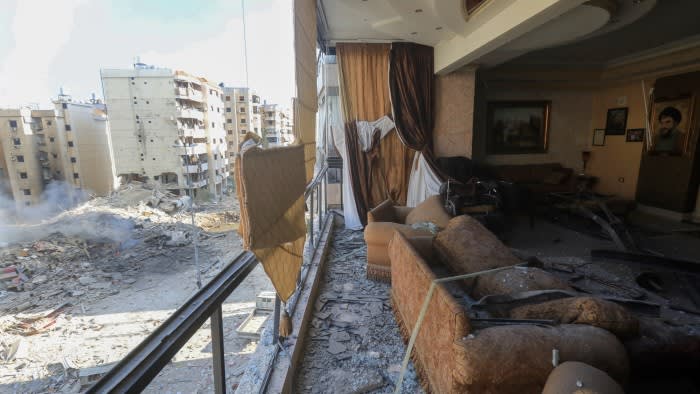
The strike in a densely populated residential neighbourhood in southern Beirut was part of an intense bombardment carried out by Israeli forces on Friday and marked a dramatic escalation of Israel’s offensive against Hizbollah.
The Lebanese group confirmed Nasrallah’s death in a statement on Saturday, saying he had joined the group’s long list of “martyrs”. It said its leadership would continue to battle against Israel “in support of Gaza and Palestine, and in defence of Lebanon and its steadfast and honourable people”.
Speaking late on Saturday, Israeli Prime Minister Benjamin Netanyahu said that “Nasrallah’s killing was a necessary step toward achieving the goals we have set,” including “changing the balance of power in the region for years to come”.
He added that the “work is not yet done”, warning Israelis that they “will face significant challenges in the days ahead”.
He also issued a warning to Israel’s adversaries. “There is nowhere in Iran or the Middle East beyond the reach of the long arm of Israel, and today you know how true that is,” Netanyahu said.
Herzi Halevi, chief of the general staff of the Israel Defense Forces, said the strike did not mark the conclusion of Israel’s operations. “This is not the end of our toolbox,” he said. “The message is simple: anyone who threatens the citizens of Israel — we will know how to reach them.”
US President Joe Biden said Nasrallah’s death was “a measure of justice for his many victims”.
“The United States fully supports Israel’s right to defend itself against Hizbollah, Hamas, the Houthis, and any other Iranian-supported terrorist groups,” he said in a statement released on Saturday. “Ultimately, our aim is to de-escalate the ongoing conflicts in both Gaza and Lebanon through diplomatic means.”
It was time to conclude deals to end the conflict in both Gaza and Lebanon, Biden added.
Israel claimed the strike had also killed the head of Hizbollah’s southern front, Ali Karaki, and other senior commanders. It was the latest in a succession of debilitating Israeli attacks on Iranian-backed Hizbollah’s chain of command.
A senior commander of Iran’s elite Revolutionary Guards, Abbas Nilforoushan, who was in a meeting with Nasrallah was also killed, an Iranian official told the Financial Times. The death of the commander and Nasrallah, one of Iran’s closest allies, raised the risk of retaliation by the Islamic republic.
On Friday, Lebanese officials warned an Iranian cargo plane to leave the country’s airspace because of the risk Israel could target it, the Iranian official said. The Israeli military had said Israeli air force planes were “patrolling the area of Beirut airport” and would not allow “hostile flights with weapons to land” there.
Iran’s supreme leader Ayatollah Ali Khamenei said that the fate of the Middle East “will be determined by resistance forces, the foremost of which is Hizbollah”.
He added that the group’s “solid structure cannot be significantly damaged” by “Zionist criminals” who he said had demonstrated their “short-minded and stupid policies”.
He urged all Muslims to stand by Hizbollah in its fight against “an occupying and vicious regime”.
At least 33 people were killed and 195 injured in the strike that killed Nasrallah, Lebanon’s health ministry said. That figure was expected to rise as rescue workers continued searching for survivors.
On Saturday, explosions were heard in Beirut as Israel continued to strike Hizbollah targets and announced it had killed a top member of the group’s intelligence department responsible for selecting targets in Israel.
The Israeli military also posted warnings on social media telling Lebanese to evacuate the southern suburbs of Beirut, the Bekaa Valley and southern Lebanon.
The IDF said it had intercepted a missile fired from Yemen that set off air raid sirens across central Israel. Late on Saturday, sirens also sounded in parts of Jerusalem, as the IDF reported a rocket incoming from Lebanon.
Lebanese leaders from across the political spectrum called for unity, reflecting concerns that the fragile nation could slide into civil strife in the wake of Nasrallah’s assassination.
“We differed a great deal with the deceased and his party and we rarely found common ground, but Lebanon was a tent for all, and in this deeply difficult time our unity and solidarity is fundamental,” Saad Hariri, former prime minister, said in a statement.
Nasrallah’s death capped a disastrous two weeks for Hizbollah during which it has sustained the heaviest succession of blows in its four decades of existence.
Residents of Beirut said the Israeli bombing raids on Friday night and during the early hours of Saturday had been some of the most intense in the city since Israel and Hizbollah fought a 34-day war in 2006.
Explosions lit up the sky throughout the night and threw huge clouds of dust into the air. Hundreds of people fled the south of the city, where Hizbollah is entrenched, to seek shelter on beaches and in public squares.
Over the past two weeks, Israel has escalated its offensive against the militant group, killing a string of its senior commanders. This week it embarked on an intense bombardment of sites across Lebanon that killed more than 600 people and displaced more than 90,000.
On Wednesday, Israel called up two reserve brigades for “operational missions” in the north of the country, with Halevi telling troops to prepare for a possible ground offensive in Lebanon.
The Israeli military said it was continuing its bombardment on Saturday, carrying out “extensive” bombing raids in the Bekaa Valley in eastern Lebanon as well as striking more targets in Beirut, after warning civilians in some densely populated neighbourhoods to evacuate.
Additional reporting by Najmeh Bozorgmehr in Tehran and Andrew England in London
