
How music became the cathartic refuge for my political frustration.
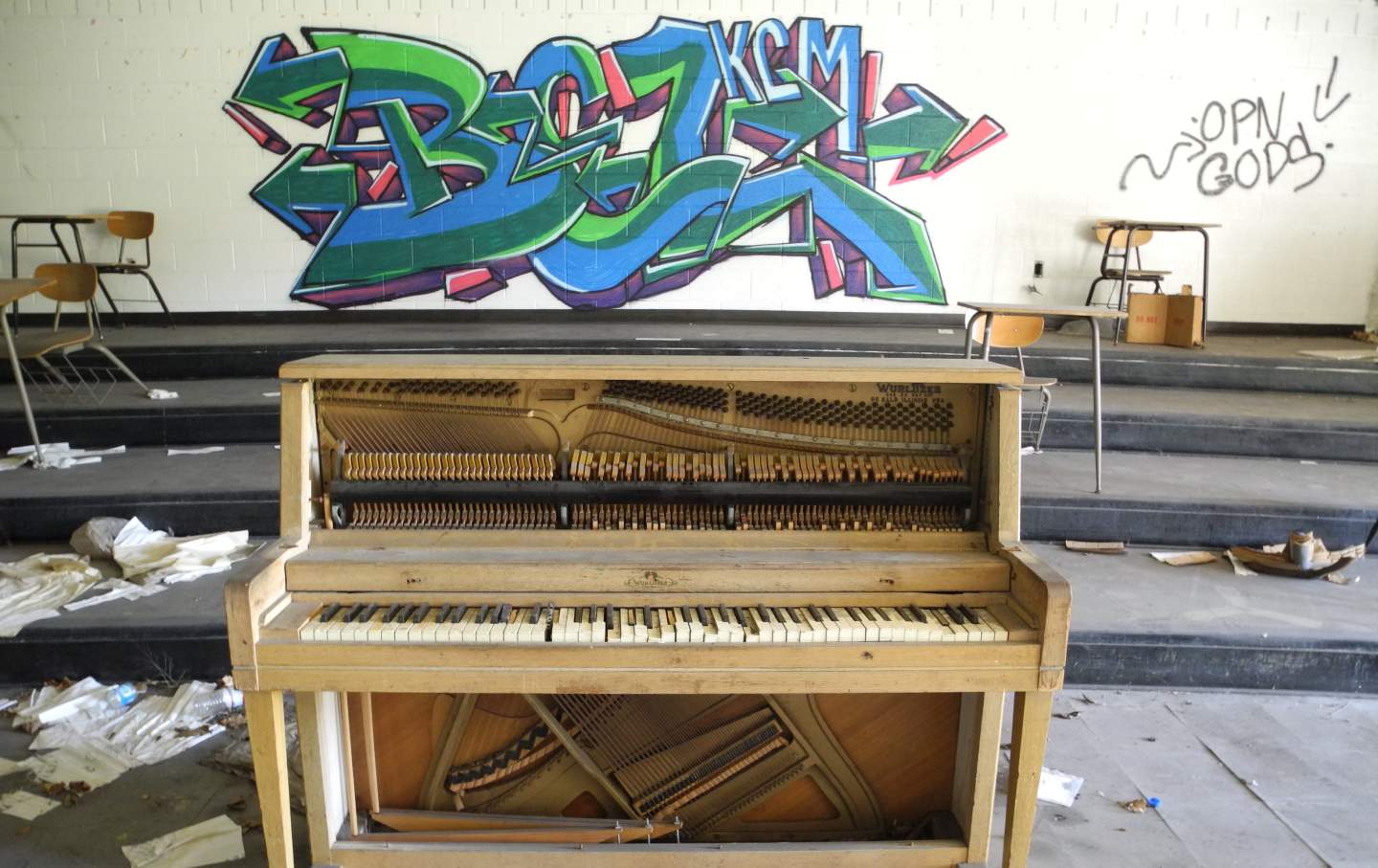
A broken piano in the music room of the abandoned Southwestern High School.
(Johannes Schmitt-Tegge / Getty Images)
Idon’t drink anymore, but a vestigial hangover clouds my recollection of the major events of recent history. On the morning of the Unite the Right rally, I lumbered down the staircase of a Catskills Airbnb rented for a bachelor party to learn that only hours before, a gang of white nationalists stormed the University of Virginia campus wielding Tiki torches and chanting, “Jews will not replace us.” My stomach wasn’t as queasy that morning as it had been on Election Day, nor did my head throb as sharply as it did after the inauguration, when I braved the crowded Washington Metro en route to the Women’s March. Like the protagonists of 1984 and The Berlin Stories, which I reread that winter with an earnestness I now find slightly embarrassing, mine was a gin-soaked existence, senses dulled against the baffling chaos closing in.
By the time I got back to Brooklyn, where I’d been crashing with the soon-to-be newlyweds, the haze curdled into indignation and shame. I had wasted a weekend killing brain cells and hiking in sandals toward nonexistent watering holes while an innocent woman was dead 300 miles away. There was no doubt in my mind that I was living in a totalitarian hellscape. When the president said that there were “some very fine people on both sides” that Tuesday, I knew that he wasn’t talking about me.
For two years, I had been living in Atlanta, where I was due back later that week to prepare for another semester of teaching freshman English to computer science majors training to engineer universal obsolescence. I’d moved to the South from California during the twilight of the Obama administration, when the idea of a Trump presidency still retained the whimsy of a Simpsons joke. As a hesitant Yankee, I’d tried to blend in with my surroundings without sacrificing an often volatile opposition to the region’s dominant norms. It was far from impossible to find like-minded individuals with whom to commiserate, but the peaceful assemblies in which I gathered lacked a discernible outcome and did nothing to assuage the precarity I felt as a carpetbagging knowledge worker on a fixed-term contract.
I retreated to points north and west at every conceivable opportunity, and when it came time to leave New York, the compounding dread sucked me into an Internet wormhole that culminated in an e-mail offering my services to the local branch of antifa, whose address I probably found on Reddit. (While the group may not be the vast conspiracy that the right assumes it to be, there very much is a real, decentralized network of activists working to combat fascism.) What volunteering for the organization might entail, however, I had no clue, aside from a vague notion of the tasks with which a literary man such as myself could be assigned: writing pamphlets, making speeches, chauffeuring freedom fighters to and from demonstrations. At 32, doomscrolling on an under-inflated air mattress in an overstimulated fugue, I was ready to put my body on the line.
The light of day softened my resolve, even as an unsigned message arrived in my inbox:
Hello Andrew,
Thank you for contacting us.
It would be best for us to meet up sometime so we can talk about how people can get involved, whatvwe [sic] do, our expectations for involvement, etc.
Let us know about any time you have available and we can meet and chat.
Keep the faith ///
I immediately promised to sort out the details as soon as possible, though I didn’t know that I actually would. A more anodyne fate awaited me as I touched down at Hartsfield-Jackson: playing piano in an indie rock band.
I’d met Virgil at a mutual friend’s house on a sweltering Georgia night earlier that summer, Michael Mann’s Heat projected onto the living-room wall. He was the type of guy with which I had become familiar over the previous decade and a half of recording and performing music: unwashed and longhaired, animated and scrawny. We weren’t fast friends, exactly, but he sought me out after listening to the albums I’d self-released, and soon after Charlottesville, we began to spend a lot of time together, our mutual disaffection a binding force.
Virgil is not his real name, though he’s gone by so many that I wouldn’t be surprised if it had a spot in the rotation. He worked as the night manager at a shabby hotel a short walk from my apartment and shared a house with other underemployed hipsters a decade his junior. He liked to hang out at Trader Joe’s, sipping free coffee samples and chatting up strangers. He idolized Harry Nilsson, and the record he’d recently put out wasn’t half bad, as imitations go. I was manic with angst and disappointment that grading papers, revising abstracts, protesting, and tweeting failed to dispel. Since childhood, music had been my refuge from the familial and social dramas that had unwittingly prepared me for an era of political instability. Remembering the boy who had spent so much time in the principal’s office, I lost faith in the virtue of my instinct to fight. So I settled for symbolic rebellion in a smaller arena where I could express my discontent and assert to myself, if no one else, an illusion of control. “Don’t shoot the piano player,” the old joke goes. “He is doing his best.”
We booked a gig opening for a touring act whose debut had scored an 8.3 on Pitchfork, back when those ratings had some cachet. The night before the show, Virgil showed up at my place with a friend from Florida who had produced his album. Roland, he told me, was sober, but it only took a dozen or two beers between us for him to call up his old dealers, and it wasn’t until 7 am that we stopped jamming in Virgil’s hallway. In the light of day, I understood why recovery was a smart decision for Roland; I was less than relieved to receive a call from my wife on my way home. “If you ever do that again, I’m divorcing you,” she said with chilling stoicism as I walked in the door.
Soon, I was practicing several nights a week with the rest of the band: the lead guitarist, a divorced dad gone gray; the bassist in 11th grade; and the drummer, a resident of an intergenerational punk house near the federal penitentiary that booked DIY shows in the basement. Other nights, Virgil would appear unannounced to raid my fridge and persuade me to spot him the cover at the Star Bar or one of the galleries downtown, where I overheard unsettling rumors from those who’d known him longer than I. Mounting suspicions notwithstanding, Virgil’s unflappability was intoxicating: Here was a truly apolitical man, seemingly unhindered by conviction, fear, or awareness of current events—a twee Cosmo Kramer with overgrown fingernails and an Instagram addiction. In his own private Southern bohemia, there had never been a Confederacy and the 1990s dream of the 1970s lived on, so it was easy to forget about the indignities of our demoralizing reality in his presence. My wife, who was writing international news for cable TV at the time, resented how compliantly I’d been seduced.
In music as in the studiousness of his disheveled appearance, Virgil demanded precision, and I was grateful to show off the chops I’d honed sitting nightly with a six-pack atop the upright I inherited from an acquaintance. Long hours at the keyboard had resulted in new compositions, but Virgil wasn’t much interested in my songs. One I called “Atlanta” aptly captures my sentiment at the time:
Forgot about the anniversary
Of the offbrand fascist state
I felt like shit so I ate some Fentanyl
America’s never looked so great
You see, down here we do things different
We talk to Jesus all the time
Our dicks get hard for mama’s barbecue,
Going to church, and getting high
I was playing Randy Newman to Virgil’s Nilsson, the topicality of my own irony pointing in directions he wasn’t willing to commit to. And frankly, nor was I, beyond my clownish smirk and the anti-authoritarian rants I hosed at students who mostly yawned in response. The shallow incredulity of liberal colleagues more concerned with getting tenure wore on my patience, and the news cycle stalked my wife home from work. Doubting the wisdom of enlisting in a movement that even Democrats were beginning to associate with terrorism, though I knew that wasn’t true, I never followed up with antifa.
My classes that fall considered the history of punk rock as a site of radical politics and artistic experimentation, but I didn’t believe what I was saying half of the time; in retrospect, this must have been clear to the hiring committees who skimmed the hundreds of applications I shipped off for teaching jobs across the country. Moonlighting in the indie rock scene restored an enthusiasm that I’d missed for too long. Atlanta’s scrappy underground, small as it was vibrant, gave me a sense of purpose and belonging, however puerile, that the university could not, and whenever I chipped away at the proposal for a monograph that I never wrote, there was always something I’d rather be doing.
The ideas of the moment that had me preoccupied—from Adam Curtis’s Hypernormalisation and Angela Nagle’s Kill All Normies—contextualized my malaise in the post-Watergate retreat from politics of the artistic milieu that abandoned the collectivist action of the New Left in favor of a nihilistic turn inward, which I recognized in my extracurricular activities as pointedly as in the texts assigned on my syllabus. Like the early punks who sneered at the sentimental hypocrisy of hippies’ utopian ideals, I too had cast aside society in favor of the self, channeling my frustration into deceptively upbeat verses and hooks. Guilty though I must have been of identifying with my subject, there was comfort in seeing myself among a lineage of daydreamers sublimating the horrors of reality into an alternative plane. Playing music allowed me to conjure a material record of experience that was more euphonious and infinitely less dismal than the conditions under which it was produced. The consciousness I courted was false without question; I was living in a fantasy, laboring through a process of wish-fulfillment that is, Freud argued, the vocational province of creative writers and children alike. It made little difference to me that no one was paying much attention to what I was up to: The vibrations that plugged my fingertips into my cochleae closed the circuit on a one-man feedback loop, overpowering the dissonance more effectively than substance abuse or moving to Canada ever could.
In February, about six months into my stint with the band, my wife and I drove to New Orleans, where a drag queen collective was to lip-sync the George Michael remixes I’d made for the annual ball of a vaporwave-themed Mardi Gras krewe. At the 11th hour, Virgil insisted on tagging along, and my wife reluctantly agreed on the condition that he secure his own place to stay, and not rely on us to serve as his tour guides: We had our own people to see, and she had been assigned to cover the event for a website. Virgil slept in the front seat for the duration of the seven-hour drive shortly after volunteering, insincerely, to take the wheel. We parted ways outside of his friend’s house uptown, but the next day, as I shuffled electronic equipment around the venue, my phone began to blow up with texts and calls from Virgil requesting my whereabouts. I ignored him as long as I could bear, and he showed up obscenely early, hungry for kicks he expected me to facilitate.
Popular
“swipe left below to view more authors”Swipe →
The night elapsed in a psychedelic blur: Win Butler DJ’d between sets, and the staging of my remixes moved me to the verge of tears. At the afterparty, my host showcased rap skills that came as news to me, and not long before dawn, we all stumbled back to Alvar Street, Virgil trailing behind. We’d been had, and now we were stuck. As our movable feast assembled at the parade grounds the following evening, there was Virgil: bumming cigarettes, beers, sandwiches, and cash from whomever he could manage to entrap in conversation. In his burlesque of the spirit of New Orleans, I saw myself as the rube. I’d had enough, and told him so; soon my wife and I were shouting at him with enough volume that the bartender threw him out. Livid as ever the next morning, I looked up the cost of a Megabus back to Atlanta and Venmo’d him the fare, skeptical that he had enough in his bank account to make it on his own.
I haven’t spoken to Virgil since, but from what I can gather online, nothing much has changed. As I have attempted, in the intervening years, to disentangle the act of creation from the romantic myths of my youth, I have managed to understand that Virgil’s Dionysian influence on me wasn’t all bad. His ostrich stance and Peter Pan lifestyle amounted to the very passivity that had drawn me to him, an unlikely antidote to the anomie I blamed on my armchair Marxism. At his best, he approached a negative capability, embracing the forces of creativity against the voices of reason amplifying futility—a perspective that provided the perfect foil for my brooding over the artist’s role in society. I have not forgotten the catharsis his lumpen hedonism unleashed from my information-induced paralysis, initiating a dialectical process of synthesizing art and politics that has brought me, if no closer to enlightenment, some clarity, and intermittent peace.
Meanwhile, the ensuing onslaught of international crises, domestic terror, and the countless microaggressions of everyday life under fascism has not subsided in undermining my efforts to lead a meaningful life, but the capacity for introspection, creation, and common ground that music has not ceased replenish as my habits gradually approximate the expectations of a teacher, husband, and father eases the anxiety of catastrophic times.
Art demands suffering to the same extent that being does, and I am not naïve enough to believe that music will see us through, no matter how many tragedies Bruce Springsteen deems worthy of a song. But the persistence of humans in humming a tune or plucking a string as an affirmation of community or personhood is a form of resistance that transcends the vicissitudes of tyranny and destruction. For as long as we are alive, there will be harmony and discord; the prominence of one does not altogether silence the other. Perhaps Virgil already knew something that I’m still figuring out: that to maintain the vision, energy, and motivation required to make art, one must find ways of drowning out the noise. The machines at my disposal may not kill any more fascists than Woody Guthrie’s did, but nothing sounds so sane or so true to my ear when, as happens all too often, the world is going to shit.
