
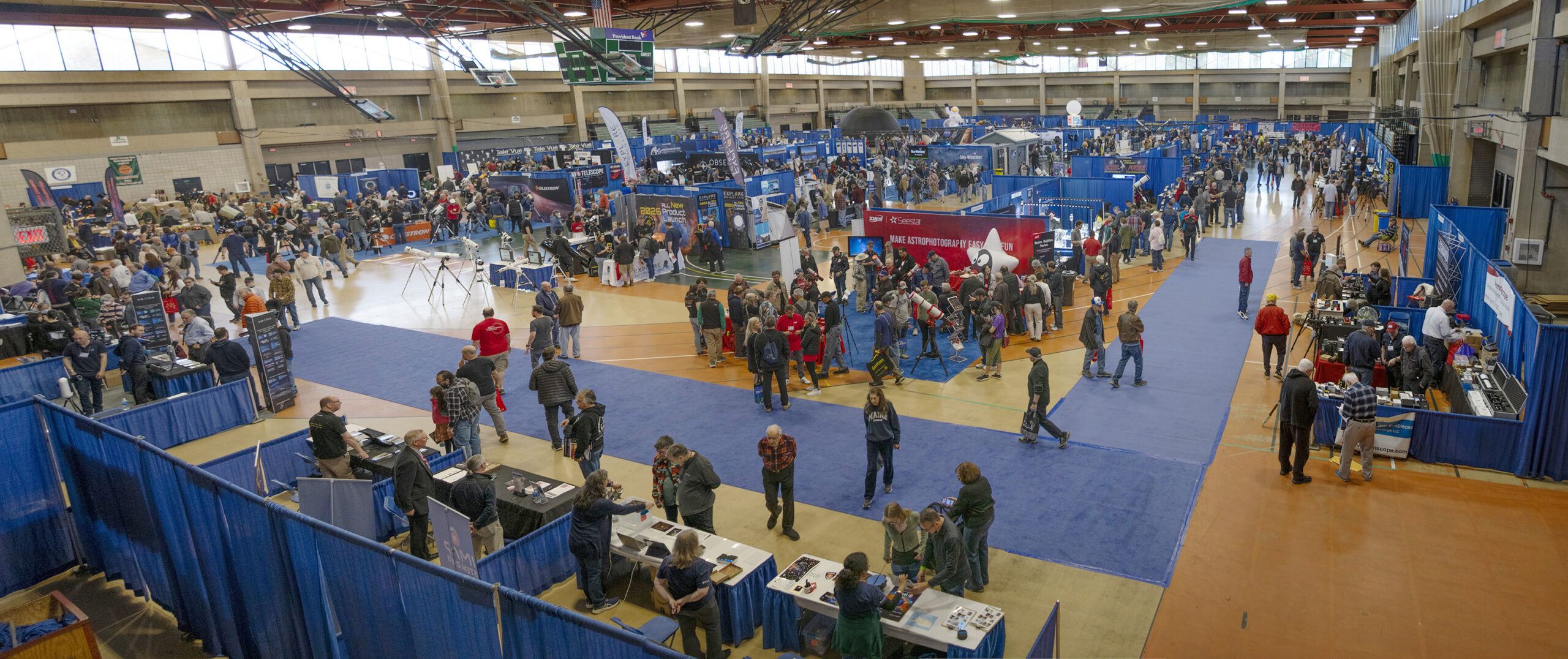
The Northeast Astronomy Forum (NEAF) in Suffern, New York, provides a busy, fun-filled weekend for astronomy and space enthusiasts across New England. It’s an annual pilgrimage for the editors of Sky & Telescope, too, who go to meet readers, contributors, and take in all of the new equipment on offer. Below, S&T staff report what they saw at NEAF this year.
On the Showroom Floor
with Sean Walker
NEAF was very busy this year, and it was a pleasure to meet numerous authors and readers in person, discussing what they’ve enjoyed in the past and what they look forward to in the magazine. Among those were members of the Amateur Astronomy Association, whose Gateway Project is the cover story of Sky & Telescope‘s May issue; they had a booth and were signing new members to their collaboration.
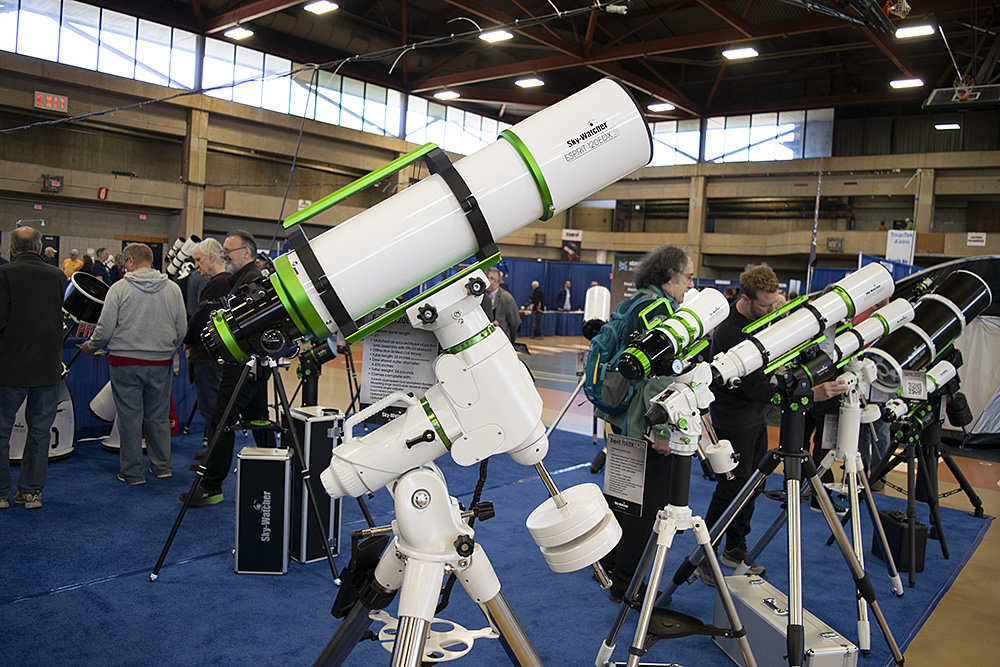
Walking the showroom floor, it was great to see many familiar faces as well as newcomers to the show. Celestron was out in force with their updated Origin Mark II personal observatory. But what really caught my eye was the tabletop StarSense Explorer 114-mm reflector, which brought back fond memories of a certain beloved tabletop scope from in the past. Celestron motivated customers with their Lumina program: For each 130-mm tabletop Dobsonian sold, the company donates one to an elementary school.
Sean Walker / Sky & Telescope
Explore Scientific revealed two new series of eyepieces, the waterproof 92ED and 72ED, as well as several new Dobsonians. They also showed off a new alt-az mount: the Sidara with a 127 Maksutov-Cassegrain telescope. (Look for a review of their 8-inch Dobsonian in the upcoming July issue of S&T).
Of course, there were many new smartscopes on hand from ZWO (the Seestar s30 Pro), DwarfLab (DWARF Mini), Vaonis (Vespera III), and several new offerings from Spectrum Optical Instruments (see our review of its Mirrosky SPi53 Intelligent Scope in the May issue). The ES Astro 53 Pro offered by Spectrum may be the most affordable smartscope on the market today at only $299.99. ZWO also rolled out a new, higher-capacity strain-wave mount, the AM7 and several deep-sky cameras for advanced imagers.
Sean Walker / Sky & Telescope
Many binoculars dotted the showroom floor, with a large number of offerings from Oberwerk and newcomer Sky Rover Optics, the latter also featuring several apochromatic refractors. Explore Scientific and Celestron also had several pairs on offer, ranging from hand-held models to tripod-mounted versions.
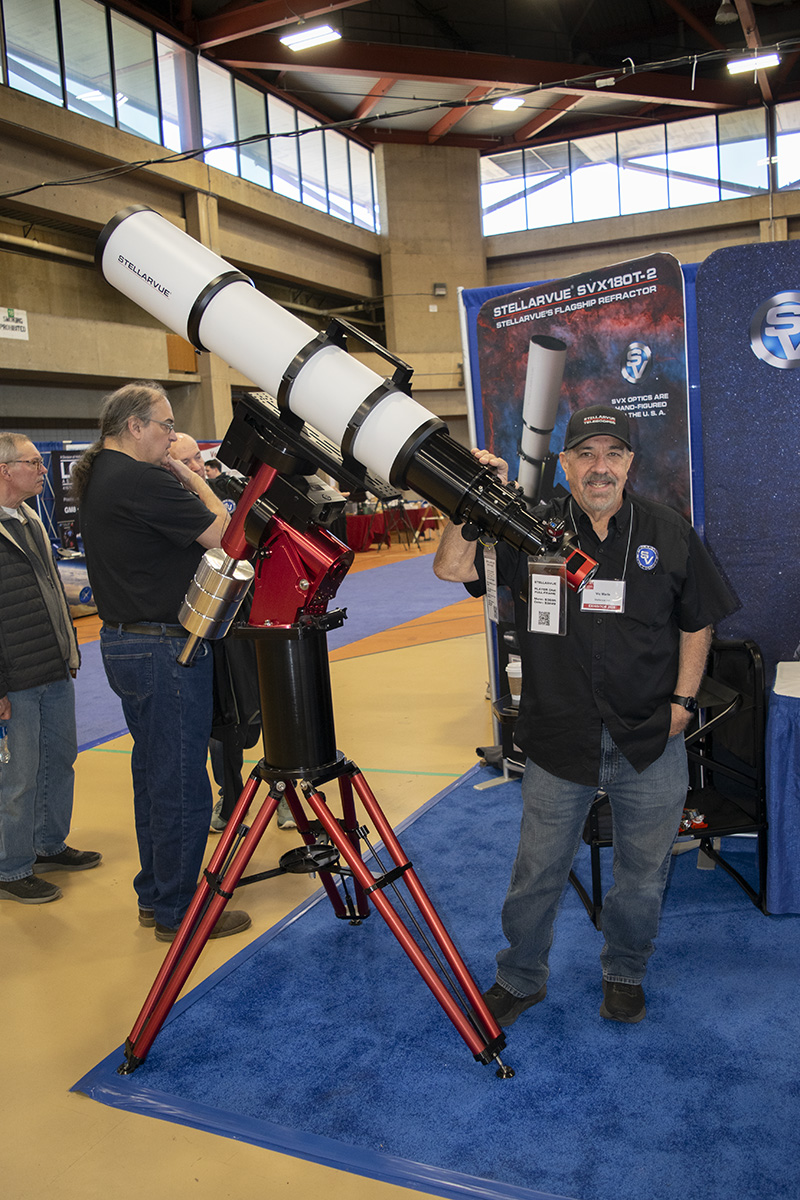
Big refractors from Astro-Physics and Stellarvue towered over attendees on the middle of the floor. Astro-Physics even gave away a tiny scope keychain to attendees, the AP15-mm StarFire.
Sean Walker / Sky & Telescope
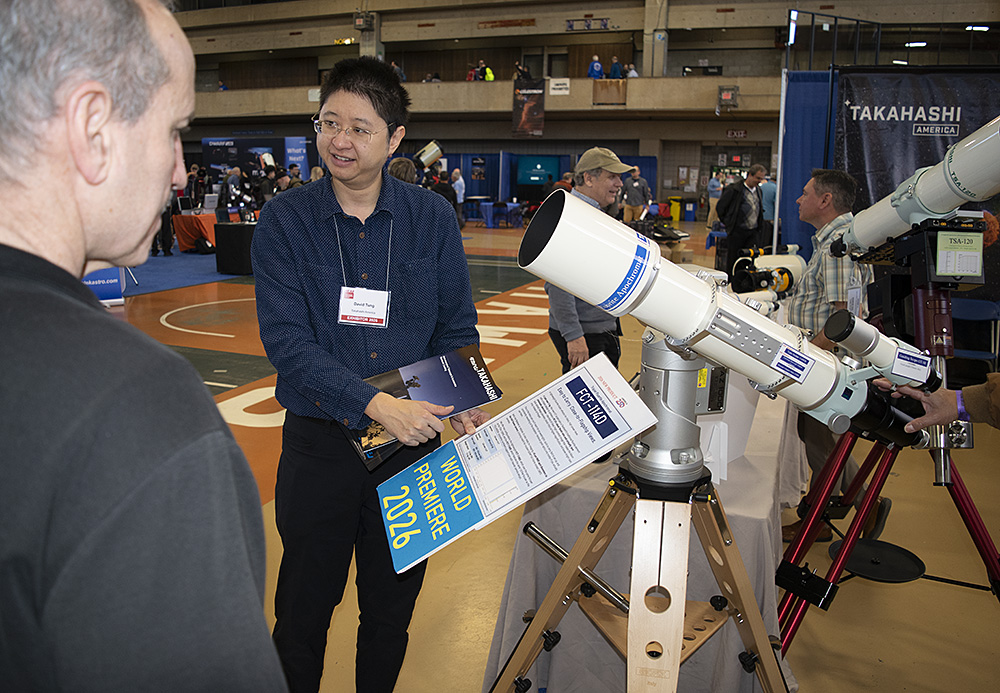
Takahashi was represented at the Texas Nautical booth and used the opportunity to unveil two new refractors: the FCT-114D, a fluorite apochromat as well as a new entry in their legendary FSQ line of Petzval astrographs, the FSQ-80FC.
Sean Walker / Sky & Telescope
Imaging, of course, was practically everywhere at NEAF this year. QHYCCD, FLI Cameras, Starlight Xpress, ToupTek, and Player One Astronomy were all displaying new cameras for the discerning astrophotographer. Robotic imaging mounts were found in all corners of the convention, including the new Paramount Series 6 from Software Bisque, several alt-azimuth satellite trackers from both iOptron and Primalucelab, as well as large mounts from Observable Space (who recently merged with PlaneWave Instruments). The latter also showed off its new 11-inch astrographs, designed for the Argus Array but also available to amateur astronomers, and a super-fast 8-inch f/2.8 Schmidt-Cassegrain astrograph.
All in all, there was something for everyone at NEAF this year, and the showroom floor was buzzing with interested amateur astronomers.
At the Sky & Telescope Booth
With Meg Thacher
Sean Walker / Sky & Telescope
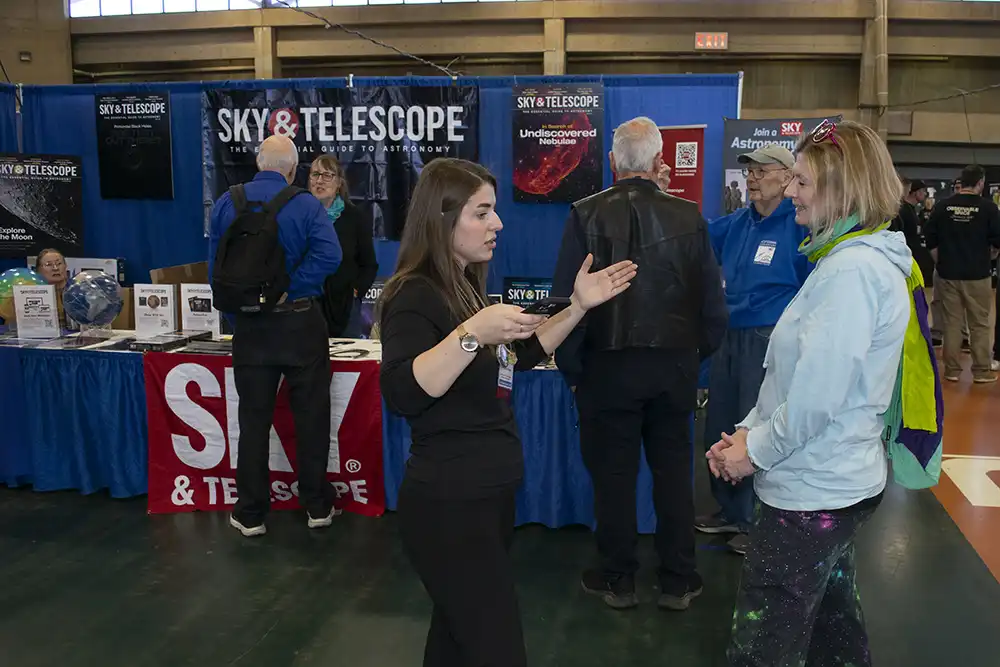
This was my first-ever NEAF, and I’m still processing the experience. It was wonderful to meet all of our advertisers, see their products in 3D, and meet the people behind the gear. As a new member of the S&T staff (I started in January), it was lovely to meet several of our contributors and put faces to the names, articles, and emails that I’m already familiar with.
So many readers stopped by just to say hello — long-time subscribers (the current record-holder started in 1957), recent subscribers, and those who signed up on the spot — everyone had something good to say about the magazine. We handed out plenty of stickers and activity sheets. I got to channel my inner professor to teach folks how to make and use planispheres and star clocks.
It’s fantastic to be part of a team that supports amateur astronomy in all its incarnations!
