
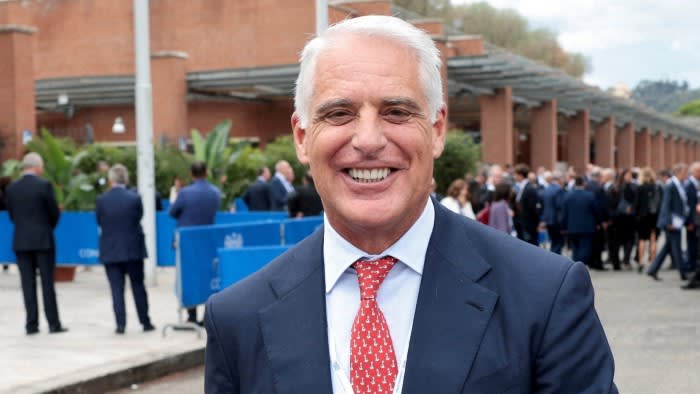
When UniCredit bought 9 per cent of Commerzbank this month, the Italian bank’s chief executive Andrea Orcel sought to reassure Berlin of his intentions by saying cross-border deals in the industry could not happen against the will of governments.
Outside its home market, any bank needed the “support from local institutions”, he said, noting UniCredit “always entertained a dialogue with regulators, institutions and counterparts in Germany”.
That dialogue appears to have broken down. On Monday, UniCredit said it was about to overtake the German government as Commerzbank’s biggest shareholder with a 21 per cent stake after taking a position — pending regulatory approval — on a further 11.5 per cent of the German lender’s stock.
In New York that day, Chancellor Olaf Scholz said: “Unfriendly attacks [and] hostile takeovers are not a good thing for banks and that is why the German government has clearly positioned itself.”
What, if anything, can the German government, regulators and rival banks do to thwart Orcel’s ambitions to take over Commerzbank?
What can Germany do?
German politicians across the political spectrum have been united in their condemnation of what they perceive as Orcel’s aggressive tactics. But the government has few tools to block a takeover bid.
Berlin had already said on Friday that it would no longer put its remaining 12 per cent stake up for sale. Instead, Orcel found another way to increase UniCredit’s stake, through derivative instruments.
The German government’s powers to shoot down takeovers were strengthened after robotics maker Kuka was acquired in 2016 by Chinese group Midea in an acrimonious takeover that fostered fears of a sellout of engineering expertise. But outside of the defence industry, the rules apply only to buyers from non-EU members.
UniCredit needs permission to lift its stake in Commerzbank above 10 per cent, but from its regulator, the European Central Bank, not Berlin.
Mechthilde Wittmann, an MP for the opposition CSU party, said Scholz should “take the next plane to Rome and tell [Italian prime minister Giorgia] Meloni that this takeover can’t happen. We won’t agree to it”.
Others, however, disagree. “I don’t see that the German authorities have any leverage,” said Hans-Peter Burghof, a banking expert at Hohenheim university.
“UniCredit is a European bank and so European rules on competition, bank supervision and capital markets apply. And the German authorities don’t really have any say in the matter.”
Ministers were within their rights to express their opinion on a possible takeover, as Scholz did on Monday, “but it’s just a description”, said Burghof. “Yes, it’s a hostile takeover . . . and they can express their annoyance, but little more than that.”
What can the ECB do?
The idea of a UniCredit merger with Commerzbank was initially welcomed within the ECB, which has long called for more cross-border consolidation in the sector.
But some at Europe’s top banking regulator are annoyed about what they regard as Orcel’s “aggressive” tactics, according to people familiar with their views.
European rules on bank ownership — designed to prevent criminals and shady funds from getting control of a bank — are complex and bureaucratic.
Joachim Kaetzler, banking partner at law firm CMS Hasche Sigle, described them as “an avalanche of documents”.
However, “reasons to reject the application [by UniCredit to take its stake above 10 per cent] are highly unlikely to arise”, said Kaetzler, because the Italian bank was one of Europe’s largest and most profitable lenders and its top-ranking officials had been approved by the ECB.
Under the application rules, the ECB is required to make a decision within 60 days but can add another 30 days in complicated cases.
With BaFin, Germany’s financial regulator, responsible for assembling the application to be submitted to the ECB, German bureaucrats in theory have scope to take a particularly rigorous approach — by requesting additional documents, for instance.
“An ownership-control procedure can easily take six to 12 months,” said Kaetzler.
What can other banks do?
Any bidder deemed preferable to UniCredit would have to secure support from the government.
The most obvious candidate is Deutsche Bank, which has discussed a move for Commerzbank several times before.
Such a deal would mean Commerzbank — a crucial lender to the Mittelstand, the small and medium companies that form the backbone of the German economy — remained in domestic hands.
However, it would result in a large number of job cuts and branch closures, which may be unpalatable to German voters and unions.
Deutsche is also not in the best position to buy Commerzbank, as it would have to pay in cash for shares owned by the government or in the open market.
Doing so would disrupt plans to return €8bn to shareholders by 2025, which Germany’s largest lender paused earlier this year after taking a €1.3bn hit from a long-running lawsuit.
Deutsche Bank boss Christian Sewing said this month he was unfazed about a potential takeover of Commerzbank by UniCredit. “Competition is good for business”, he added.
Other banks such as France’s BNP Paribas, Spain’s Santander and ING of the Netherlands could also be encouraged to make a bid.
These banks do not have German operations of the size of UniCredit’s HypoVereinsbank, so such a combination would not benefit from the same synergies.
Entering a bidding war with a rival holding a 21 per cent stake is another complication.
What can Commerzbank do?
Orcel unveiled his initial move on Commerzbank hours after the German bank said its chief executive Manfred Knof would leave by the end of 2025.
Commerzbank on Tuesday evening appointed chief financial officer Bettina Orlopp as its new chief executive to champion the lender’s standalone strategy and rally investor support.
But even Commerzbank insiders who are sceptical about a deal acknowledge that it will be almost impossible to present a standalone strategy that is financially as attractive as a merger.
A combination with HypoVereinsbank would result in billions of euros of cost savings and economies of scale.
Commerzbank could come up with a poison pill to scupper the deal — for example by agreeing to sell its corporate bank to Deutsche Bank in exchange for a stake in the rival.
But people close to Commerzbank told the Financial Times that management “won’t do anything crazy” to derail a UniCredit bid if it came at the expense of the German lender’s franchise.
The alternative may be to try to squeeze a generous takeover premium from Orcel, as well as guarantees to keep decision-making and a listing of the German operations in Frankfurt.
