
Unlock the Editor’s Digest for free
Roula Khalaf, Editor of the FT, selects her favourite stories in this weekly newsletter.
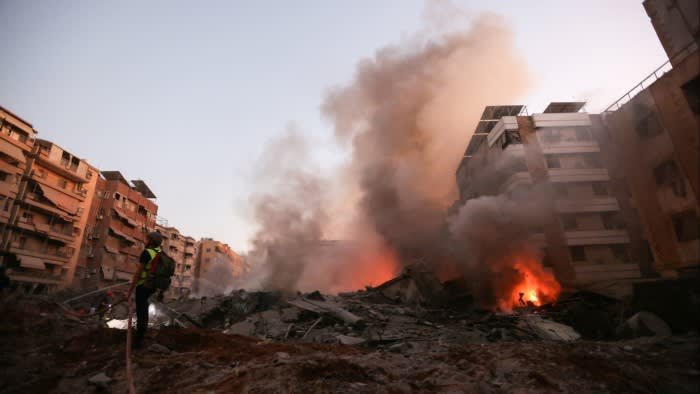
Israel’s military hit Hizbollah’s “main command centre” in Beirut’s southern suburbs on Friday in a strike targeting Hassan Nasrallah, the group’s leader, in the most intense bombardment of Lebanon’s capital since the start of its offensive.
The strike on Beirut came after Prime Minister Benjamin Netanyahu said in a defiant speech at the UN that Israel “must defeat” the Lebanese militant group despite growing international pressure for a ceasefire.
The Israeli army said it had struck Hizbollah’s headquarters, which was located under residential buildings. Two people familiar with the situation said the strike had targeted Nasrallah.
There was no official confirmation from Hizbollah about whether Nasrallah survived the attack — or was in Beirut when it took place.
But senior Iranian politicians told Iran’s state television that Israel’s killing of senior leaders and commanders of Hizbollah — the Islamic republic’s most important proxy — would not weaken the group.
Iran’s reformist president, Masoud Pezeshkian, urged Muslim countries to condemn the Israeli strike, which he described as “blatant war crimes”. He said his government would “stay by Lebanon’s side and the axis of resistance”.
An Iranian regime insider warned that whether or not Nasrallah was killed, Friday’s attack would “push the war into a totally different phase”.
US President Joe Biden said Washington “had no knowledge of or participation in the [Israel Defense Forces] action”. Asked if he was concerned about the conflict escalating in the region, he added: “I’m always concerned about that.”
The White House said Biden had directed the Pentagon “to assess and adjust as necessary” the posture of the US military in the Middle East and to take appropriate protective measures at US embassies. Kamala Harris, the vice-president, was also briefed on the Israeli action, her office said.
Residents of Beirut reported hearing powerful blasts that shook the city, with large clouds of dust and smoke seen rising. At least six people were killed and 91 injured, according to Lebanon’s health ministry. That figure was expected to rise as rescue workers continued searching for survivors.
Six buildings were reduced to rubble in the Haret Hreik neighbourhood of southern Beirut, said Lebanon’s state-run news agency.
Hizbollah controls the area, which is home to many of the group’s offices, including those belonging to its social welfare institutions, but it is also a densely populated urban centre.
Late on Friday evening, the Israeli military warned residents of Beirut’s southern suburbs to evacuate for “your safety and the safety of your loved ones”.
“You are located near Hizbollah interests,” Avichay Adraee, an Israeli military spokesperson, said in a post on X, which included maps and specified streets and buildings. The warnings echoed those given by the IDF to Palestinians in Gaza ahead of new offensives.
Daniel Hagari, the chief IDF spokesperson, on Friday night warned Hizbollah had developed land-based anti-ship missiles that presented a “clear and present danger to global shipping lanes” and Israel’s strategic infrastructure.
He added the Israeli air force was patrolling near Beirut airport and would “not allow enemy flights bearing weapons to land”.
Early on Saturday morning, the IDF said it was conducting “targeted strikes” on Hizbollah weapons that had been stored beneath civilian buildings in the area of Dahiyeh, a suburb in the south of Beirut.

The scale of the attack targeting Nasrallah risks triggering a robust response from Hizbollah and Iran. The IDF said Hizbollah had fired at least 65 rockets at Israel on Friday night.
Nasrallah’s role in the so-called axis of resistance of Iran-backed militant groups has grown in significance since the US assassinated Qassem Soleimani, Iran’s most powerful commander, in 2020.
The 64-year-old cleric is rarely seen in public and has been in hiding for much of the past 20 years. While he regularly gives public addresses, they are always via video link and from unknown locations. The location of the air strike had not been publicly known to be Hizbollah’s headquarters.
The Israeli attack came less than two hours after Netanyahu’s speech to the UN General Assembly, during which he made no mention of a US-French effort to broker a ceasefire with Hizbollah, doubled down on the campaign against Hamas in Gaza, warned Iran that Israel could hit it anywhere, and branded the UN a “swamp of antisemitic bile”.
He later cut short his visit to New York to fly back to Israel on Friday evening, underlining the potential significance of the events unfolding in Lebanon. It is rare for an Israeli prime minister to travel on the Sabbath.


“As long as Hizbollah chooses the path of war, Israel has no choice, and Israel has every right to remove this threat and return our citizens to our homes safely — and that is exactly what we’re doing,” he said.
Netanyahu’s address, which was met with walkouts from some other delegations and cheers from his supporters, came after the US and France proposed a 21-day truce in a last-ditch attempt to prevent the hostilities from spiralling into all-out war.
During his half-hour speech — twice the time allotted to speakers — Netanyahu pledged to keep up the pressure on Hizbollah, and insisted Israel would also continue its offensive in Gaza until Hamas had been destroyed and the Israeli hostages held there had been freed.
