
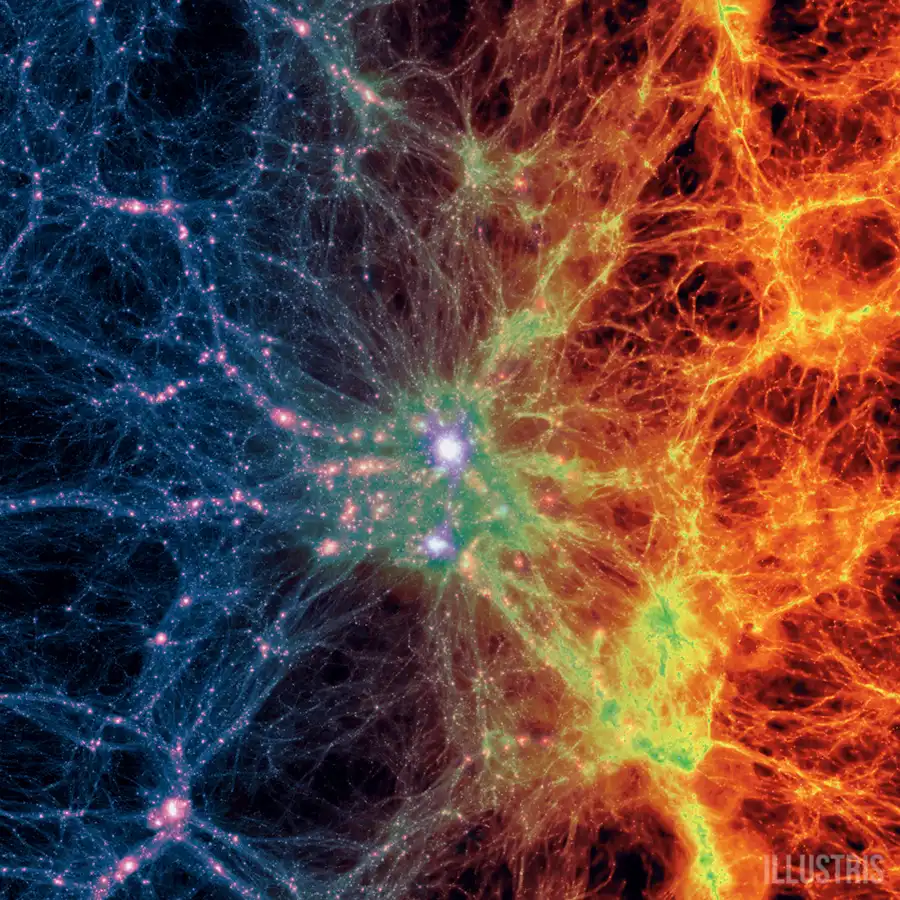
Springel et al. (2005)
Astronomers have discovered one of the largest structures in the universe and the galaxies within it all spinning like a teacup ride at a fairground. This unusual motion could change the way we think about early galaxy formation, and even how we measure the main constituents of our universe.
The structure in question is a vast cosmic filament that’s relatively nearby, some 140 million light-years from Earth. (That’s three times as distant as the Virgo galaxy cluster, but half as far as the Coma cluster.) Filaments are the cosmic threads that stitch the universe together — celestial scaffolding without which there would be no structure. Both ordinary and dark matter flow along these enormous features, feeding galaxies hungry for material from which to build new stars. These flows also transport angular momentum, helping set the eventual spin of the galaxies that form within them.
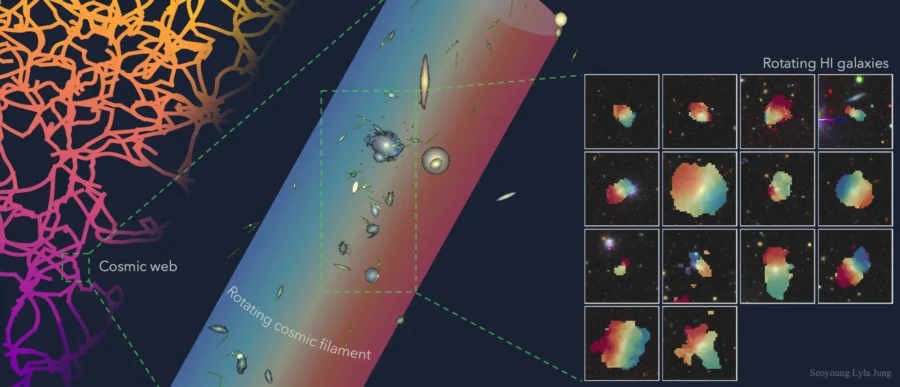
Lyla Jung / CC BY 4.0
A team led by Madalina Tudorache and Lyla Jung (both University of Oxford, UK) used the MeerKAT radio telescope in South Africa to perform a deep extra-galactic survey of such structures and the galaxies within them. The team followed up with visible-light observations from the Dark Energy Spectroscopic Instrument (DESI) and the Sloan Digital Sky Survey (SDSS).
One particular filament stood out immediately. “What makes this structure exceptional is not just its size, but the combination of spin alignment and rotational motion,” says Jung. The filament appears to be rotating at 110 kilometers per second (250,000 mph) and stretches out for almost 50 million light-years. The team’s findings are published in Monthly Notices of the Royal Astronomical Society.
The team identified a string of 14 hydrogen-rich galaxies embedded within the filament, concentrated into a narrow 5.5 million-light-year long “spine.” Many of those galaxies appear to be spinning in the same direction as the filament.
“You can liken it to the teacup ride at a theme park,” says Jung. “Each galaxy is like a spinning teacup, but the whole platform — the cosmic filament — is rotating too. This dual motion gives us rare insight into how galaxies gain their spin from the larger structures they live in.”
Galaxy formation theory had predicted that the spin of such galaxies would be randomly distributed. However, the filament’s own angular momentum appears to be imprinting itself on the galaxies within it, suggesting a more coherent transfer of spin than astronomers had thought.
The abundance of hydrogen in these galaxies enabled the team to trace the gas as it moves between them. “This filament is a fossil record of cosmic flows,” says Tudorache. “It helps us piece together how galaxies acquire their spin and grow over time.”
Peng Wang (Shanghai Astronomical Observatory, China), who was not involved in the research, backs the team’s claims. “The analysis is careful and . . . provides convincing evidence that this structure carries a significant amount of angular momentum,” Wang says. “The strength of the galaxy–filament spin alignment is also unusually high compared with most previous observational studies.”
Studies like this one could have wider-reaching consequences.
Upcoming surveys by ESA’s Euclid mission and the Vera C. Rubin Observatory will look for minute distortions in the apparent shapes of galaxies, which happens when the gravity of intervening dark matter slightly bends their light. But if those galaxies share an intrinsic alignment — as seen in this study — astronomers must accurately account for this pattern. Otherwise it can affect our measurements of dark matter and dark energy.
So it seems this giant filament could play a big role in the future of cosmology.
