
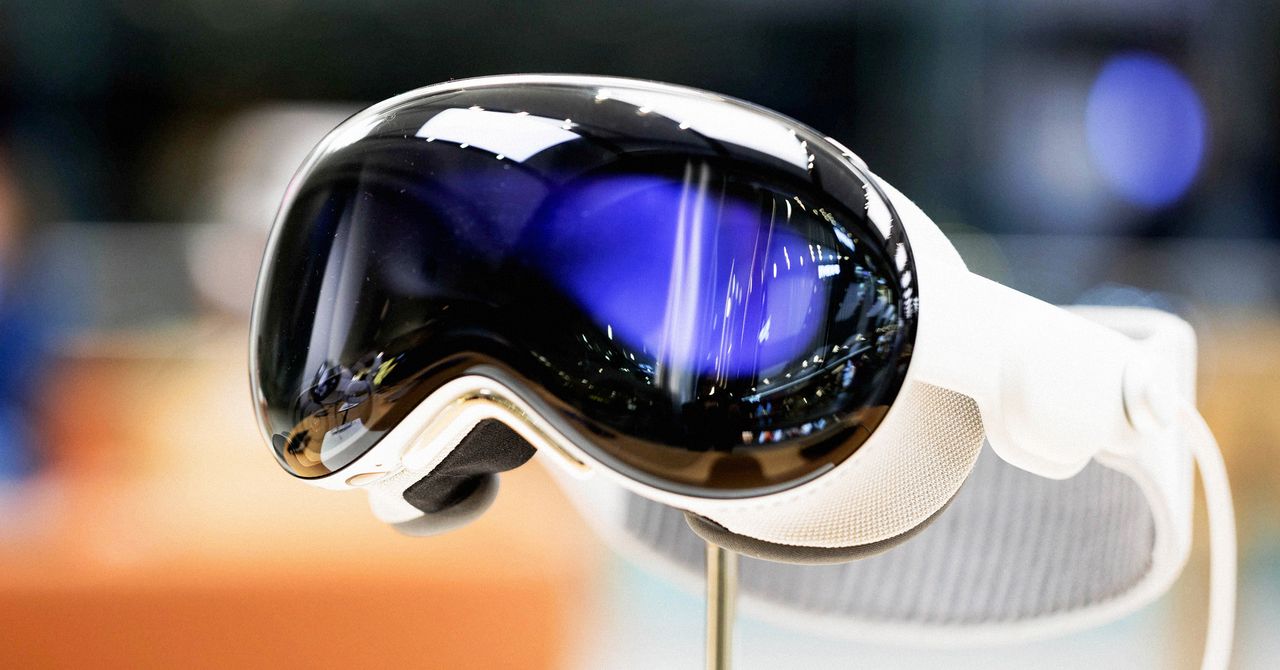
Now, Cognixion is bringing its AI communication app to the Vision Pro, which Forsland says has more functionality than the purpose-built Axon-R. “The Vision Pro gives you all of your apps, the app store, everything you want to do,” he says.
Apple opened the door to BCI integration in May, when it announced a new protocol to allow users with severe mobility disabilities to control the iPhone, iPad, and Vision Pro without physical movement. Another BCI company, Synchron, whose implant is inserted into a blood vessel adjacent to the brain, has also integrated its system with the Vision Pro. (Apple is not known to be developing its own BCI.)
In Cognixion’s trial, the company has swapped out Apple’s headband for its own, which is embedded with six electroencephalographic, or EEG, sensors. These collect information from the brain’s visual and parietal cortex, located at the back of the head. Specifically, Cognixion’s system identifies visual fixation signals, which occur when a person is maintaining their gaze on an object. This allows users to select from a menu of options in the interface using mental attention alone. A neural computing pack worn at the hip processes brain data outside of the Vision Pro.
“The philosophy of our approach is around reducing the amount of burden that is being generated by the person’s communication needs,” says Chris Ullrich, Cognixion’s chief technology officer.
Current communication tools can help but aren’t ideal. For instance, low-tech handheld letterboards allow patients to look at certain letters, words, or pictures so that a caregiver can guess their meaning, but they’re time-consuming to use. And eye tracking technology is still expensive and not always reliable.
“We actually build an AI for each individual participant that is customized with their history of speaking, their style of their humor, anything they’ve written, anything they’ve said, that we can gather. We crunch all that down into something that is a user proxy,” Ullrich says.
