

How Swing Left is learning to listen, not lecture—and rebuild trust door to door.
When I took a job as a church-based community organizer in 2010, I had no previous exposure to religion. As a secular Iranian American, my knowledge of the Bible was limited to my Bay Area high school’s AP English elective, Gay Literature, where we analyzed homosexual innuendo in the books of Ruth and Samuel.
A few weeks into the job, an ambitious priest asked me to help lead his parish’s evangelization campaign.
“Trust me,” he said, offering faint reassurance. “We do it differently.”
Over the next few months, we knocked on every door in the parish boundaries. Never once did he ask, “Will you come to church?” Instead, he asked: “What’s keeping you up at night?”
When people answered, the priest listened. He helped however he could and never made false promises. Anxious about a needle-strewn park? Join the church’s efforts to reallocate city funds to build a better one. Overwhelmed by energy costs? The church will help enroll you in the city’s home weatherization program. Regardless of their connection to the church, everyone we spoke to was grateful to have someone listen and provide support.
One day, we knocked on the door of a woman whose husband had died unexpectedly. She sobbed, ashamed that she couldn’t afford a funeral and that she had no close family or friends to send him off with dignity.
The priest ministered to her movingly. As always, he never asked “Will you come to church?”
Instead, he went back to the Mexican American matriarchs who led the parish prayer group. They got to work, cooking trays of lasagna and enchiladas to deliver to her daily. And then they organized a funeral fit for a mayor.
I don’t know if that woman ever went to mass. But I do know she believed that her parish made her life better.
That experience had deep meaning for the prayer group leaders, too. As true believers, they long endured snide comments from family and friends: “The Catholic Church is corrupt and hypocritical; they don’t care about people like me.” Rather than recite focus-grouped talking points from their diocese, they could respond: “I don’t know about the Catholic Church, but in my church, when someone is struggling, we show up.” They could cite story after story like that funeral. Stories of listening, not lecturing. Of building relationships, not passing out pamphlets.
Today, I knock doors in a very different context. As the executive director of Swing Left, I help steer our community of 1 million members through the political wilderness with a singular goal: to help Democrats win back power, starting with winning back the House in 2026.
The differences between electoral organizing in 2025 and parish organizing in 2010 are, of course, vast. But I’m struck by just how much we as Democrats can learn from the example of the priest who so shaped my understanding of public life.
The first lesson: we all have far more agency to effect transformative change than we think. I hear from volunteers and donors regularly who feel stuck. “Fixing” the Democratic brand at some abstract, national level, feels impossible. Too many are waiting for a presidential candidate to come and save us.
Just like those prayer group leaders: We need to save ourselves. As political scientist Hugh Heclo once wrote, “Institutions are repaired the same way they are built: through countless small acts of responsibility.”
The second lesson I learned in San Antonio: Effective evangelization starts with listening. People trust leaders and institutions that listen and help them solve real problems. Plenty of grassroots groups still organize this way, yet national Democrats simply don’t do it at scale or with consistency. But we must. To win in 2026 and beyond, Democrats must not only mobilize our true believers into action but also earn converts.
We can do that by scaling what that priest and those prayer leaders did. That means demonstrating to voters—not telling them, but showing them—that Democrats aren’t just here to ask for their vote in the final weeks of an election. We’re here to listen and help, today and for the long haul.
That’s what we’re aiming to achieve with “Ground Truth,” the new program we’re launching at Swing Left to reimagine how Democrats connect with voters.
First, we’re talking to everyone. Not just likely Democrats or frequent voters, but every voter and potential voter in competitive House districts. Like a parish, a congressional campaign should serve the whole community.
Second, we’re being curious and open. The priest never quoted scripture at the door. He asked what people cared about and met them there. Our Ground Truth volunteer canvassers are trained the same way. They simply ask, “What do you think about the direction of our country?” They listen openly and nonjudgmentally. They don’t pivot immediately to “vote for Democrats.” They take time. They probe. They share honestly. And in so doing, they create fertile ground for persuasion.
Current Issue

Third, we’re following up. That priest couldn’t do everything alone. He called on his parish prayer group to carry the work forward. Similarly, Ground Truth uses technology to make follow-up easier. When someone shares a concern, we connect them with help.
But while the priest relied on a cell phone and a notepad, we have new tools—including AI—that make sure no interactions or insights are lost. Technology can’t replace real human connection. But it can retain and analyze the insights from long conversations—takeaways that used to get lost in notebooks or reduced to checkboxes. Used well, these tools help us focus more on people, not less.
And finally, we’re moving fast and at scale. We need to mend the Democratic Party brand district by district, all at once. That means we can’t just rely on one group of prayer leaders. We need hundreds of thousands of people to join us. And we don’t have the luxury of waiting. Our democracy, our freedoms, our planet—too much is at stake.
Early results from our pilot canvasses in nine battleground states are promising. Nearly half of all voters—Republicans, Democrats, and independents—say they’re frustrated with both parties. But despite that frustration, two-thirds of those who answer the door are engaging in real, meaningful conversations. And many say they’re surprised that Democrats wanted to listen, not just ask for votes. That’s the opening we’re betting on: that when Democrats show up differently, we can win converts and elections.
To do this, we can’t just be against Trump. We need to be for something. That something needs to be anchored in real relationships with real voters in real communities. The work of rebuilding trust starts one door, one conversation, one enchilada plate at a time.
So we’re laying the tracks as we go—piloting, learning, and adapting in real time. Ground Truth launched its pilot in fall 2025 and will expand nationwide in January 2026. It’s messy, ambitious, and necessary.
And if we do it right, when someone says, “The Democratic Party doesn’t care about people like me,” someone else will be able to respond, “I don’t know about the national party. But in my district, when I needed someone to listen, Democrats showed up.”
That’s how we rebuild. That’s how we win.
More from The Nation
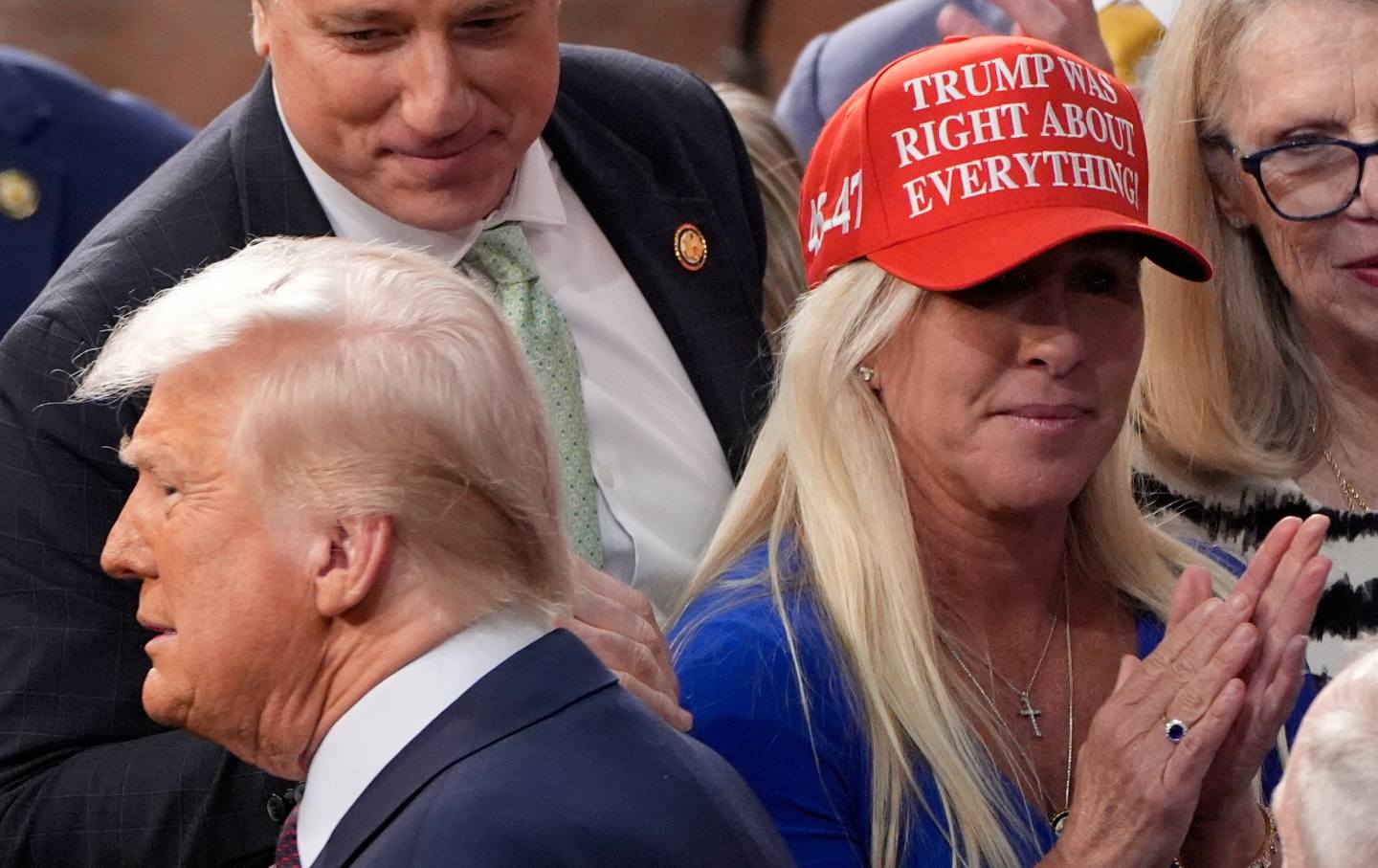
His surrender on the Epstein files—and his attack on Marjorie Taylor Greene—proves it.

In this week’s Elie v. U.S., The Nation’s justice correspondent digs into the fallout from the Democrats’ shutdown letdown. Plus: why the SNAP fight is far from over—and Kim Karda…


The East Wing of the White House has been destroyed—along with some of the most
important values of democracy.
