
Kerfuffle over supernova in Pegasus galaxy. The astronomers who reported a 9.5-magnitude supernova in NGC 7331 early Sunday morning retracted their report just a few hours later. It’s apparently the previously discovered Supernova 2025rbs, only about magnitude 13.7.
They were using the 6o-inch Mount Wilson telescope visually during an observing session for the public. They had compared the brightness of the new star to the galaxy’s stellar-like nucleus. But the larger a telescope’s aperture and the higher the magnification, the fainter a galaxy’s innermost stellar nucleus will appear visually as compared to the galaxy’s total light. As is also true for a comet’s nucleus, as comet observers well know.
FRIDAY, JULY 18
■ That late-summer landmark, the Sagittarius Teapot, already sits low in the south-southeast after nightfall. It’s made of 2nd- and 3rd-magnitude stars and is about as big as your fist at arm’s length. Its handle is on the left and its triangular spout is on the right.
As the night advances, and as summer advances, the Teapot moves westward and start tilting to pour from its spout.
SATURDAY, JULY 19
■ Pleiades occultation Sunday morning. In the early-morning hours tonight, the bright limb of the waning crescent Moon will occult some of the Pleiades stars for various parts of North America. Somewhat later they’ll reappear from behind the Moon’s dark limb, events that will be easier to observe. For more information, including maps and timetables for four of the brightest Pleiads, click here and see the links for July 20th.
SUNDAY, JULY 20
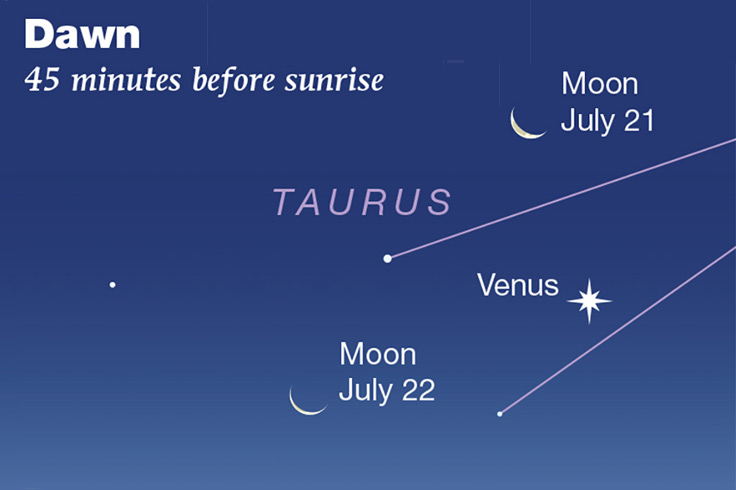
■ During dawn Monday morning the 21st, look east for the thin (14% illuminated) waning crescent Moon hanging 7° or 8° above Venus as shown below. A little farther than that to their right (off the right edge of the illustration) is fainter orange Aldebaran. Way down to their lower left, can you pick up Jupiter?
These scenes are always drawn for a skywatcher at 40° north latitude. If you’re far south of there, Betelgeuse will be higher than Jupiter.
MONDAY, JULY 21
■ As dawn begins to brighten on Tuesday morning the 22nd, look east-northeast for the thin crescent Moon with Venus shining to its upper right, as shown above. Forming a quadrilateral with them are the two horntip stars of Taurus: Beta and lesser Zeta Tauri, shown in the illustration.
Far below them all, catch Jupiter coming up.
TUESDAY, JULY 22
■ Cassiopeia is now well past its bottoming-out for the year. Look for its tilted W pattern low-ish in the north-northeast after dark. The farther north you live, the higher it will be.
■ Fourth star of the Summer Triangle. The next-brightest star near the three of the Summer Triangle, if you’d like to turn it into a diamond, is Rasalhague (Alpha Ophiuchi), the head of Ophiuchus. Look high toward the southeast soon after dark. You’ll find Rasalhague about equally far to the upper right of Altair and lower right of Vega. Altair is currently the Summer Triangle’s lowest star. Vega is the highest and brightest.

WEDNESDAY, JULY 23
■ Standing atop Scorpius in the south after darkness is complete, and butting heads with Hercules much higher, is enormous Ophiuchus the Serpent-Holder. Just east of his east shoulder (Beta Ophiuchi) is a dim V-shaped asterism like a smaller, fainter Hyades. This is the defunct constellation Taurus Poniatovii, “Poniatowski’s Bull.” The V is 2½° tall and stands almost vertically now.

Adapted from Tomruen / Wikimedia Commons
The top two stars of the V are the faintest (magnitudes 4.8 and 5.5). The middle star of its left (east) side is the famous K-dwarf binary 70 Ophiuchi, visual magnitudes 4.2 and 6.2, distance just 17 light-years. The two stars of the pair are currently 6.7 arcseconds apart in their 88-year orbit: close but nicely separated at medium-high power in any telescope.
Just 1¼° NNE of Beta Oph (Cebalrai) is the large, very loose open cluster IC 4665, a binocular target 1,100 light-years away. That’s relatively near for an open cluster, which accounts for its rather large apparent size; it’s a little more than ½° across.
If you orient your view so celestial SSW is up — in other words putting Beta Oph straight above the group — its central stars spell out a ragged welcome: “HI”.
(The “HI” will be in mirror writing if your view is mirror-reversed. That happens whenever your optical system has an odd number of reflections, such as if you use a star diagonal at the eyepiece.)
For more telescopic sights in this area, including Barnard’s Star, doubles in IC 4665, and two other clusters, see Ken Hewitt-White’s “Suburban Stargazer” section in the July Sky & Telescope, page 55. (The text there misidentifies Collinder 350 as “359”.)
THURSDAY, JULY 24
■ New Moon (exact at 3:11 p.m. EDT), and a new lunar month begins. Unlike the calendar month, which averages 30.437 days long, the lunar month (from one new Moon to the next) averages 29.531 days. This means that, on average, you’ll see the Moon in any given phase about one day earlier each month by the calendar.
■ In this dark of the Moon, learn the important, rich little Milky Way constellation Scutum, the Shield, off the tail of Aquila using Matt Wedel’s Binocular Highlight column “Challenging Scutum Clusters” in the August Sky & Telescope, page 43. With chart.
FRIDAY, JULY 25
■ As summer progresses, bright Arcturus moves down the western side of the evening sky. Its pale ginger-ale tint always helps identify it.
Arcturus forms the bottom point of the Kite of Boötes. The Kite, rather narrow, extends upper right from Arcturus by 23°, about two fists at arm’s length. The lower right side of the kite is dented inward, as if some invisible celestial intruder once banged it.
SATURDAY, JULY 26
■ Look again to Arcturus high in the west. In astronomy lore today, Arcturus may be best known for its cosmic history: It’s an orange giant some 7 billion years old, older than the Sun and solar system, racing by our part of space on a trajectory that indicates it was born in another galaxy: a dwarf galaxy that fell into the Milky Way and merged with it.
But in the astronomy books of our grandparents, Arcturus had a different claim to fame: It turned on the lights of the 1933 World’s Fair in Chicago optimistically celebrating “a century of progress.” Astronomers rigged the newly invented photocell to the eye end of big telescopes around the US and aimed them where Arcturus would pass at the correct moment on opening night. Where the sky was clear the star’s light crept onto the cells, the weak signals were amplified and sent over telegraph wires to Chicago, and on blazed the massive lights to the cheers of tens of thousands.
Why Arcturus? Astronomers of the time thought it was 40 light-years away (the modern value is 36.7 ±0.2). So the light would have been in flight since the previous such great event in Chicago, the World’s Columbian Exhibition in 1893.
And earlier? Arcturus was famous as one of the first stars discovered to show proper motion, its own independent motion on the celestial sphere. In 1718 Edmond Halley realized that Arcturus, Sirius, and Aldebaran had moved more than half a degree from where the Greek astronomer Hipparchus measured them to be some 1,850 years earlier.
And before that? Arcturus was the first nighttime star to be seen in the daytime with a telescope: by Jean-Baptiste Morin in 1635.
SUNDAY, JULY 27
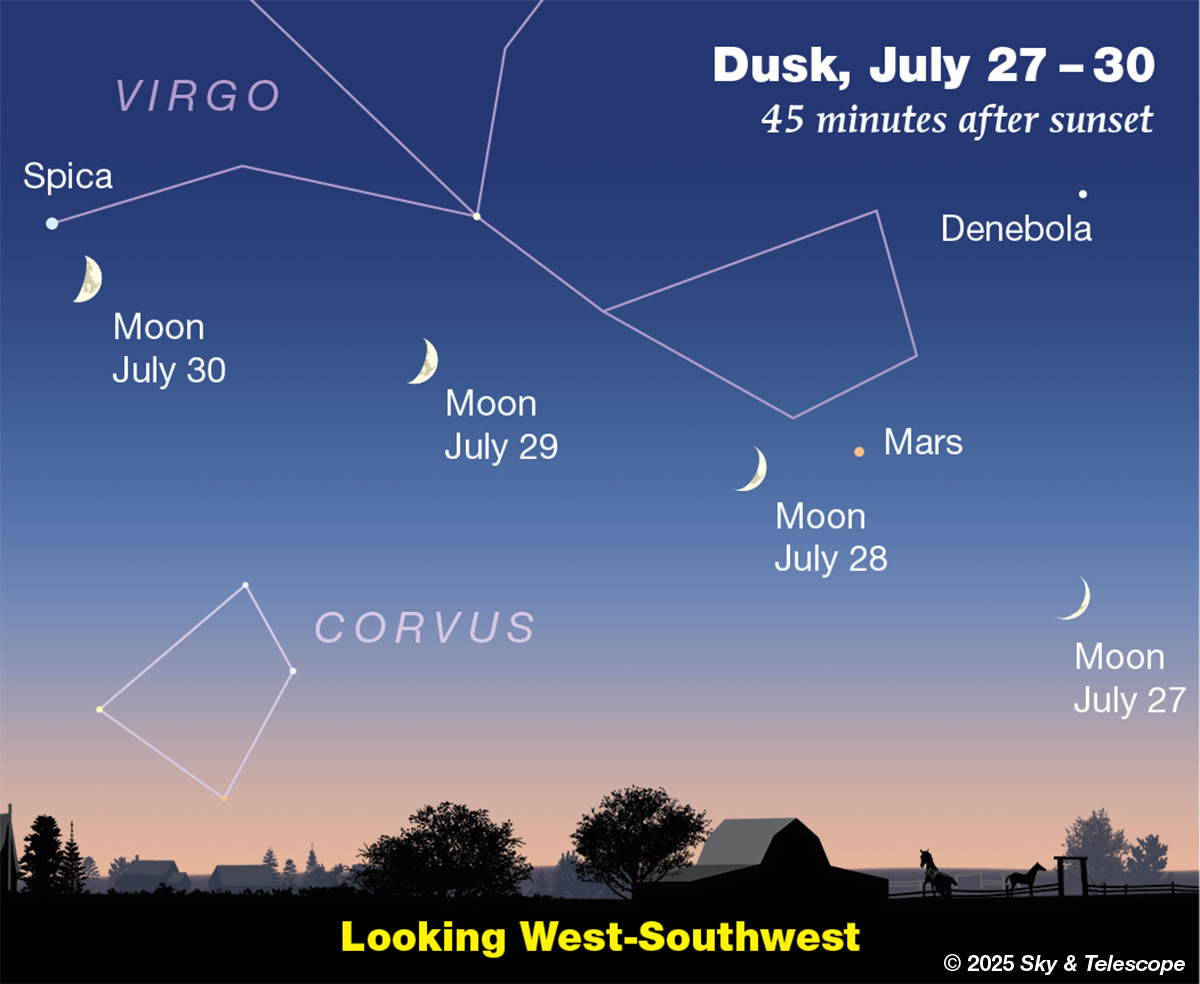
■ Use the crescent Moon to guide you to Mars and Denebola in the fading twilight this evening, as shown below.
■ At this time of year the Big Dipper hangs diagonally in the northwest after dark. From the Big Dipper’s midpoint, look three fists to the right to find Polaris, not very bright at 2nd magnitude, glimmering due north as always.
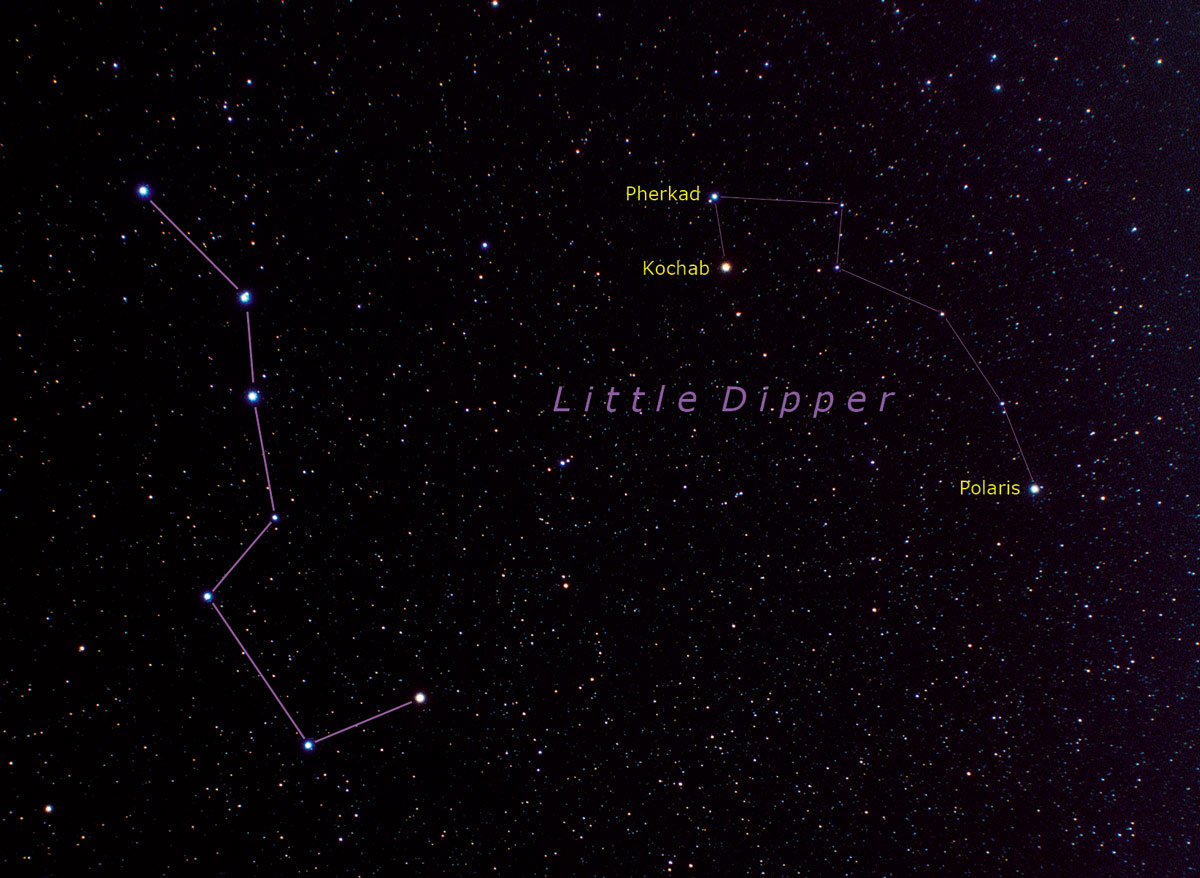
Polaris is the end of the Little Dipper’s handle. The only other Little Dipper stars that are even moderately bright are the two forming the outer end of its bowl: Kochab and Pherkad. These evenings you’ll find them to Polaris’s upper left by about a fist and a half at arm’s length, as shown above. They’re called the Guardians of the Pole, since they ceaselessly circle around Polaris through the night and through the year. I sometimes imagine them marching around and around like the Wicked Witch’s guards in the Wizard of Oz movie, chanting “O-ee-o, eeee-o.”
They do not in fact do this. They are giant orange-hot and white-hot balls of gas, respectively, spectral types K4 III and A2 III, located 131 and 490 light-years away. They neither march nor speak. Nevertheless, imaginative conceptions and artistic impressions are real things: abstract things that exist in the few cubic inches of your skull, physically encoded in part of the neural network that gives rise to your mind. External realities and your internal experiences of them are both real things, but they are fundamentally separate orders of being. Confusing the two with each other is, the more you examine it, the origin of a very large slice of humanity’s many failings.
This Week’s Planet Roundup
Mercury is lost deep in the glow of sunset.
Venus, brilliant at magnitude –4.0, rises above the east-northeast horizon about an hour before the first glimmer of dawn. Venus climbs higher until the dawn sky finally grows too bright. In a telescope Venus’s shrinking globe is small and gibbous, 15 arcseconds pole to pole and 73% sunlit.
Mars, magnitude 1.5 at the border of Leo and Virgo, glows low in the west in late twilight and sets soon after dark. Above or upper right of it by about 10° is Denebola, Leo’s tailtip, magnitude only 2.1 but not as extincted by thick low layers of the atmosphere.
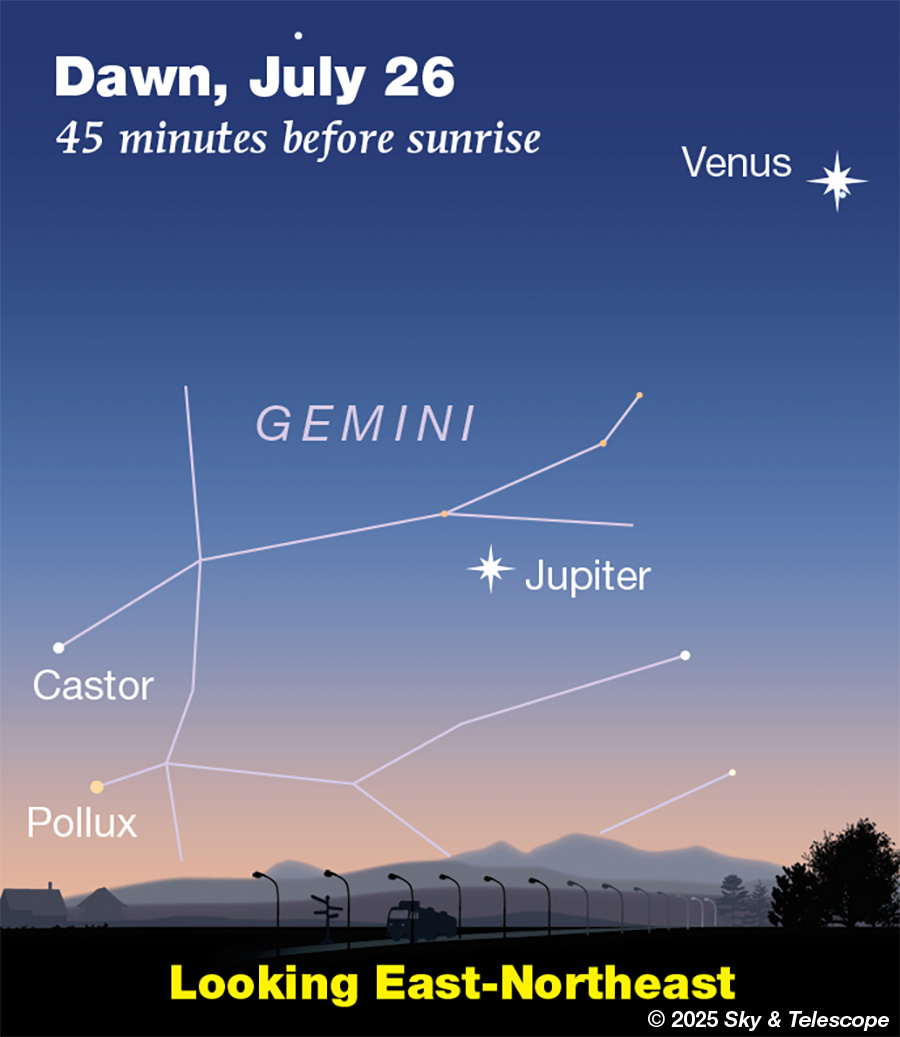
Jupiter, magnitude –1.9, rises around the beginning of dawn. Find it one or two fists lower left of Venus; see the July 21 – 23 view at the top of this page. Venus and Jupiter are closing in toward a pre-dawn conjunction just 0.9° apart on August 12th.
Saturn (magnitude +0.9, in Pisces) rises around 11 p.m. daylight-saving time. But the best time to try a telescope on Saturn is just before dawn, when it’s near its highest in the south.
Saturn’s rings are almost edge-on this year. They and their shadow form a super-thin black line along Saturn’s equator.
Uranus (magnitude 5.8, in Taurus near the Pleiades) hides deep in the east just before dawn.
Neptune, a telescopic “star” at magnitude 7.9, lurks 1° above Saturn before dawn begins. Use the finder chart for Neptune with respect to Saturn in the June Sky & Telescope, page 51. With a pencil, put a dot on the path of each of the two planets for your date. Get everything planned out and ready for use the evening before, so that dawn doesn’t catch you out.
All descriptions that relate to your horizon — including the words up, down, right, and left — are written for the world’s mid-northern latitudes. Descriptions and graphics that also depend on longitude (mainly Moon positions) are for North America.Eastern Daylight Time (EDT) is Universal Time minus 4 hours. UT is also known as UTC, GMT, or Z time.
Want to become a better astronomer? Learn your way around the constellations. They’re the key to locating everything fainter and deeper to hunt with binoculars or a telescope.
This is an outdoor nature hobby. For a more detailed constellation guide covering the whole evening sky, use the big monthly map in the center of each issue of Sky & Telescope, the essential magazine of astronomy.
For the attitude every amateur astronomer needs, read Jennifer Willis’s Modest Expectations Give Rise to Delight.
Once you get a telescope, to put it to good use you’ll need a much more detailed, large-scale sky atlas (set of charts). The basic standard is the Pocket Sky Atlas, in either the original or Jumbo Edition. Both show all 30,000 stars to magnitude 7.6, and 1,500 deep-sky targets — star clusters, nebulae, and galaxies — to search out among them.
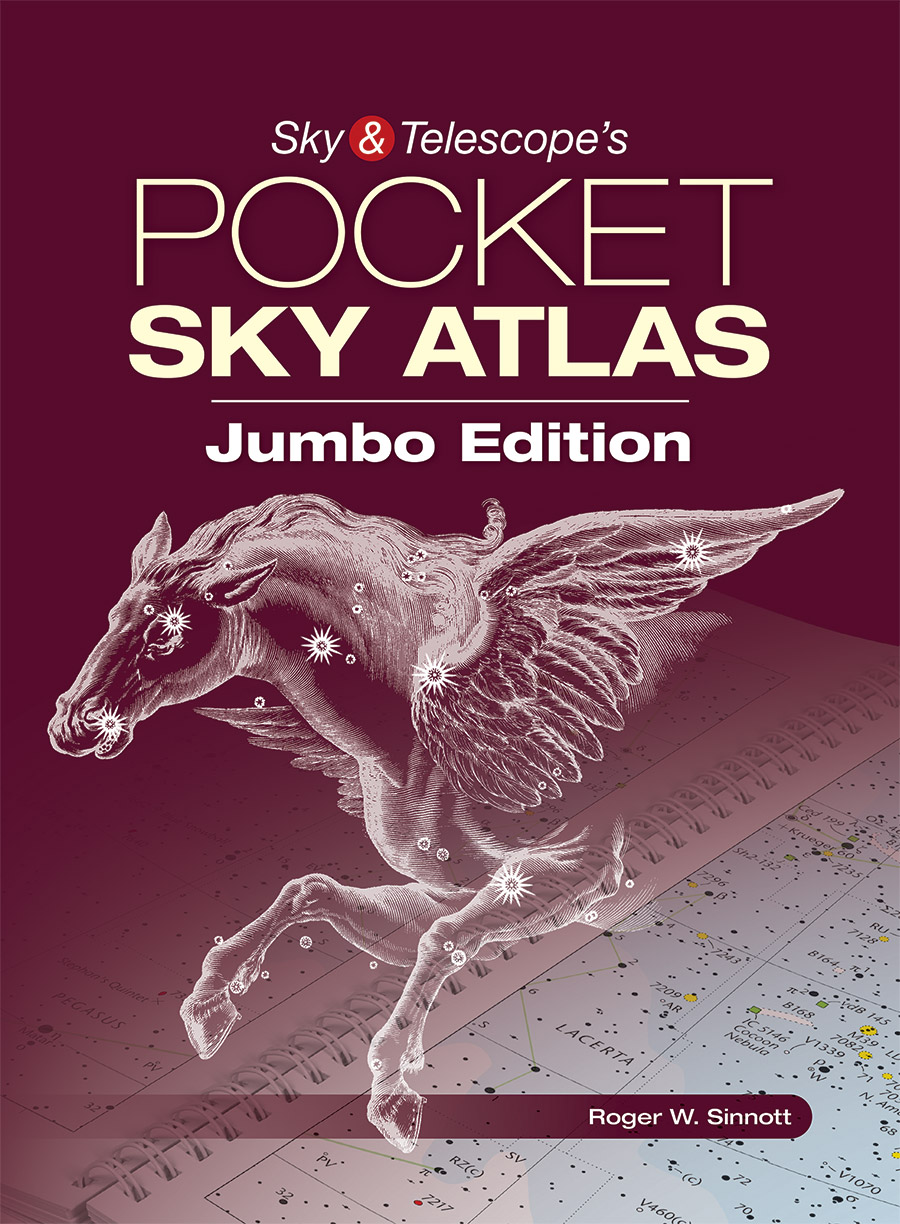
Next up is the larger and deeper Sky Atlas 2000.0, plotting stars to magnitude 8.5; nearly three times as many, as well as many more deep-sky objects. It’s currently out of print, but maybe you can find one used.
The next up, once you know your way around well, are the even larger Interstellarum atlas (with 201,000+ stars to magnitude 9.5 and 14,000 deep-sky objects selected to be detectable by eye in large amateur telescopes), and Uranometria 2000.0 (332,000 stars to mag 9.75, and 10,300 deep-sky objects). And read How to Use a Star Chart with a Telescope. It applies just as much to charts on your phone or tablet as to charts on paper.
You’ll also want a good deep-sky guidebook. A beloved old classic is the three-volume Burnham’s Celestial Handbook. An impressive more modern one is the big Night Sky Observer’s Guide set (2+ volumes) by Kepple and Sanner. The pinnacle for total astro-geeks is the new Annals of the Deep Sky series, currently at 11 volumes as it works its way forward through the constellations alphabetically. So far it’s up to H.
Can computerized telescopes replace charts? Not for beginners I don’t think, and not for scopes on mounts and tripods that are less than top-quality mechanically. Unless, that is, you prefer spending your time getting technology to work rather than learning how to explore the sky. As Terence Dickinson and Alan Dyer say in their Backyard Astronomer’s Guide, “A full appreciation of the universe cannot come without developing the skills to find things in the sky and understanding how the sky works. This knowledge comes only by spending time under the stars with star maps in hand and a curious mind.” Without these, “the sky never becomes a friendly place.”
If you do get a computerized scope, make sure that its drives can be disengaged so you can swing it around and point it readily by hand when you want to, rather than only slowly by the electric motors (which eat batteries).
However, finding faint telescopic objects the old-fashioned way with charts isn’t simple either. Do learn the essential tricks at How to Use a Star Chart with a Telescope.
 Audio sky tour. Out under the evening sky with your
earbuds in place, listen to Kelly Beatty’s monthly
podcast tour of the naked-eye heavens above. It’s free.
“The dangers of not thinking clearly are much greater now than ever before. It’s not that there’s something new in our way of thinking, it’s that credulous and confused thinking can be much more lethal in ways it was never before.”
— Carl Sagan, 1996
“Facts are stubborn things; and whatever may be our wishes, our inclinations, or the dictates of our passion, they cannot alter the state of facts and evidence.”
— John Adams, 1770
