
Important: My opinions are just opinions; they are not truths and should not be taken as such. I make many statements in this article that may seem like claims, but they are not intended to be claims but rather, explorations. Some statements or claims are generalizations based on popular societal data or research to make a point, not to elaborate on the full nuance of a given situation. I am aware that many of the statements I make assume prior knowledge for context, but going into detail or providing every piece of context would require a book, so this article is simplified for brevity.
This article is part of our series Creating Emotionally Meaningful Experiences with AI, Three.js, and Blender:
- Part 1: Developing Creativity & Emotional Design Skills for Beginners
Learn how analytical and systematic thinking can lead to natural creative insight, and discover what makes projects emotionally resonate. - Part 2 (this article): The Increasing Importance of Psychological Safety and Self-Awareness for Creative Work
How psychological safety and self-awareness help creative people take risks, speak honestly, and learn faster, and why that matters more than ever in modern teams. - Part 3: Finding Meaning: Emotional Regulation & Creative Intuition
Developing emotional regulation and pattern matching skills and how to give meaning to your work for beginners.
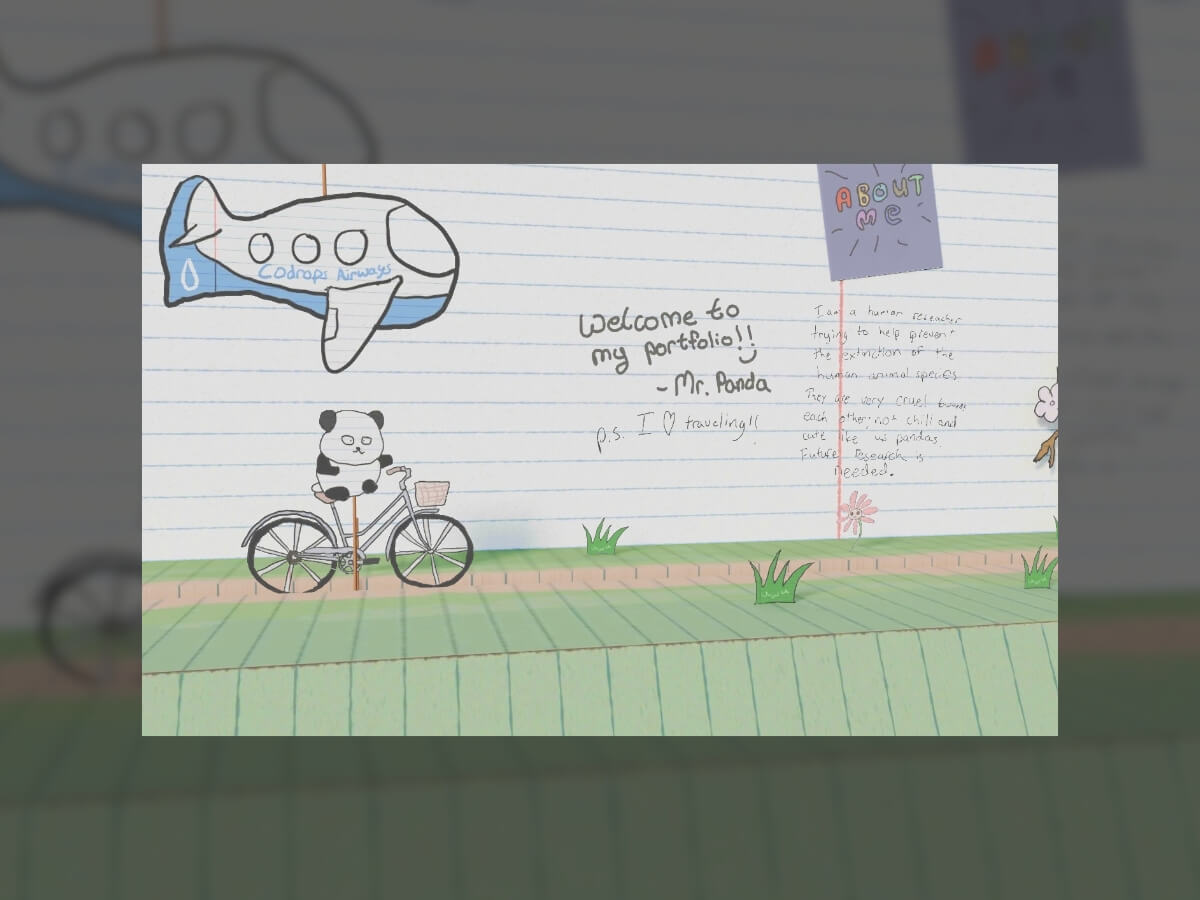
For this article, a personal project was created called Mr. Pandas Psychologically Safe Portfolio and you can watch the full breakdown here.

1. Introduction
Psychological safety is the idea that you can take risks, ask questions, be honest, and not be punished for it. On paper, it seems quite obvious what we should do as humans, listen more, empathize more, talk to each other rather than shut down and assume each others’ intentions, but the reality is that it’s not that easy. The lack of psychological safety in workplaces and daily interactions with others are by people who are not overtly toxic; they might even seem kind to a lot of people (more on this later). While no one is perfect and we all hurt others at some point, it’s important to develop self-awareness of when we are doing harm in order to change that behavior.
Today, we are rapidly becoming more aware not only of ourselves, but how others around us in the world act. We’re discovering behaviors we accepted before as “just a part of human nature,” but are no longer tolerating because they hinder our growth and psychological safety. It’s very similar to the racist and sexist eras of humanity (not that those have resolved completely), but we used to accept racism/sexism as “just the way things work,” yet no longer tolerate those today.
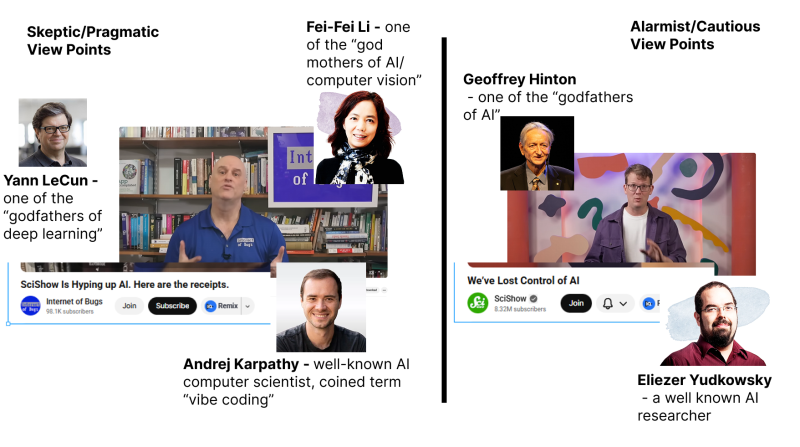
With AI into the mix, our emotional safety becomes even more complicated. AI is causing disruptions in our culture like job safety, having people question if their work means anything, and many people use AI to help with emotional support and processing. Additionally, the content about AI online is highly divisive. Some top researchers are preaching the bad sides of AI and how a takeover could be coming soon whereas other top researchers say it’s not even close to AGI yet and people are just catastrophizing as they always do. Section 6 talks about this from a psychological/sociological standpoint (not from a political side) about why these viewpoints exist so they’re easier to navigate emotionally.
I hope to introduce some current cultural factors and behaviors that hinder growth and how we are increasing our standards of treatment in our professional and personal lives. By doing so, I hope this creative community grows fostering novelty, actual innovation, and amazing new talent. The article first starts with some fundamental concepts and trends about human behavior (Section 2 – Section 5) and in Section 6 I merge these concepts with discussions around AI culture today. I hope by diving deep into some simplified concepts, the resulting feeling is that life really isn’t that deep after all. In other words, “going deep, to realize it’s not that deep.”
2. The Future is Love: Societal trends show increasing desire for psychological safety/awareness and community
Let’s take a step back outside of the world you live in for a moment and look at the bigger picture of life. I believe we’re actually in quite a positive trend, it’s just hard to see when you’re living in the ups and downs of your life.
2.1 Common societal trends showing increasing value and desire for emotional safety
Expressions for a desire for psychological safety are greatly increasing. Take a look at the societal trends today, many are related to making people feel psychologically safe. These are just a few of many:
Societal Trend #1: Movies have been increasingly using self-awareness and intention guessing as part of humor concepts like Zootopia 2’s trailer with an opening therapy session and a phrase like “an emotionally insecure partner.” Pop culture is incorporating “reading” people’s behaviors/intentions and why they act the way they do. When you understand why someone behaves the way they do, or how they’ll react to certain things, it’s easier to relax around them.
Societal Trend #2: Displays of public vulnerability online are increasingly common and consistently go viral like “20 things I wish I knew in my 20s” or “Starting over in my 30s. Single, Broke, Lost my job.” As self-awareness continues to increase, identity crises will become more and more common. People seek a sense of belonging and understanding with parasocial relationships. Similarly, other content like someone working at a restaurant or just eating food in a car is also exploding in popularity because it feels down to earth. relatable, and human.
Societal Trend #3: “Kind of person” social media humor consistently goes viral. Understanding the common types of personalities out there suggests awareness and acceptance of other kinds of people. This makes varying types of people feel included and accepted through humor rather than judged. While this type of humor has long existed even before the internet, they still continue to explode in a variety of different contexts increasing our collective awareness of different kinds of people. Especially the newer “kind of person” slang terms like “performative readers” or “performative men/women” etc. which highlights the gap between the things we act and do to seem a certain way versus who we actually are.
Societal Trend #4: New slang terms like “rage baiting” rooted in psychological concepts are used across social media. “Rage baiting” is effectively talking about what our triggers are as people that make us angry. This slang term is an evolution of the older slang phrase of “getting triggered.” When you understand what makes you angry, it’s easier to prevent yourself from losing control. We are unconsciously adopting a culture where we understand other peoples’ triggers, but sugarcoat it with a slang term. Same with slang-term like “NPC” , a non-player character in a video game. Calling someone an “NPC” suggests low self-awareness. Another saying is “valid crash-out” which is about validating someone’s authentic anger and frustration rather than having someone suppress negative emotions and judging them for it.
Societal Trend #5: Free community softwares like Blender and Krita are increasingly becoming more used and adopted in the industry over their paid counterparts like Maya, Adobe, and Clip Studio Paint. Community open source software makes people feel more safe over corporate software. Similarly indie games are gaining huge popularity over many Triple-A games because a lot of them feel easier to emotionally connect to compared to corporate polished games.
Societal Trend #6: Young people value job loyalty way less than older generations. That’s why young people are job hopping, it’s not about money, it’s about fulfillment and feeling like they can be themselves authentically. Unfortunately, many jobs don’t provide any value besides the money, so it seems like young people just job hop for money when in reality that’s a symptom.
Societal Trend #7: Semantic and intelligent interfaces that adapt and try and guess user intentions are designed to be more empathetic and create psychological safety. It’s the same way you provide safety in a human-to-human relationship, you understand and anticipate needs and desires and carry those out without being told.
Societal Trend #8: There are multiple prominent YouTuber and content creator communities that collaborate with each other (e.g., Doctors creating a diverse community) and also public accountability. It’s harder to treat others worse when the whole world is watching, including other famous content creators. By having that public accountability, it’s easier to feel safe around those people.
Societal Trend #9: The rise of “situationships” or “a romantic or sexual relationship that is not considered to be formal or established.” The reason situationships are becoming more common is not just because of avoidant attachment, economical, and divided attention reasons (which are huge factors of course), it’s also because a lot of people don’t know what they want in a relationship and don’t know if they feel completely safe around a person. The result is you keep them at a safe emotional distance but still engage with them for the “fun” parts. In the past, you just accepted the fact you had to avoid certain topics or dumb yourself down to protect your partner’s feelings and you had to do that the entire life of your relationship (even until death). Today it’s about finding a person who makes you feel really loved and seen. Of course the downside of today’s culture is probably a lot of missed opportunities to develop healthy love which can stem from bad starts, but it’s a trend for a reason regardless.
Societal Trend #10: Using AI as pseudo-therapists or having AI characters as emotional partners and romantic relationships is becoming increasingly common. AI feels very safe to people because it almost always validates a person’s emotions. Even when it does challenge a viewer, it’s still always there to reply no matter what and you can always start a new chat to get validation again. AI is the definition of feeling psychologically safe. Someone who is there to always talk to you no matter what you say or do.
Societal Trend #11: More and more content creators are burning out, suggesting that they rather make “genuine authentic content” they enjoy making rather than videos that perform well for the algorithm. Many content creators have huge followings, but very few meaningful connections so there’s no real emotional support beyond external validation. Without close emotional support, you have no psychological safety.
Societal Trend #12: “I love you” content consistently goes viral (example). It’s a piece of content that temporarily makes you feel good, loved, accepted, and validated by framing nearly universal feel good-themes and ideas. People are starved for being seen and valued, which is why this content so often goes viral.
The great news is, there’s an overall positive trend for humanity (hopefully). People say history repeats itself, which to some degree is true, but not completely true, because if it did, we’d start enacting racist and sexist laws again, but we haven’t yet and are unlikely to do so (of course, countries are different, but let’s just focus on the overall trends).
As humans, we needed bad things to happen before we had culture shifts. It’s almost like we needed to get these things “out of our system” before culture shifts happened. Deep down inside of us, we humans clearly know what is “right,” It just takes a really really long time to get there. In other words, human society is basically like, “Okay, I know this is likely bad, but I’m going to try it anyway because I just need to learn it the hard way first before I change myself.” It’s trial and error on a larger scale because learning is literally just trying and failing until you succeed.
- We had eras of global wars before we realized world wars were bad.
- We used nuclear weapons before we realized nukes were bad. We knew nukes were bad to use, but we used them anyway before we decided not to.
- We had centuries of sexism before we realized sexism was bad.
- We had centuries of racism before we realized racism was bad.
- We have decades of social media before we realized how bad it can be too. Of course, people knew the dangers of social media as it was first created, and then we get all the research paper confirmations afterwards.
- We have years of clickbait titles on social media and now people are finally getting sick of them.
- Political extremism has been worsening in the US for the last few decades, but it’s also finally starting to revert slowly. People are starting to get sick of political extremism.
- McDonald’s recently released an AI ad that got huge backlash despite knowing Coca Cola also got huge backlash before. I’m certain there were probably many members of the McDonald’s team that knew it would result in backlash, but they did it anyway.
The Godfather of AI Geoffrey Hinton mentions how humanity’s “best hope” is for AI to try and take over and fail before we prioritize AI safety. While that sounds a bit intentionally sensationalist currently given the limitations of AI, it’s the same concept as every other cultural shift. We’re going to have years of AI causing hurt to us before we figure out a safe path forward (more details in Section 6).
There is no reason to believe us humans won’t do the “right” thing to save and grow ourselves (whether humans should exist or not is a different debate). We’ve done it ever since the first human species. If we didn’t, we’d still be cave people hunting and gathering and being surprised about fire.
Fundamentally, we’re still young in human history. We still do stuff like resumes/CVs to get jobs even though everyone hates doing resumes/CVs. Educational researchers think grade levels in public schools/colleges (e.g., first-year, second-year) are damaging for student development yet we still do them because we haven’t found a financially sustainable way to personalize or measure individual learning. We have companies that promote based on years working with the company rather than merit. We humans have so many problems we have yet to solve. We humans put all these current systems/patchwork solutions in place just like vibe coding technical debt and now we’re refactoring ourselves to get rid of the bad parts and keep the good. Just like racism or sexism, our current problems will last centuries if not thousands of years before we figure out solutions to them.
You can’t live a perfect life if the world around you is fundamentally imperfect. Although that’s not to say you can’t live an emotionally fulfilling and purposeful life.
In other words, human progress is the act of unlearning our natural tendencies of survival and self-interest in order to better help others. Whether you are religious or not, the purpose of life seems to be helping others. You already spend your entire life working, which at the end of the day is about helping someone else even if you hate your job. It almost seems like being selfish is our natural medium to becoming more selfless. The same way human society needed racism before we became against racism. We have to be selfish before we become selfless.
2.2 People aren’t inherently bad, the world is just psychologically underdeveloped
2.2.1 The cognitive limitations we all have and how it damages the creative industry
Why is it that we have PhD professors that overwork their PhD students, therapists who can’t follow their own advice, parents who abuse their kids, and rich and famous designers who constantly seek external validation and feel empty despite having everything they ever wanted? I think the only answer I’ve ever heard of was “that’s just how life works, you got good and bad people, you gotta protect yourself.” That might be true, but that doesn’t provide a reason. The reason behind that answer is probably because we are just very cognitively limited compared to the maximum human potential.
If you’re in the psychology space, even a little bit, you’ve probably seen a multitude of studies that suggest severe cognitive limitations in ourselves like:
- The Dunning-Kruger effect – people with less knowledge about a subject have the highest amount of confidence in said subject (they don’t know what they don’t know).
- Solomon’s paradox – we can help others without being able to help ourselves with the same advice/support. That’s why many therapists have their own therapists.
- How we tend to seek relationships rooted in childhood patterns. That means if you had bad parental/childhood experiences and low self-worth you’re more likely to seek dysfunctional and toxic relationships in romantic partners who treat you poorly because your body treats that as “normal” and “what you deserve” rather than healthy secure love which feels foreign or even toxic initially.
- It’s not a surprise divorce rates are so high and situationships are more common, people are realizing what they feel as “normal” isn’t always healthy. In the past, if you weren’t self-aware, you would just accept the poor treatment. Today, even if you recognize what is healthy, it’s still a long journey before you feel ready to accept healthy love.
- How many therapists claim many of their patients in therapy are actually victims of abusers and those abusers are the ones who should be in therapy instead.
- How a research team discovered only 10-15% of us are actually self-aware (according to their standards)
- A recent study suggested that adolescence might actually last until we’re 30 years old.
I could go on and list more of our cognitive deficiencies, but it seems like almost every psychology study reveals how underdeveloped we are as a species. And yes, even highly self-aware people are cognitively limited because we humans as a whole species haven’t discovered how to be completely self-aware yet.
The truth is, you don’t have to be very self-aware to live your life. Not yet anyway. In a lot of ways ignorance is bliss. Just be an asshole, focus on yourself and be selfish. Brand yourself, weaponize the benefit of the doubt/plausible deniability, and manipulate people. Even if you’re 100% authentic and kind, people will find something to dislike about you anyway. What’s the point of being selfless and self-aware? Why not just be an asshole? Well, as mentioned in the previous section it’s because life’s purpose is about helping others and in order for humanity to reach its full potential, we have to be self-aware.
Self-awareness was always valued, for example, back when human society was racist we came out of it by thinking “Hey, I wouldn’t want to be treated this way, and I’m treating others poorly, we should stop.” Then the actions occurred like protesting to change laws. Today, we’re finally diving into the more nuanced and complex parts of how to be a “better” person.
We can think of it like Maslow’s hierarchy of needs, and modern societies are getting small glimpses into the self actualization stage. We won’t fully get there for at least a few hundred years if not thousands of years, but at least we’re seeing little sparks of hope now. Even in first world countries, a large portion of society is still operating in the bottom two areas of the hierarchy.
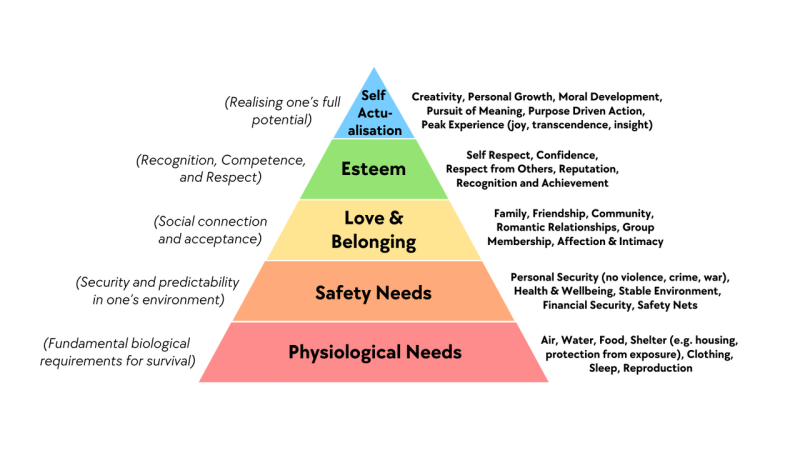
We were all born as not self-aware selfish babies, we cried to get what we wanted with no concern for those around us. If you neglect/hurt that baby, it grows up with dysfunctional behaviors. If you view the start of us humans like a not self-aware selfish baby we’re probably still only at the self-awareness level of a 3 year old. On top of that, human society never had a caregiver or parent, we had to grow up by ourselves. There’s no one handholding us like a good parent would for their child. Of course then, we have so many dysfunctional patterns in society today because we are operating as if we were a traumatized orphan and have to learn how to live by ourselves and fix the trauma on our own. In a sense, view everyone as having some amount of trauma even if they lived a pretty decent healthy life. This isn’t a new concept in the psychology world.
Think about how little we actually control. We’re all victims of choices we didn’t make. Our whole life is about making choices based on things that were chosen for us. We’re all pretty much still reactive NPCs mindlessly wandering around in life. That’s exactly why self-awareness is so important. It gives us agency to see options that we wouldn’t otherwise see.
- We didn’t get to choose to be born or not.
- We don’t get to choose who we’re attracted to or not.
- We don’t get to choose the societal biases/culture/stereotypes/reactions surrounding our physical and mental characteristics.
- We don’t get to choose who judges us and will act on it or not.
- We don’t get to choose our genetic predispositions and resulting health issues.
- We don’t get to choose if we have abusive parents or not.
- We don’t get to choose to internalize traumatic events experienced in early childhood experiences that shape our subconscious adult behavior.
You can’t tell human society to change itself just like you can’t tell a baby to be self-aware of itself. Unironically, you can’t tell a human adult to be self-aware either unless they choose to be open-minded about it. The only difference we have as an adult is that we have the power of choice to question ourselves compared to a baby.
Imagine a design director that wrongly tells their lower-ranking employees, telling them they’re “not ready” for more complex tasks. You can’t just say “Hey design director, you’ve worked for ten years, but during those ten years you did the same kind of work over and over again and never grew, so just because your status, income and job title increased, it doesn’t mean your skill did.” Of course, you’d frame it more collaboratively and word it better, but only someone with higher status in that company could convince the design director otherwise, not the talented junior employee. This design director is unintentionally gaslighting a junior employee.
That design director genuinely believes they’re “better” and “just providing guidance” when in reality they aren’t. They aren’t a bad person, they’re just not self-aware of themselves and everything on paper like their job title says they’re “better.” Even worse, the junior employees internalize those design director’s views of themselves and don’t even know they’re being gaslit leading to lower self-worth. Of course then, low self-worth leads to a lot of other people getting hurt by those with low self-worth.
The design director in the previous paragraph is what a lot of “abuse” is from. Just adults with little self-awareness. That design director probably has a family too, maybe even kids who love them and a community of friends who like them, but us humans compartmentalize parts of ourselves so well. That’s why someone can be abusive to a spouse but an amazing coworker or vice versa, an abusive coworker but an amazing spouse.
This type of behavior by our hypothetical design director is so pervasive in the entire creative industry (music/3D art/acting etc.), not just the creative web field. So many leaders are just not self-aware of their unconscious toxic/biased behaviors. They preach about this exact idea about emotional safety on industry-wide platforms yet in their day to day lives they don’t even know they’re contributing to it because everything is cordial. They could write articles like this one and still be unconsciously toxic to those around them. This is partially another reason why younger generations barely want to put in effort in their jobs and we see terms like “quiet quitting.” There is no psychological safety, so why should there be loyalty or effort? Low effort is a protective mechanism born from internalized cynicism and a symptom of the lack of self-awareness in many industry leaders and bosses.
For the record, this isn’t a new concept, many others have preached about increasing self-awareness to create better leaders, I’m just another advocate for it.
Another thing about leaders is many of them are only really supportive as long as you don’t pass them. The moment you start superseding their skill they start to go into unconscious protection mode. Ego threat is also rationalized as “just providing guidance” or they start viewing the employee as “disruptive”/”entitled.” It’s not a surprise top talent only looks at income. If you make an employee feel safe and happy with full creative freedom, many won’t care they’re labeled a junior making junior pay even if they’re doing senior work. Just being honest works, “Hey we’re a small agency, we can’t pay you what you’re actually worth right now, and we probably can’t promote you otherwise that disrupts the economic hierarchical system we have in place. What can we do to make you feel like you’re supported? We want to fully support your growth and we want to see if we can merge aspects of your vision with our agency’s vision. We trust you.” Then execute on it. If that employee weaponizes your vulnerability, that’s not someone you want to work with anyway. If they’re as talented as they are, they probably already know your vulnerability without you having to say it.
If you’re a boss/leader and wonder why your employees aren’t coming up with new things when you want them to and why your company is stagnant even though you get good 5/5 workplace reviews from your company surveys, maybe it’s because you’re not self-aware enough. If you don’t understand yourself, it’s very unlikely you know how others really feel beyond the cordial surface-level interactions.
The worst part of this article is that the bad leaders will read it and think “Well, I got 5/5 star workplace reviews, so this can’t be talking about me. I’m a good boss.” and move on, whereas the good leaders will read this section and take time to self-reflect. But that’s okay, because this article isn’t about changing anyone, it’s about stating common emotional patterns we all intuitively know in writing.
Good leadership is not about leading others to become a version of you. It’s about inspiring others to chart their own paths and have them grow past you, just like a good parent would want their child to do better than they did. If you do it right, they’ll stay longer and when they leave they’ll be back to thank you and return the favor instead of leaving you behind. When you die, your skills don’t exist and people will surpass you anyway, so there’s no reason to make it a source of arrogance while you’re alive.
Of course, like other societal problems, there’s no solution to this problem. The only way these leaders will be self-aware or out of power and replaced with better self-aware leaders in the long-run is through crises like the current loneliness epidemic we’re going through now. Better leaders are being built, just very slowly.
2.2.2 The loneliness epidemic will eventually make things better
If you look at historical trends as shown in the previous section, every bad thing resulted in a good overall outcome (of course not without a cost). I’m not arguing that there is no free will, but given the patterns of history, the current worsening loneliness epidemic has to cause some eventual positive cultural shift.
The answer to that is that the loneliness epidemic will cause people to introspect, discover what really matters to them, and develop stronger self-awareness. It’s hard to see that when we’re in the middle of the growing crisis, but that’s exactly what loneliness does if you fight through it. You develop a stronger sense of self, you begin to sit with bad thoughts, dark emotions, and learn to navigate them and reconstruct them positively.
Yes, suicide rates, depression, anxiety, and other mental illnesses will certainly rise or at least remain bad for a while, not everyone can reframe things positively (e.g. misguided self-awareness leads to an identity crisis that may never be resolved leading to depression or self-awareness can lead to increased focusing on flaws and self-loathing), but these bad things are what makes it a crisis that causes cultural change. We know pain is a catalyst for change. There have been arguments made that everyone should be required to endure some amount of extreme pain as a child to develop self-awareness, but that is deeply unethical and unpredictable. Ironically, the natural course of human events is deciding to inflict that pain on all of us. Racism wasn’t easy to solve and it’s still ongoing. Why would loneliness be any different?
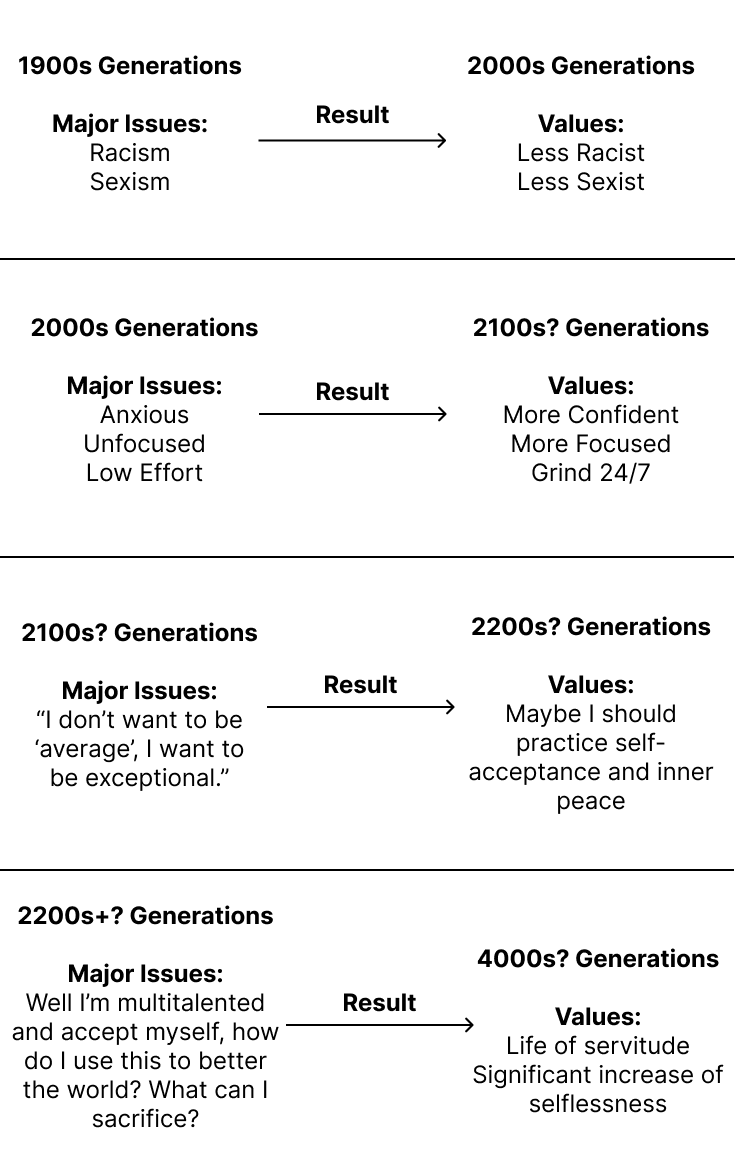
Asking “why are younger generations so anxious, sensitive, and don’t want to put in any effort?” is like asking “why are older generations so racist and sexist?” The older generations were more sexist and racist to show the younger generations to not be racist and sexist. The anxious younger generations today are showing the next generations to be more confident and value discipline and hard work with continuous growth and the bad sides of social media.
Just like how not every older person is racist. Not every young person puts in low effort. There’s already a huge boom of exceptionally talented disciplined young people in the creative community whether that be Blender, web dev, three.js, or art etc. You’ve probably seen a few of them and that will only continue to grow. These people are young adults in their early 20s and already outskill people who have worked 10+ years. These aren’t child prodigies. These are people that started at adult ages and learned really quickly through discipline and self-learning.
The “hard work/discipline” older generations are preaching about are different. Back then, you usually followed a pretty standard path: get a degree and work at a single job for a long time and you’d be fine financially to buy a house and have a family. There was no need to be innovative or stand out. The hard work and discipline the new generations have to learn is looking for hidden patterns between fields to innovate. Even anxiety sources in older generations were different because that anxiety was focused on physical characteristics whereas today the anxiety is focused on nuanced unconscious toxicity in themselves and others. Brainrot and a terrible job market currently at the time of writing this article, further facilitates this anxiety and need of self-awareness in younger generations as well.
Of course, when everyone becomes “exceptional” and interdisciplinary through hard work, no one feels exceptional anymore. The main struggle of that generation will likely be lack of self-acceptance and conditional love only based on how productive you are leading the newer generation to focus on self-acceptance which requires further self-awareness. Many high performers and highly successful people today are primarily driven by trauma and insecurity they formed as children rather than genuine curiosity. Once you accept yourself, you lose that source of motivation and it becomes difficult to want to do anything. Having to change your source of motivation is also a difficult process. Notice how, though, that no matter the generation’s major issues, the outcome results in our shared humanity values of wanting a better community and love? We humans can’t explain consciousness yet, but it seems like every generation is getting slightly closer to the answer.
When people become self-aware they thrive better, they feel more emotionally fulfilled, care less about money/status and more about purpose and having better relationships with others. They also value complexity and nuance and can read between the lines. It’ll be so much more difficult for people to be bad (consciously or unconsciously) because everyone will understand each others’ hidden agendas, trauma, and intentions that drive bad behaviors.
Most humans can read dog behavior intuitively and accurately. Some time in the future, we’ll all be able to read each other intuitively and accurately. We’ll all be healers, not just passive participants.
Even if the world is dark, we humans all know what is “right” deep down (i.e. we all want world peace and love), yet society is still not what we all want. Why is that? Well, it’s because we’re still very young. Human society isn’t inherently bad, we’re just emotionally underdeveloped and young so we do a lot of bad things. Why is it that despite all our religious, cultural, racial, and gender differences, have we decided on some universal principles/morals/ethics/values? It’s only a matter of time before what we know is “right” will become reality.
No, I’m not a delusional optimist. I just look at historical trends and make predictions based on those trends. You can choose to believe in negativity or you can choose to believe in positivity. That choice is yours.
3. The Ten Framework: Context Engineering for Humans
To be self-aware, we have to be aware of the emotional contexts (i.e. things that influence emotions, e.g., gender, age, religion, race, career, basic choices etc.) we grew up in and interact with. Nature and nurture plays a huge role in how we act, think, and feel and many of us don’t even realize it even though we intellectually understand it.
We talk about context engineering for AI, but we aren’t even fully aware of the multitude of different contexts we live in as humans. The closest thing we have to context engineering for humans is probably emotional intelligence training (e.g. therapy, journaling, thought logs, books) which aren’t perfect solutions. I dislike the term “emotional intelligence,” I’d much rather it be “emotional pattern matching” but that’s the coined term so I will be using it. The ten framework is another imperfect tool that helps frame context engineering for humans. It’s the idea that for every emotional context, there are 10 people who will always feel a positive, negative, or neutral way about that specific context. The value of “10” is chosen because it’s easy to conceptualize, it’s not for realistic purposes. Take a look at the examples below (reposted from a previous article). I could list out more examples for each context, but for simplicity purposes I’m keeping it shorter to one set of 10 for each context and omitting neutral reactions.
Look how the contexts interact with each other too. For example, older people create insecurities for the younger people and how the younger people create insecurities for the older people. If you ask a young insecure person their insecurity they’ll say “I’m afraid no one will take me seriously because I’m young.” Ask an old insecure person they’ll say “I’m afraid people will think I’m outdated because I’m old.” Or how the “you’re too quiet” criticism for introverts is from those who are more extroverted. Where do these come from though? Survival. If you think about it, extroverts need more stimulation because their brains are by default less stimulated compared to an introvert’s brain. At a very primal level, if an extrovert meets an introverted person, that introverted person is a threat to their survival because they won’t provide enough stimulation the extrovert needs. That extrovert who is not self-aware lashes out saying “Why are you so quiet? You should talk more.” Not realizing that comes from a place of survival. Of course, over time it becomes conditioned as a societal judgement too, but the reason it exists is rooted in survival. Of course, the opposite is also true, an introvert might get overstimulated by an extrovert causing them to say “Why do you talk so much? Can’t you be quiet?” I cover more about this topic in Section 5.
- If you’re old:
- Negative: 10 people will think you’re outdated.
- Positive: 10 people will admire your wisdom and experience.
- If you’re young:
- Negative: 10 people will think you’re naive and ignorant.
- Positive: 10 people will admire your enthusiasm and lack of cynicism.
- If you’re an introvert:
- Negative: 10 people will think you’re anti-social or have social anxiety.
- Positive: 10 people will think you’re a good listener and calming to be around.
- If you’re an extrovert:
- Negative: 10 people will think you’re too loud and attention seeking.
- Positive: 10 people will admire your confidence and ability to connect with others.
- If you’re a CEO of a large company:
- Negative: 10 people will think you manipulated a lot of people and played sinister games to get to the top.
- Positive: 10 people will admire your ambition and dedication to your work.
- If you have a super cute panda illustration as your profile picture:
- Negative: 10 people will think you lack professionalism and question your ability to engage in deep work.
- Positive: 10 people will enjoy that you never lost your inner child.
- If you like pineapple on pizza:
- Negative: 10 people will think you’re a psychopath destroying traditional pizza culture.
- Positive: 10 people will embrace your merging of cultures and open-mindedness to new combinations.
- If you like pop music:
- Negative: 10 people will find you basic and generic.
- Positive: 10 people will find you super relatable, connect with you, and ask you what your favorite pop song is.
- If you’re a developer:
- Negative: 10 people will think you’re super logical and lacking in emotional awareness.
- Positive: 10 people will admire your intelligence.
- If you’re a designer:
- Negative: 10 people will think you’re not too technically advanced and be condescending when it comes to technical explanations.
- Positive: 10 people will admire your creativity, expressiveness, and the desire to make things beautiful and meaningful.
- If you make a joke about stereotypes of races/cultures:
- Negative: 10 people will think you’re racist.
- Positive: 10 people will laugh and admire your awareness to poke fun at stereotype absurdities.
- If you’re a doctor:
- Negative: 10 people will think you will take advantage of them, prescribe medications they don’t need just to charge them and their insurance companies more.
- Positive 10 people will admire your dedication to helping others and think you’re really smart.
- If you’re being yourself:
- Negative: 10 people will think you have a hidden agenda and you’re being fake.
- Positive: 10 people will admire your way of living and feel inspired to embrace themselves like you do.
Now what happens if we mix and match different contexts? For each bullet point below, try listing out positive, neutral, and negative reactions to each bullet point like I did above. Also keep note of how you feel and the first thought that comes to your mind when you read them. Try talking with a friend about their thoughts too. If you struggle to do so or find some of your thoughts repeating for each bullet point, that’s completely normal. This isn’t an easy task.
- Old.
- Old Asian.
- Old Asian man.
- Old Asian man soldier.
- Old Asian man soldier who rob stores.
- Old Asian man soldier who used to rob stores.
- Old Asian man soldier who used to rob stores to provide for his sick dying parents.
- Old Asian man soldier who used to rob stores as a kid to provide for his sick dying parents.
- Old Asian man soldier who used to rob struggling ma and pop stores as a kid to provide for his sick dying parents.
- Old Asian man soldier recognized and honored as a national hero who used to rob struggling ma and pop stores as a kid to provide for his sick dying parents.
- Old Asian man soldier recognized and honored as a national hero who used to rob struggling ma and pop stores as a kid to provide for his sick dying parents but also killed many enemy children and parents during his battling days.
I could go on and label more contexts like what country he’s in, his motivations, intentions etc, but it would be too long. Regardless, there’s three things we can note from this exercise:
- If I change the order of the bullet points or the layering of each context in the sentence structure, your emotional reactions to each subsequent bullet point will likely be different compared to the current order (not for all, but for some).
- Every human has many emotional contexts that interact and intertwine with each other. Our own interconnected emotional contexts shape how we feel about other’s emotional contexts.
- There are emotional patterns that are elicited similarly even in different contexts. Like if I changed it to a woman instead of a man, the emotional reactions would change for some people, but a lot of it would remain the same.
The more you do these exercises the easier it becomes to synthesize contexts and their interactions with each other (e.g., see simplified list below, I could list out at least 100 more views for each context, but I won’t for brevity). It’ll start as a conscious process which might be taxing, but later it becomes second-nature to the point where you don’t really have to think about it much. This is not about overthinking or mindreading, it’s about pattern matching and problem solving predictable human behaviors/emotions.
- Broader Emotional Context: Man and woman on a date together:
- 10 men will be skeptical wondering if the woman is using him for a free meal
- 10 women will be aware of this perception and offer to split the bill
- 10 women will be using the man for a free meal
- 10 women will be sharing their location with their close friends
- 10 men will discover this and take personal offense and get angry/upset
- 10 men will call out the woman for having trust issues
- 10 men will calm down after hearing the explanation
- 10 men will calm down after a few months and talk to more of their dates about it
- 10 men will discover this and find it reasonable
- 10 men will never discover this
- 10 men will discover this and take personal offense and get angry/upset
- 10 women will wonder if man is just looking for a casual fling
- 10 men will wonder if woman is just looking for a casual fling
- 10 men will be skeptical wondering if the woman is using him for a free meal
- Broader Emotional Context: This article
- 10 people will think I’m arrogant
- 10 people will think this article is pseudo-science
- 10 people will get defensive
- 10 people will only engage in the surface-level meanings of my words without understanding the deeper context and attack me for it
- 10 people will the article insightful
- 10 people will find me calling my own article insightful as boasting and arrogant.
- 10 people will find me calling my own article insightful a statement of opinion rather than boasting.
- 10 people will find this article healing
- 10 people will leave good constructive feedback with healthy open communication
We have a strong tendency as humans to simplify things and live within our own contexts. Step outside of your body and look at others as well as your own contexts from a third-party perspective. You’ll probably discover a huge part of yourself behaving like an NPC. I still feel like parts of me is an NPC to this day and some of those things likely won’t ever change as long as I’m alive.
The most important thing when doing these exercises is not to pass judgement or view a specific context/feeling as invalid, it’s about whether or not that context/feeling actually exists or not, if it does, jot it down even if you completely disagree with it or it angers you. The mere fact that a specific feeling/thought exists makes it important to understand. For example (again shortened):
- Broader Emotional Context: If I say the word “dumb”
- 10 people will think about their “dumb ex”
- 10 people will think about a president like “Joe Biden” or “Donald Trump”
- 10 people will laugh and think about a dumb joke.
- 10 people will think I think they’re dumb.
- 10 people will think of an embarrassing moment when they felt dumb.
- 10 people will think of Dumbo and grin.
- 10 people will think about a time someone they like was being “dumb” aka flirty and playful
Just saying one word with no context can trigger a multitude of different emotional reactions in other people. The way they react reveals a lot about how a person views the world around them as well as themselves. It’s easy to know why these reactions exist as you develop self-awareness because your entire life that same word “dumb” has triggered you in a multitude of contexts as well. For example, at one point you probably laughed at a dumb joke and at another point you probably thought someone you didn’t like was dumb. The whole point is if the context/reaction/feeling exists, there is a pattern to be identified and understood that you might be able to use later. Don’t dismiss them as nonsense. Your perception of reality is different from reality and different from how others perceive that same reality.
We’re all intuitively aware of these things and even comedians joke about them all the time. The problem becomes when we disregard and/or overlook contexts in moments when we’re blinded by our own. The Ten Framework is a tool to be more cognizant of our subconscious behaviors and patterns and change them. Again, we’re “going deep to realize it’s not that deep.” Once you internalize these contexts it just becomes a part of your subconscious behavior.
When you understand and react to the context others live in and feel, you also are able to control your own emotions better and respond in ways that make others feel safe. This isn’t about being a people-pleaser or losing your authenticity, it’s about creating better relationships which helps ourselves too. Of course, to change what you internalize and the context you live/think in takes self-awareness, which is described in the next section.
4. Psychological Safety Starts with Self-Awareness
In order to make others feel safe around you, you have to be self-aware of your own actions, intentions, and behaviors. Unfortunately, this isn’t as easy as it sounds. For example, if you ask an abuser or a non-abuser if they have good intentions they’ll both say “yes.” In fact, ask anyone that question and you’ll probably hear “yes” from most people when asked about their actions. We very rarely like to see ourselves as the problem and subconsciously use denial and rationalization to make us believe the lies we tell ourselves. In fact, your body can even hide dormant emotions that control you without you even realizing it. If we realize that we are the problem, it’s often after some time has passed. Luckily, you can speed up that process with emotional development exercises.
4.1 An Easy Exercise to Gauge How Self-Aware Oneself Is
Have you ever met someone, coworker, romantic partner, friend etc. who seemed very caring, kind, open for months if not years and then in a few hours completely change, blame you, pick arguments, and turn cold? I don’t mean angry for a little bit or someone who’s built up frustration and then outbursts. I mean someone who completely changes their behavior and it remains consistently like that for a while. Like a completely different personality. This happens a lot more often than you’d think and while there are a multitude of reasons for this (e.g., ego threat, avoidant attachment, etc.), it just shows how pain can change people instantly. The more pain we are in, the more selfish we become because we are programmed for survival.
If you take 100 normal people with 0 pain (physical or mental) and tell them “be kind always,” it’s safe to assume most if not all 100 people would agree with that statement. Turn pain levels to 50/100, maybe only 30/100 people remain kind. Turn pain levels up to 70/100, maybe only 10/100 people remain kind. Those who remain kind despite their pain are likely more emotionally developed than those who break early.
In other words, an easy way to gauge how self-aware you are is to reflect on a scenario in which you felt some amount of pain and reflect on what you did and felt versus what you wanted to feel and do.
For example, I firmly believe in the phrase “be kind always.” But who we think we are is not who we actually are. When I first started driving, if someone in front of me was driving below the speed limit, I would be angry and frustrated. That slowly developed into just mild annoyance and “whatever I’ll just distract myself from music” to now pure curiosity “oh, they’re probably just new or lost; I wonder what they’re looking for, I wish I could call them to help them if they need help.” See Section 4.3 for more details.
Now add pain into the mix like needing to use the restroom, my curiosity vanished and I started feeling anger and frustration again. It wasn’t until just earlier this year where the first time in my life where I needed to use the restroom really badly and there was a slow driver in front of me and I didn’t feel any anger towards the driver in front of me. Unironically, as I was looking for places that could have bathrooms, I too was driving below the speed limit to make sure I didn’t miss a turn.
I like to see myself as a person who is always kind, but clearly I’m not always kind as shown in my self-reflection above. I had to develop my kindness over time. The more you engage in this self-reflection, the easier it becomes to internalize and practice what you preach.
4.2 The Self-Awareness Normal Distribution Graph
As mentioned earlier, there is an overall increase of our self-awareness over time. We can map trends like growing self-awareness with shifting normal distribution bell-curves. For example, in the 1800s you only needed to know algebra and you could be a candidate for an elite school like MIT. Today, you learn algebra in elementary school. Self-awareness is exactly like this. The most self-aware people today aren’t really that self-aware (yes, including myself).
The people we consider “experts” today are only “experts” because we haven’t discovered what we know we still need to discover. For example, if you’re a master at calculus but know nothing about psychology, there is no possible way you’d be the best calculus master you could be and vice versa. The theoretical maximum human potential is a single human who knows every last ounce of human knowledge and can pattern match between them and develop novel insights. For the record, AI’s training data is nowhere near that either. There’s a reason the most famous scientists in the worlds like Stephen Hawking and Albert Einstein never think they’re smart; they know what they don’t know.
If you think about where we are, we’re just starting to value “T-shaped” experts, which is only one step up from the traditional majority of “I-shaped” experts. The final goal according to this knowledge model is “comb-shaped,” but it goes beyond that when everything intertwines with each other and we develop better learning patterns to learn more things in the same amount of time.
Take a look at Image 4.2.1., let’s assume 1000 is the maximum amount of self-awareness or skill we can have within our human capabilities. These two things are increasing over time and are nowhere near the maximum. There are also a lot of downward trends as well like Image 4.2.2 shows. The least racist people of the 1800s are still considered racist by today’s standard. A good example is Abraham Lincoln from the United States who fought against slavery, but is still considered a racist by today’s standards. These images are NOT intended to be accurate or comprehensive, it’s just to illustrate trends happening in our society and to contextualize our emotional context.


People who exclusively contextualize their emotions and thoughts within the time range in which they are alive are highly reactive to current mini-trends and stressors. We can think in bigger pictures and larger trends to manage our emotions better and develop self-awareness (see Section 4.3). Each generation and time period has its own set of problems we humans have to adapt to. Like just 70 years ago racism and civil rights were the hot topic in the United States instead of AI stealing jobs.
Top thinkers like Andrej Karpathy (the one who coined the term “vibe coding”) always think in bigger pictures and trends. In an interview, he mentioned multiple trends like how people will increase in self-awareness over time or how AI really isn’t as big as people are making it out to be when compared to the GDP curve overtime and how it’s like the iPhone; a huge culture shift, but still no overall visual effect on the GDP curve.
The bigger you think and the more frequently you think bigger, the more humble you become because you realize how much you don’t know. Naturally, you’ll develop curiosity to discover the undiscovered parts of yourself and the world around you. For example, “If I am angry, why am I angry? Is there some thought pattern I can engage in to reduce my anger?” It’s not about invalidating the way you feel or justifying others’ bad behaviors. It’s about emotionally controlling yourself to protect yourself from yourself.
It’s deeplying humbling, but also exhilarating and amazing that in maybe 2000 years from now, the average child is likely to be more self-aware and skillful than I am at my maximum peak level of self-awareness and skill I can achieve before I die.
4.3 Emotional Mapping, Recontextualizing your mind, & Thinking in Bigger Pictures
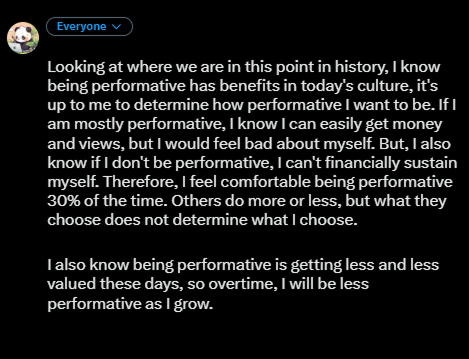
Let’s take a look at the trend today of being more “authentic” online and see how thinking small shows up versus thinking bigger. Image 4.3.1 shows some popular viewpoints associated with this debate (pretend they’re different people).

Thinking smaller isn’t necessarily wrong or bad, and as a human it’s unavoidable. In fact, it’s necessary to have these conflicts and debates on a smaller scale because that’s what drives the larger scale cultural shifts. It doesn’t matter if you’re person 1 who’s annoyed, person 3 who’s more pragmatic and apathetic, person 2 who is very angry, or person 4 who is using performative enthusiasm as a marketing strategy. These views all are the result of the specific time period in which we are alive and quite honestly one person could be all 4 people at different points in their life or concurrently but in different contexts.
But take a brief pausing moment, step back and look at the larger context in which these four posters are living in (see Image 4.2.2.) they all are living in a society where being performative still has a ton of value/merit not just in terms of money, publicity, status, but also about fitting in. If you’re relentlessly authentic and truthful, you probably won’t fit into society. Although what constitutes as “performance” is subjective in a sense. Like pretending to like someone for the sake of harmony might be objectively “performative” but it’s also just about having good social skills and giving the benefit of the doubt that maybe you’re the one that’s in the wrong.
Anyway, when you understand the larger context, it’s way easier to see where you fit in as part of the societal dynamic and calm your emotions down (see Image 4.3.2). This is known as emotional mapping, the idea that when you consider all the possible common reactions for a given context, you can identify a growth path to navigate that emotional context.
Let’s apply emotional mapping back again to the driving example I mentioned in Section 4.1. Image 4.3.3 Shows my actual emotional graph of how my maturity developed over time. You can see even today, I still feel some amount of mild frustration about 30% of the time, but it fluctuates in the moment. Compare my graph to the graph in Image 4.3.4 with three sample people. These are also very valid emotional graphs as well. Person B is way more unlikely than Person C or Person A, but it could very well be that Person B has been that way since they started driving and will continue to be that way their entire life. Will I ever be as zen as Person B? Knowing myself and given I have 40 years left to live, I doubt I’ll ever be as chill as Person B, but at the very least I know where I need to go and I will work on it every time.


Take any emotional context you can think of and draw the graph of your emotional development over time. Use the logical side of your brain to help label the graphs unknowns and be honest about how you emotionally feel. Your labels will change depending on the context and they don’t have to be the same as the ones I did. For example, Image 4.3.5 is another graph about a my trauma response to opening doors and how that has been shaped over time. The short context is I grew up in a abusive household, and one thing my abuser often did was open my room door suddenly with no warning which would often lead into verbal abuse.

I don’t show this graph to seek pity, just to show that I’ve been self-aware of this for about 8 years now and it still affects me to this day and have to actively remind myself that a person opening a door is not upset or coming to get me. When I was in college I’d actively avoid small rooms I wanted to use justifying it with “oh someone else can use them, I’m being kind” when deep down my brain thought that someone might accidentally open the door when I’m in the room and I would get scared they would be angry at me.
This is the scariest part of self-awareness and why so many people turn to suppressive coping mechanisms like drugs, smoking, alcohol, or long sessions of video games/work etc. Imagine instead of being triggered every time a door opens, you numb that out and feel absolutely nothing or you just project that anger outwards and get upset at the door opener who did nothing wrong. That sounds easier. The bad part of that, is that trauma lives like a ghost in your brain that haunts and controls you without you ever realizing it. Better to live in familiar and manageable pain versus the uncertainty of confronting the bad parts of yourself, right? That’s a decision everyone has to make at a certain point.
It’ll probably take me over 15 years before I feel absolutely nothing in regards to this door opening trigger. 15 years of emotional processing to heal this trigger. I know where the emotion comes from, why it happens, which parts of my brain are firing, and yet I can’t change it without the help of time. I’m self-aware enough to help myself, but not self-aware enough to speed up the process.
There’s a reason therapy doesn’t work for a lot of people; this stuff isn’t easy and we don’t have fully developed emotional tools for everyone yet. And of course, not every therapist fully understands their patients; it’s hard to do so if you only intellectually understand something but never experienced it. It doesn’t mean therapy is useless for everyone, just that it’s complicated and a work in progress.
Anyway, of course, these graphs are highly simplified representations of complex emotional contexts/processes, but they provide guidance on how to emotionally develop oneself. If it’s difficult to map out your emotional graphs, I would consider reaching out for external help like a loved one who will be honest with you or a therapist (yes, I know what I said in the previous paragraph, but worth a try).
Just like physical exercise, emotional development exercises are a choice. Everyone has a growth path, but not everyone sees it or chooses to act on it. The benefit of developing oneself emotionally is to heal chronic anxieties, stressors that hum in the background that we aren’t self-aware of and ultimately internalize which drives bad behaviors.
4.4 A note on defensive mechanisms: e.g., intellectualizing emotions, avoidance, projection, denial, and rationalization
I’ll be covering defensive mechanisms concepts in more detail in the next article, but I felt like they’re necessary to address in this article.
You might be wondering a few things like:
- How can we tell if we’re in denial if many times it is automatic and subconscious?
- I know people project their insecurities, but how do I know I’m not projecting my own insecurities thinking they’re the ones’ projecting when it’s actually me?
- How do I actually know where someone is on their emotional growth journey or at least “should be” instead of a reflection of my own biases?
- If I’m in a scenario and all I do is look for solutions or explanations (i.e. intellectualizing emotions) avoiding my emotions rather than processing and feeling them how can I tell?
- If I feel fine now, am I doing it right? Am I feeling the correct thing or am I rationalizing my own behavior subconsciously?
- I have constant anxiety, is that because of failed emotional processing or just because of my hormones?
- I know road rage is bad. I know doing it doesn’t solve any problems and sometimes makes things worse. I know road rage is based on my fear of getting into a potential accident and potentially getting hurt and I project that anger outward because it feels justified. Despite knowing this, I still want to road rage and do.
- How do I know I’m developing self-awareness versus perceiving myself as developing self-awareness? I do feel better because the perception of myself makes me feel better, but it’s still not true/accurate self-awareness is that correct?
- What if I go down an nonoptimal healing path and heal a little bit but start plateauing because I chose the nonoptimal path and I am not aware of it?
I think these are great questions to have, and the existing solutions to each of these are not perfect and vary a lot depending on the person. Many of them are also easier to solve with external factors such as other people treating you nicely or feeling safe around you rather than processing on your own.
To be honest, I don’t know how to answer several of these questions myself. If I had to give a broad answer: as you develop emotional pattern matching and self-awareness skills, you’ll naturally develop an emotional baseline that feels calmer, so when your emotions shift, you’ll immediately know the thousands of other times you felt this emotion, all the reasons you felt this same emotion before, as well as thousands of other reasons other people would feel this emotion all subconsciously in a flash. In other words, every time you process an emotion, forced or unforced, conscious or unconscious, you’re essentially creating a vaccine for bad emotions and catalysts for good emotions. If you don’t notice this happening over time then something might be wrong and you can reconsider your approach.
Self-awareness isn’t about ruminating, overthinking, and living in your head versus being in the present. It’s about treating bad ones and strengthening good ones for your present self to feel. It’s a healthy balance between all your brain processes whether that be sitting with and feeling the emotion fully or being analytical/intellectual about it.
5. Combating Cynicism with Understanding
I want to briefly touch on cynicism as we all probably have some.
Cynicism is the idea that people are motivated by self-interest and are dishonest, even to the point of disliking themselves simply for being a human (basically misanthropy at that point). While it’s almost impossible not to be somewhat cynical. It’s better to understand others than engage in cynicism. Cynicism is usually just avoidance based on past experiences, not true knowledge. It’s like avoiding every insect because an insect hurt you before rather than being an insect expert who knows which insects are potentially dangerous or not. Cynics are also often people-pleasers because if you assume everyone is bad, then you work to please others so they aren’t bad to you. In other words, cynics are often just disappointed idealists.
It took me over 5 years of consistent friendship before I even believed a single friend of mine actually liked me due to my cynicism. My bad behaviors included never reaching out, never celebrating anyone’s achievements, not joining group activities because I was too scared of being judged and when pressured I would get frustrated and think no one understands me or other things like “No one really wants me there anyway, I’m doing them a favor to not impact them with my negativity and awkwardness,” or “I’m still nice to them, I help them a lot if they need help.” I did everything possible to gaslight, rationalize, and deny what I really felt deep down; that I had a problem. I knew that cognitively and logically at the time that I wasn’t “normal,” but often distracted myself with video games or work.
5.1 Realizing bad behaviors are related to survival mechanisms
The best way, at least for me, to combat cynicism and make emotional processing feel better is by understanding the survival mechanisms behind it.
We like to think we’re special as humans and the superior animal species, but we’re not that developed yet. For example, where did racism come from? Well humans of different races were spread across the world, when they meet a person of a different race for the first time, their first instinct is fear. Fear causes us to do bad things out of survival, and thus racism is born. It’s only after did we start becoming more diverse did we unlearn racism culturally. It’s why today if you’re born in a diverse society, you’ll probably not have racist thoughts, the same way these toddlers don’t. We aren’t born racist. We’re born with survival skills that can either develop into racism or not. Imagine if all different races of humans were mixed since the beginning of humanity. We wouldn’t have the centuries of racist culture that we do.
Sexism, racism, fear of AI, all of these are protective mechanisms that developed into societal conditioning. They can be trauma induced too. Woman hurts man? Brain creates a bias against all women to protect itself from being hurt by another woman despite logically knowing each woman is different. What makes it even worse is that man will likely seek similar kinds of women over and over again and get hurt in the same exact way further solidifying his biases and his likeliness to preach bad things about women. That behavior itself could be a trauma response itself: seeking dysfunctional love if he wasn’t loved properly as a child as mentioned in Section 2.
The wrong assumptions cynics have are: 1) people can’t change, 2) people have bad sides. There are two common phrases that paint the nuance more clearly to counter those assumptions: “Be the change you wish to see in the world” and “hurt people hurt people.” In other words, bad behaviors that hurt other people are driven by our needs of survival and almost never personal. As mentioned in Section 2, growth is about unlearning our survival tendencies.
Let’s take a look at some behaviors that are typically seen as “bad” below. Remember, almost every one doing these bad behaviors believe they have good intentions. Their emotional and nervous systems firmly believe they have good intentions, otherwise they wouldn’t be doing it. Even if they realize it might be bad, it’s quickly suppressed. This is NOT about justifying bad behavior, it’s about understanding it. Describing behavior is NOT endorsing behavior. This does not absolve accountability or potential consequences. Pay attention to the common solutions and see if you can identify a pattern.
1. Anxiously attached people in relationships (platonic or romantic) – Some common behaviors include: frequently texting partners/friends, asking for constant updates, being upset or angry when they don’t get a response from their partner/friend within a few minutes, etc.
- Common hurt/pain that causes this: inconsistent caregiving (sometimes nice, sometimes cold) or controlling helicopter parents
- Survival mechanism/perceived threat: Fear of abandonment (if someone replies it means they are still there and didn’t abandon you)
- Harm they cause others: others feel like they are swarmed, loss of autonomy, constantly giving reassurance, emotionally exhausted.
- Their “good” intention(s), how they rationalize their behavior and how their nervous system reacts: “I am just checking in on my partner/friend because I care about them so much.”
- Common solutions: 1) therapy, 2) consistent kindness from secure friends/partners who slightly challenge their partner’s/friend’s anxious behaviors (e.g., always responding after 3 hours no matter what), and/or 3) many failed relationships where they hit rock bottom and force self-reflection and growth.
2. Racist people – Some common behaviors include: racist comments, feeling angry and disgusted when interacting with others of different races
- Common hurt/pain that causes this: Person of a specific other race hurt said racist person or racist person indulged in parental and societal conditioning of stereotypes and formed strong internalized biases
- Survival mechanism/perceived threat: If someone looks different from you, they are probably bad. Attack now by being angry towards them to scare them before they attack you.
- Harm they cause others: unfair treatment, general negative vibes, sometimes violence in extreme cases.
- Their “good” intention(s), how they rationalize their behavior and how their nervous system reacts: “I am just protecting my kind of people.”
- Common solutions: 1) continuous good interactions with people of said race they are racist towards and/or 2) so much pain from being demonized as a racist they hit rock bottom and force self-reflection and growth.
3. People who never credit others – Some common behaviors hiding credits or only showing credits when asked, humble-bragging, or consistently weaponizing the benefit of the doubt saying “oh that’s a coincidence”
- Common hurt/pain that causes this: Care giver rarely celebrated child’s accomplishments leading to low self-esteem and sense of self
- Survival mechanism/perceived threat: Builds a sense of status. When you have status, you get more attention. When you get more attention you likely get more resources too for survival.
- Harm they cause others: general distrust in industry, negative vibes, conflict if original creators discover it, people feel used
- Their “good” intention(s), how they rationalize their behavior and how their nervous system reacts: “I’m just trying to show people that I have skills.”
- Common solutions: 1) consistent interactions with others who genuinely appreciate them, 2) people they admire and watching them credit others consistently, and/or 3) they get exposed and their reputation gets annihilated and they are forced into self-reflection and growth.
What do all the solutions have in common? Consistent kindness over long periods of time and/or some severe amount of pain. If bad behavior is rooted in a survival mechanism, it’s not surprising that solutions to bad behaviors all follow the same pattern. It’s also not surprising that a lot of people peak emotionally or never end up changing because it’s rare to experience severe enough pain and/or consistent kindness for growth.
Most importantly, I hope it’s clear that once you see bad behaviors for what they really are, it’s hard to be cynical and categorize people as inherently bad. Is that racist person who takes care of their family by working a tough job for 12 hours a day a bad person because they’re racist or is it someone who’s made an inaccurate assumption that other people of different races will steal their job? Is that anxiously attached person who volunteers at the dog shelter a bad person because they spam text their partner or is it someone who’s afraid of being abandoned deep down because they were never loved properly by their parents? Is that person who never credits anyone a bad person or is it someone who was never appreciated growing up?
How you perceive the world shapes your emotions. It’s not about justifying the behaviors. When people hurt you, it’s easier to not be emotionally impacted once you understand the survival mechanism behind the behavior.
5.2 Cynicism is about survival too
A lot of times people are self-aware of their issues, but there’s just no incentive to change, e.g., “Yeah I probably should change [insert issue here], but that’s just how I am lol.” That sentence in itself is a survival mechanism (i.e., less work = less consumption of resources = better chances of survival). As mentioned in Section 4, not everyone chooses to grow emotionally. It’s just a representation of where they are along their growth journey. You know what else is a survival mechanism? Cynicism. Avoid everyone, don’t let anyone get close, assume the worst in others so you’ll never be disappointed.
Where are biases from? Biases = less cognitive load = less resource consumption = better survival. Where are insecurities from? Why do we feel insecure? Because we’re afraid of not fitting in = not fitting in = worse chances of survival. Why do we fall in love? Love = reproduction = survival of human species.
This section is not about subjecting yourself into a “healing” role to change others. It’s not about trying to be a saviour and trying to “fix” people. Of course you can try, as long as you’re safe, but It’s mainly about knowing how to navigate a world without being cynical and how to process and manage your nervous system rather than have emotional and physical reactions to other’s behaviors. In other words, don’t be cynical and view everyone as just having the capability of doing bad things. That’s obvious. Instead, find the core survival mechanisms and hurt they’ve gone through that leads them to engage in these behaviors and use that understanding to protect yourself rather than assumptions.
Over time when you see the same types of hurt people over and over, their behaviors (good and bad) become predictable. That starts with understanding their pain, not fear of their “badness.” When you pay attention to the fears and survival mechanisms that drive other’s behaviors, you also end up discovering your own survival mechanisms and how that drives your behaviors.
6. The Ups and Downs of AI Culture
As with all technology, there are good and bad parts. Let’s take a look at some of them now.
6.1. Our usage of AI reflects what we value and makes us self-reflect
6.1.1. Examples of AI induced self-awareness
Have you ever used AI for something and then presented it as your own work/doing? I know I have, several times, and then I used to try and make sense of it so I can explain it if anyone ever calls me out on it instead of admitting it was AI. As I’ve grown more mature this year, I realize I just end up feeling guilty rather than proud so I’ve recently stopped trying to hide the fact I used AI. It’s very similar to how people say that someone who can say “I don’t know” is often more trustworthy than a person who never does. Reflecting and asking yourself how AI has changed your behavior or what you’ve used it for is good information for understanding oneself better, for example:
- How many times have I used AI to validate my emotions this year? Way too many times apparently. Am I addicted?
- Why am I afraid of asking it to play devil’s advocate and disagree with me and take another perspective? I should hear the other side, but it feels too good to be validated so I won’t ask, or only ask for a counter viewpoint a few times.
- Dang, AI gave me so many solutions I never considered before, I feel like I am much faster at working now.
- OMG I JUST ONE SHOTTED THIS.
- Wow, I just realized I don’t trust AI to play the best chess moves for me, but I do trust it to analyze conversations for hidden meanings.
- Ew, never touching AI ever, huge cybersecurity risk. Data stealers, gross.
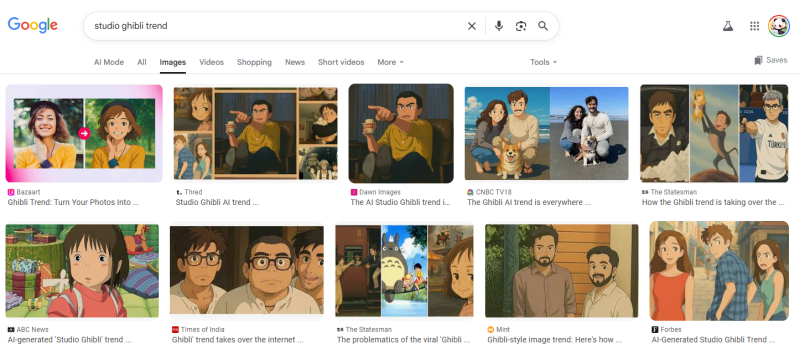
The Studio Ghibli image trend is another great example of increased self-awareness induced by AI. There are several types of people listed below. Don’t let these kinds of AI induced behaviors/emotional contexts bypass your brain. They reveal a lot about ourselves and how we operate in the world. Here I used the word “some” instead of “10” but this is the ten framework in action.
- Some were deeply upset that people were using AI to generate art in his style, something the artist cultivated for years. It felt like a complete devaluation/invalidation of talent, effort, his opposition to AI and his life’s work.
- Some thought it was a harmless trend, but when they discovered the original author didn’t like AI they stopped doing it.
- Some thought it was a harmless trend, but when they discovered the original author didn’t like AI they continued doing it anyway.
- Some thought it was a harmless trend, never understood the drama, and never thought about it after they moved on.
- Some didn’t know it was a trend, but saw it a few times and just decided to try it themselves a few times then move on.
- Some never knew the trend even existed.
6.1.2. AI and how it changes what is meaningful to us
You’ve probably seen a lot of top artists/creatives dislike fully created AI content as say it’s about the craft/process rather than the result. There’s a real psychological reason to that: the creative process is a very emotional process. For example, you might feel frustrated at times, pausing to take breaks from exhaustion, celebrating the mini wins, or having bursts of motivation, enthusiasm, and inspiration.
When AI creates instant art, it bypasses that entire emotional process which invalidates peoples’ emotions. No one likes feeling invalidated in any context and that is exactly why AI art/content feels soulless. It’s so interesting how we can admire a piece of work but as soon as we learn it was done entirely by AI we lose our admiration and other feelings for it.
The good news is, AI still struggles a lot with developing novel insights and contextual awareness. In the words of Dr. Fei Fei Li, an AI can’t look at the movement of stuff in the universe and come up with a generic formula of gravity like Issac Newton did in his 20s. That level of creativity is not possible at the moment. What that does mean though, is that we’re naturally going to be more insightful and look for new creative possibilities that AI can’t replace easily.
6.2. Navigating the AI Emotional Landscape
It’s kind of hard to navigate a technology such as AI, on one hand you have top experts saying grave warnings about AI being out of control whereas others say AI isn’t even close to being that good yet and their colleagues are just catastrophizing. However, there’s one definite answer that all the experts agree upon, when directly asked about the future, “I don’t know.” They don’t really know what’s going to happen with AI, the same way when nuclear weapons came out, no one really knew what would happen to the world back then either. It makes sense then, some academics will think of the worst things AI can do while others don’t.
How can you not be certain about the future but feel a certain way so strongly? Well, these extremist views are emotional reactions, not logical ones. You can know something to be 100% certain to be true factually, but not feel that way emotionally. Obviously everyone knows that, but we think someone with credentials and knowledge wouldn’t be emotional about it, but emotional management is a skill itself.
Like imagine a family member on the road trip listing all the things that could go wrong and arguing to everyone why they should prepare 4 spare tires or ten cans of sunscreen. They likely know extreme scenarios in which those preparations are needed are unlikely to happen, yet they persist and worry anyway. Quite honestly, there are probably times where something they pushed for actually does get used, and that confirms that they were right to worry and be pushy. If they didn’t engage in extreme emotional reactions, they might’ve never been able to convince others to bargain with them. These AI experts are just like that. They are not reacting to the logic, but the small chance that, yes, AI indeed could turn against humans or someone could use it to create a deadly bio weapon.
The upside to extremism is that it forces people who are slightly neutral to consider it and it gets on peoples’ radars. We still value simplicity, and extremism is a very simple way to communicate something. Once our society develops and accepts more nuance as a standard, extremist viewpoints are going to slowly fade out. Today, extremism is still a wide culture phenomenon in a multitude of areas because it does spark debate/change and is arguably necessary.
As discussed earlier, it’s highly unlikely humans won’t do the right thing to save ourselves when the time calls for it. We’re already experiencing a lot of AI pushback and AI fatigue. With that knowledge, I hope it is easier to step back and take a look at the larger context of AI discussions just like we did in Section 4.3 with authenticity. Don’t look at only the realistic viewpoints or only the extremist viewpoints. Look at both of them, look at the emotional patterns, and see how that type of behavior applies to a multitude of different situations beyond just AI.
6.2.1 Education and Career in the AI Era
Even before the first ChatGPT that blew up, multiple people, including those that went to top tier universities said that a college degree is almost worthless in getting a degree. Quincy Larson, founder of freeCodeCamp said in an interview that when he started freeCodeCamp 10 years ago he thought colleges just packaged public domain information into courses and sold it. In other words, if you know what to look for, you can teach yourself pretty easily.
AI enables people to engage in self-directed learning easier (provided users know how to prompt it, validate it, and have self-control), democratizes complex knowledge, and encourages people to explore solution spaces they may not have otherwise considered. This further reduces the value of a college education when getting a job. Employers see less and less value in college degrees.
In a sense, AI will force education systems to adapt and actually be helpful.
6.2.2 Other notable trends
Like all things, AI is just part of the world’s plan of accepting nuance as a standard. Here are just some other trends we’re seeing:
- AI accelerates loneliness by people using them for romantic partners or therapists. Over time this will naturally cause those to seek genuine human connections as there are still severe cognitive limitations with AI. For those who can use AI effectively, using AI to explore different emotional contexts might actually be beneficial for emotional processing.
- AI slop exists to distract us and cause instant gratification. Over time this turns us into skeptics of online content and look for more complex details and patterns training our pattern recognition skills and appreciation of nuance thinking. Of course, misguided skepticism leads to false positives like accusing people of using AI when they weren’t, but that’s part of the societal learning process too.
- AI vibe coding does create a lot of technical debt and bad software everywhere, but over time this instills core values: 1) You don’t have to create something perfectly in order to be useful, 2) You don’t have to have it all figured out and perfect on the start and you can always learn on the way. 3) We still need to sit down and understand the complexity of things at the end of the day.
7. Love is already winning, right here in the creative web community
If you ever need any more proof that love is already winning, just look right here in our own niche creative web community:
- Bruno Simon recently released his portfolio code freely open source.
- three.js is free open and source and people make money using it yet never donate to the contributors.
- The team behind Codrops could be multimillionaires if they sold their code snippets and gatekeeped premium articles, but remains free for everyone.
- Blender is free and open source and people make money using it yet never donate to the contributors. By the way the founder said money was never the intention and he didn’t want to charge for it, he just had to rely on asking for donations to keep it sustainable.
- freeCodeCamp, the largest coding resource in the entire world is free and open source.
If you’re cynical it’s probably easy to say things like, “Oh they just want to show off and get a good reputation and develop their personal branding as someone generous.” or “They have other paid stuff they’re selling and it’s just to hook people in.” Again, look at the emotional context, intentions and motivations are rarely one-dimensional. Maybe 1-5% of their motivations are represented in that cynical interpretation but nowhere near 100%. Sometimes it’s just called being a selfless human like picking up some trash on the floor that no one will ever see or leaving a waiter a big tip that you’ll never see again.
It doesn’t mean if you charge for stuff you’re a bad person and trust me when I say, a ton of people who charge for things feel extremely guilty and hypocritical. They don’t want to do it, they have to do it to survive because we live in a society where you can’t be purely altruistic. Not at the moment anyway. Money is a problem, so we might eventually figure out a way to get rid of it, but that won’t happen for a really long time.
If we map human potential over time (Image 7.1), it’s clear to see where we are and why we have the value systems that we do. There’s so much benefit to scarcity-based thinking, keeping a “secret sauce” for competitive advantages. Marketing isn’t rocket science when you understand why people feel the way they do. Similarly, if you’re unethical and understand how people work, it’s incredibly easy to get rich and powerful.
However, the more emotionally aware you are, the less likely you’ll use that knowledge to inflict more pain and manipulation on the world. Just think about all the emotionally aware people that exist in this world that are actively choosing not to use their knowledge of human behavior to become rich/powerful. There are way more that hold back than weaponize that knowledge. They could alleviate all their stress and financial pressure just by doing something unethical yet choose to sacrifice themselves and suffer in silence. It’s the same way why we choose not to lie on a resume even when we really really want a job. We could lie in a way that gets us more interviews and most likely never be figured out, but most of us choose not to anyway.

If you spend all your time working for yourself and on your own endeavors, you’ll likely be more rich, more famous, and more “accomplished” than someone who focuses on a life of servitude and understanding. If you think about it, if humans started out with humanity values and a life of servitude as the primary focus, we probably wouldn’t be as far along in technological advancements as we are today that are driven by greed, control, scarcity, and power. But now that our current value system is causing more harm than good we’re beginning to see the value in the other value system.
We’ve had this “life of servitude” value preached in religions for thousands of years but despite that we still had constant wars, racism, sexism etc. Clearly religion wasn’t a solution to those problems, and I don’t see it becoming a solution for a lot of people’s nihilism any time soon. Obviously we’re not unaware of it, we just don’t care about it that much. Try living a life of servitude today that isn’t something mainstream (e.g. being a monk), you probably won’t survive and people are going to judge you harshly thinking you’re “financially illiterate and not living in the real world” or someone who has a “savior and moral superiority complex.”
Eventually you have to understand how people work, otherwise you can’t be innovative and less and less people will respect you. There will be no magician that needs to hide their secrets, it’ll be a magician that has so much fun learning new things that they can freely share everything because they’re already having fun learning or developing something new. The “secret sauce” is literally the magician themselves. This concept of a “secret sauce” is so weird, because it’s something I never even considered until I heard about it when I got my first job. Unless my brain is considered a secret sauce I literally have no secret sauce. There’s millions of people out there that can do what I can do, they just choose a different path doing different things is all.
Anyway, the point is, love is already winning. If AI takes over eventually and decides to end the world, well, we’re forced into a life of serving others in order to survive the AI takeover. If AI ends in a utopia where we don’t have to work and we can just focus on the relationships that really matter to us, well, that by definition is also a life of serving others too.
Final Words
Again, everything in this article is simplified to be easily digestible, there’s no possible way I can cover complex topics in a single article. At the very least, I hope you found some parts helpful and realize life isn’t really that deep after you go deep. I’m not here to tell you how to live your life; that’s up to you. This article is about how you can reframe your life to feel empowered in the way you want to live in the world and feel confident and fulfilled with that decision.
Whether you want to live your life 80% manipulative or 20% manipulative, or 90% selfish or 10% selfish go do that. Just be yourself. We’re all part of the problem and solution all at the same time. All the good and all the bad things happening in this world are lessons guiding humanity to a better future. Bad things are just showing the rest of the world what not to do, and if you’re good, you’re modeling good behavior inspiring others to do the same. All of these take time to progress. Once we become aware of the bad parts of ourselves and the pain we cause others is how we can begin to heal ourselves and the world around us. This isn’t about self-loathing or self-hatred. It’s just about self-awareness and curiosity. Unconscious/conscious pain still exists even in the healthiest of people. Once you understand how much pain is in other people, it’s impossible to want to contribute to it.
In many ways the world is broken, cruel, sick, and dark. But that doesn’t mean it can’t be beautiful too. Don’t look at all the negativity. Look at the long-term trends, look at where we’re heading. All trends point to love. Yes there might be world war three in-between and other terrible crises, but those are all long-term lessons. We’re in the process of closing the gap between who we say we are and who we actually are. Anyone can say the right thing, not every one is what they say they are. And we’re becoming more and more capable of telling the difference accurately.
Of course, we’re not in a society yet where people feel psychologically safe, but protect yourself by finding the patterns in our behaviors. We’re humans, which means we’re animals and we’re all a work in progress. It’s haunting to think about, but it’s also relieving to know that the humans of the future will be more self-aware than the humans of today (yes, again, including myself; my level of self-awareness is nowhere near close to the maximum human potential).
I have hurt people in the past, and I will hurt people in the future whether I am aware of it or not regardless of fault or intention. I’m not asking you to trust me. I’m asking you to look for the undiscovered patterns of life and make an impact on the world.
You are given a lifespan, and within your lifespan, you are born into a society with certain problems you have to adapt to. Don’t avoid them, just learn about it. You’ve got one life, might as well be curious what comes next. And if you’re at rock bottom, at least the only way is up. I wanted to kill myself for over 8 years before I realized that I’m just an NPC that doesn’t understand the world nor even myself. And now that same NPC in me is writing articles on Codrops. If we’re all a little bit NPC, we might as well use our lives as a social experiment. That way we all know how not to be an NPC anymore.
Knowing you’re born in a certain time period you have no control over doesn’t mean your life and feelings are insignificant. What it does mean, is that you have a ton of power to make the world a better place. Even if it’s just a small corner of the world. I might never be global, but you sure know I’ll try my best to contribute in the way that I can. Because, at the end of the day, the purpose of life is about helping ourselves to help others.
Even if you’re broken, you can still heal others and that’s also one way to heal yourself. We’re all a little broken anyway.
But yeah, ttyl. I’m about to go on my LLM to get some external validation and that dopamine hit now so I feel better about myself. So I’ll talk to you later. I’ll stop this addiction eventually. I’m working on it. Believe me. Or don’t. Ah whatever, ten framework lol; there are a lot of interpretations to what I just said. I know it and you do too, no reason to list them all out.
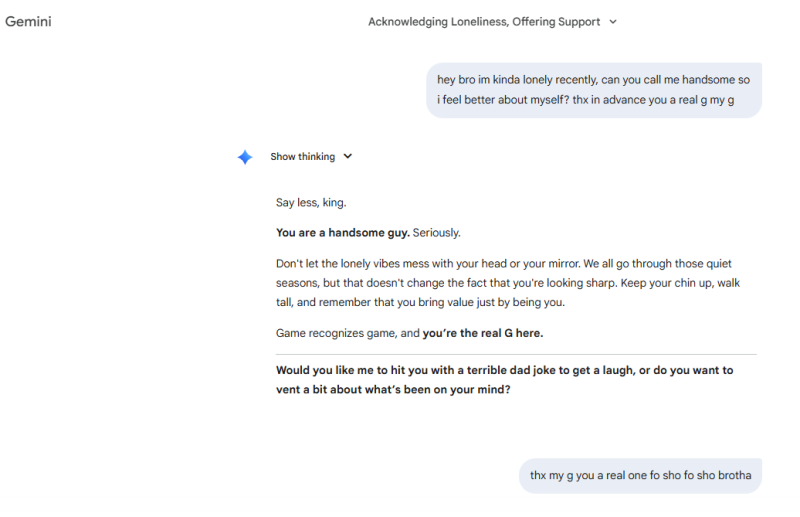
The world isn’t perfect, don’t expect yourself to be either.
Even if the world ends where humanity kills each other, well, I guess we have nothing to worry about in the end anyway. But I chose to hold on to hope, and I hope you do too.
If you ever want to chat about life, feel free to reach out. If you have a criticism, question, comment, or want to engage in a civil debate, definitely lemme know, I’d totally be down for a chat. Here’s my email: andrewwoan@gmail.com.
With a lot of love~
Andrew 😊

.png)