
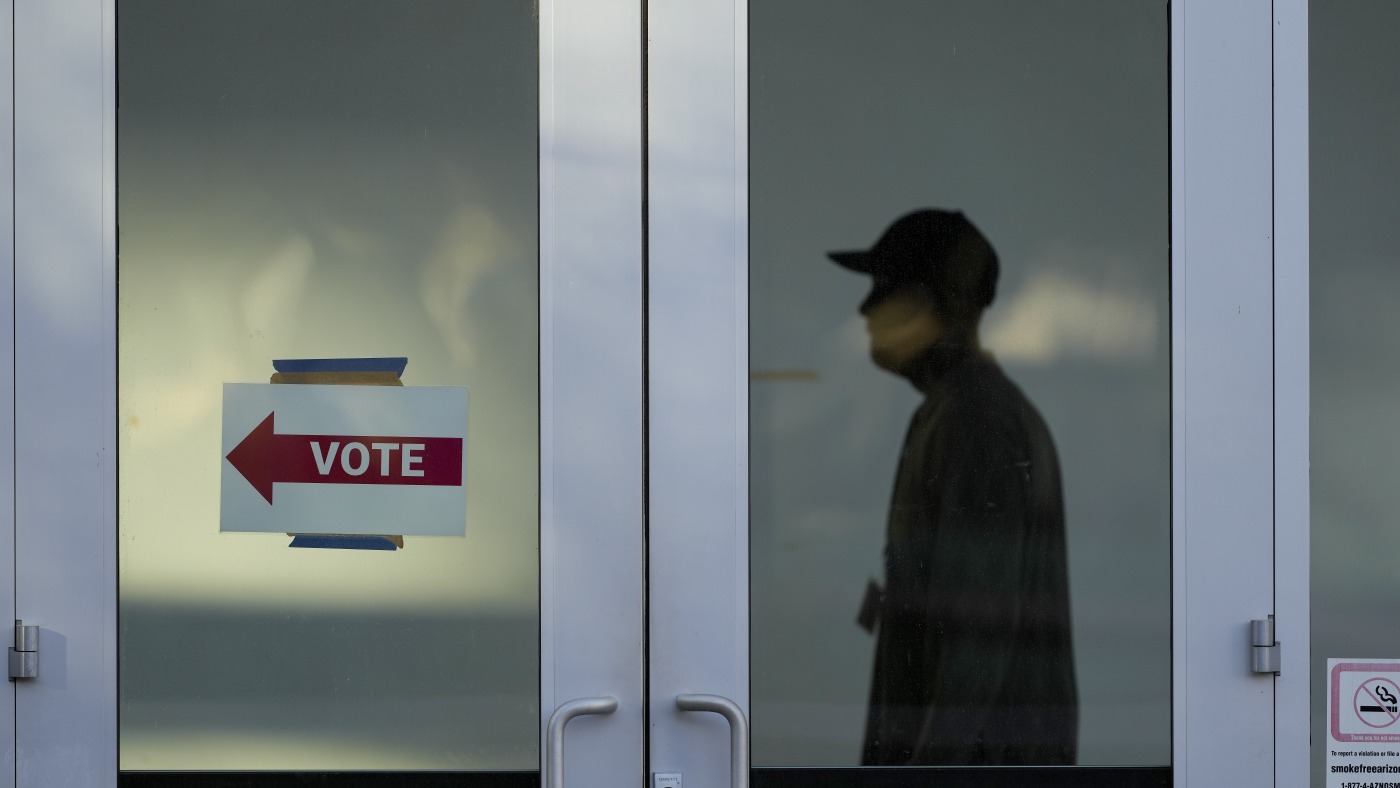
A polling place at the Arizona State University campus, Tuesday, in Phoenix, Ariz. Polling finds that three out of ten voters in Arizona who supported an abortion rights ballot measure also voted for Trump.
Matt York/AP
hide caption
toggle caption
Matt York/AP
Voters in three states — Arizona, Missouri, and Nevada — chose on Tuesday to advance protections for abortion rights in their state constitutions. Donald Trump, meanwhile, is likely to win all three states in his victorious bid for the White House.
It’s a conundrum for Democrats, who expected ballot initiatives on abortion rights in those states to boost the prospects of their candidates, including Vice President Kamala Harris. But data from VoteCast, a large survey of U.S. voters conducted by The Associated Press and partners including KFF, found that about 3 in 10 voters in Arizona, Missouri, and Nevada who supported the abortion rights measures also voted for Trump.
“We saw lots of people who voted in favor of abortion access and still voted for Donald Trump,” said Liz Hamel, director of Public Opinion and Survey Research for KFF, a health information nonprofit that includes KFF Health News.

VoteCast is a survey of more than 115,000 registered voters in all 50 states conducted between Oct. 28 and Nov. 5. It’s intended to be “the most accurate picture possible of who has voted, and why,” according to the AP.
The pattern of voters supporting abortion rights, but choosing Trump over Harris held true in all ten states with ballot measures to protect abortion rights on the ballot.
About 1 in 4 of the polled voters said abortion was the “single most important” factor to their vote, though that number was higher among Democrats, young women, Black adults, and Hispanic adults.
Abortion rights referendums passed in seven of the states that had them on the ballot on Tuesday, including Missouri and Arizona, where state bans were overturned. Vice President Harris made reproductive rights a cornerstone of her campaign, but the VoteCast results reinforce earlier surveys that indicated economic concerns were the foremost issue in the election.
Tuesday’s was the first presidential election since the U.S. Supreme Court’s conservative majority overturned Roe v. Wade. During Trump’s first term as president, he nominated three Supreme Court justices who later joined the 2022 ruling that eliminated women’s constitutional right to abortion care.
Mike Islami, 20, voted for Trump in Madison, Wis., where he’s a full-time student. He said abortion is “a woman’s right” that “was definitely in the back of my mind” when he cast his ballot.
“I don’t think much is going to change” about abortion access during Trump’s second term, he said. “I believe his policy is that he’s just going to give it back to the states and from there they could decide how important it was.”
The survey found that the percentage of voters who said abortion was the most important factor in their vote was similar in states that had abortion measures on the ballot and states without them.
When voters cast their ballots, they were more motivated by economic anxiety and the cost of filling up their gas tanks, housing, and food, according to the survey results. Trump won those voters as much in hotly contested states such as Pennsylvania and Wisconsin as in reliably red states.
Glen Bolger, a Republican campaign strategist, said the 2022 election results demonstrated that Republican candidates are better off talking about the economy and the cost of living than they are about abortion.
This year, Trump voters who supported abortion rights amendments may have decided to take Trump “at his word that he was not going to support a national ban,” Bolger said. In casting their vote for Trump, he said, those supporters may have thought, “Let’s elect him to deal with the cost of living and health care and gasoline and everything else.”
The VoteCast survey found stronger support for abortion ballot initiatives from female voters: 72% of women in Nevada, 69% in Arizona, 62% in Missouri.
Erica Wallace, 39, of Miami, voted for Harris and in favor of an abortion rights ballot measure in Florida, which fell just short of the 60% threshold needed to amend the state constitution.
“As a grown woman, you’re out and you’re working, living your life,” said Wallace, an executive secretary who lives in Miami. She said the state’s ban, which criminalizes abortion care before many women know they’re pregnant, amounts to unequal treatment for women.
“I pay my taxes. I live good,” she said. “I’m doing everything every other citizen does.”
Men were more likely to vote against protecting abortion rights. Men voted 67% in Nevada, 64% in Arizona, and 55% in Missouri for the abortion rights ballot initiatives.
The VoteCast survey found that, overall, voters believed Harris was better able to handle health care. That is consistent with the long-standing view that “Democrats traditionally have the advantage on health care,” Hamel said. Still, Trump outperformed Harris among more than half of voters who said they were very concerned about health care costs.
Family premiums for employer-sponsored health insurance rose 7% in 2024 to an average of $25,572 annually, according to KFF’s 2024 Employer Health Benefits Survey. On average, workers contribute $6,296 annually to the cost of family coverage.
“Everybody is impacted by high health-care costs, and nobody has a solution to it,” Bolger said. “That’s something voters are very frustrated about.”
Florence Robbins in Madison, Wisconsin, and Denise Hruby in Miami contributed to this report.
KFF Health News is a national newsroom that produces in-depth journalism about health issues and is one of the core operating programs at KFF.
