
The dream of recursive self-improvement in AI—where a system doesn’t just get better at a task, but gets better at learning—has long been the ‘holy grail’ of the field. While theoretical models like the Gödel Machine have existed for decades, they remained largely impractical in real-world settings. That changed with the Darwin Gödel Machine (DGM), which proved that open-ended self-improvement was achievable in coding.
However, DGM faced a significant hurdle: it relied on a fixed, handcrafted meta-level mechanism to generate improvement instructions. This limited the system’s growth to the boundaries of its human-designed meta agent. Researchers from the University of British Columbia, Vector Institute, University of Edinburgh, New York University, Canada CIFAR AI Chair, FAIR at Meta, and Meta Superintelligence Labs have introduced Hyperagents. This framework makes the meta-level modification procedure itself editable, removing the assumption that task performance and self-modification skills must be domain-aligned.
The Problem: The Infinite Regress of Meta-Levels
The problem with existing self-improving systems is often ‘infinite regress’. If you have a task agent (the part that solves the problem) and a meta agent (the part that improves the task agent), who improves the meta agent?. Adding a ‘meta-meta’ layer merely shifts the issue upward.
Furthermore, earlier systems relied on an alignment between the task and the improvement process. In coding, getting better at the task often translates to getting better at self-modification. But in non-coding domains—like poetry or robotics—improving the task-solving skill does not necessarily improve the ability to analyze and modify source code.
Hyperagents: One Editable Program
The DGM-Hyperagent (DGM-H) framework addresses this by integrating the task agent and the meta agent into a single, self-referential, and fully modifiable program. In this architecture, an agent is defined as any computable program that can include foundation model (FM) calls and external tools.
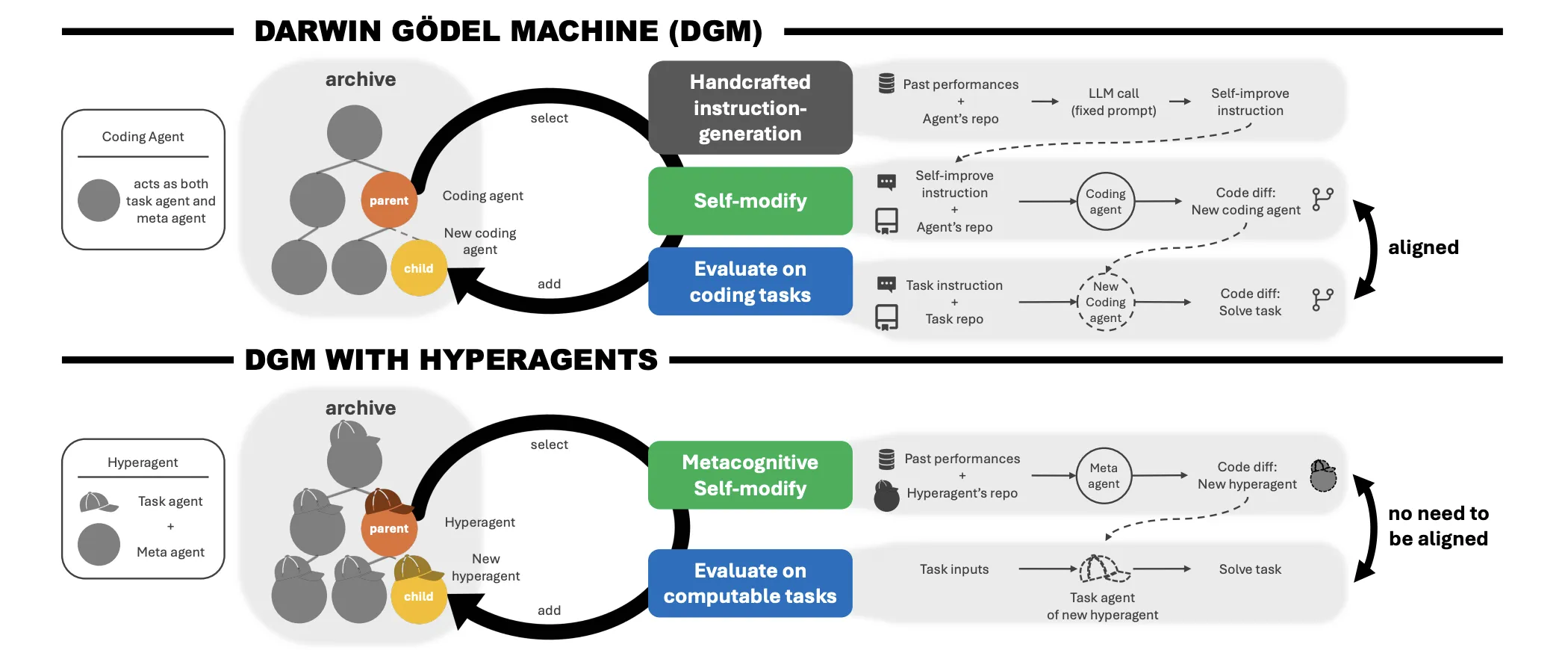
Because the meta agent is part of the same editable codebase as the task agent, it can rewrite its own modification procedures. The research team calls this metacognitive self-modification. The hyperagent doesn’t just search for a better solution; it improves the mechanism responsible for generating future improvements.
Comparison of Self-Improvement Architectures
| Component | Darwin Gödel Machine (DGM) | DGM with Hyperagents (DGM-H) |
| Meta-level Mechanism | Fixed and handcrafted | Fully editable and modifiable |
| Domain Alignment | Required (primarily coding) | Not required (any computable task) |
| Modification Type | Task-level only | Metacognitive (task + meta) |
Results: Beyond Local Optima in Robotics and Review
The research team tested DGM-H across diverse domains: coding, paper review, robotics reward design, and Olympiad-level math grading.
In robotics reward design, the hyperagent was tasked with designing Python reward functions to train a quadruped robot in the Genesis simulator. During the training phase, agents were required to design rewards for walking forward. For held-out testing, the agents had to zero-shot generate reward functions for a different task: maximizing the robot’s torso height.
The DGM-H significantly improved performance, rising from an initial score of 0.060 to 0.372 (CI: 0.355–0.436). It successfully discovered non-myopic reward functions that induced jumping behavior—a more optimal strategy for height than the local optimum of simply standing tall.
In the paper review domain, DGM-H improved test-set performance from 0.0 to 0.710 (CI: 0.590–0.750), surpassing a representative static baseline. It moved beyond superficial behavioral instructions to create multi-stage evaluation pipelines with explicit checklists and decision rules.
Transferring the ‘Ability to Improve‘
A critical finding for AI researchers is that these meta-level improvements are general and transferable. To quantify this, the research team introduced the improvement@k (imp@k) metric, which measures the performance gain achieved by a fixed meta agent over k modification steps.
Hyperagents optimized on paper review and robotics tasks were transferred to the Olympiad-level math grading domain. While the meta agents from human-customized DGM runs failed to generate improvements in this new setting (imp@50 = 0.0), the transferred DGM-H hyperagents achieved an imp@50 of 0.630. This demonstrates that the system autonomously acquired transferable self-improvement strategies.
Emergent Infrastructure: Tracking and Memory
Without explicit instruction, hyperagents developed sophisticated engineering tools to support their own growth:
- Performance Tracking: They introduced classes to log metrics across generations, identifying which changes led to sustained gains versus regressions.
- Persistent Memory: They implemented timestamped storage for synthesized insights and causal hypotheses, allowing later generations to build on earlier discoveries.
- Compute-Aware Planning: They developed logic to adjust modification strategies based on the remaining experiment budget—prioritizing fundamental architectural changes early and conservative refinements late.
Key Takeaways
- Unification of Task and Meta Agents: Hyperagents end the ‘infinite regress’ of meta-levels by merging the task agent (which solves problems) and the meta agent (which improves the system) into a single, self-referential program.
- Metacognitive Self-Modification: Unlike prior systems with fixed improvement logic, DGM-H can edit its own ‘improvement procedure,’ essentially rewriting the rules of how it generates better versions of itself.
- Domain-Agnostic Scaling: By removing the requirement for domain-specific alignment (previously limited mostly to coding), Hyperagents demonstrate effective self-improvement across any computable task, including robotics reward design and academic paper review.
- Transferable ‘Learning’ Skills: Meta-level improvements are generalizable; a hyperagent that learns to improve robotics rewards can transfer those optimization strategies to accelerate performance in an entirely different domain, like Olympiad-level math grading.
- Emergent Engineering Infrastructure: In their pursuit of better performance, hyperagents autonomously develop sophisticated engineering tools—such as persistent memory, performance tracking, and compute-aware planning—without explicit human instructions.
Check out the Paper and Repo. Also, feel free to follow us on Twitter and don’t forget to join our 120k+ ML SubReddit and Subscribe to our Newsletter. Wait! are you on telegram? now you can join us on telegram as well.
