
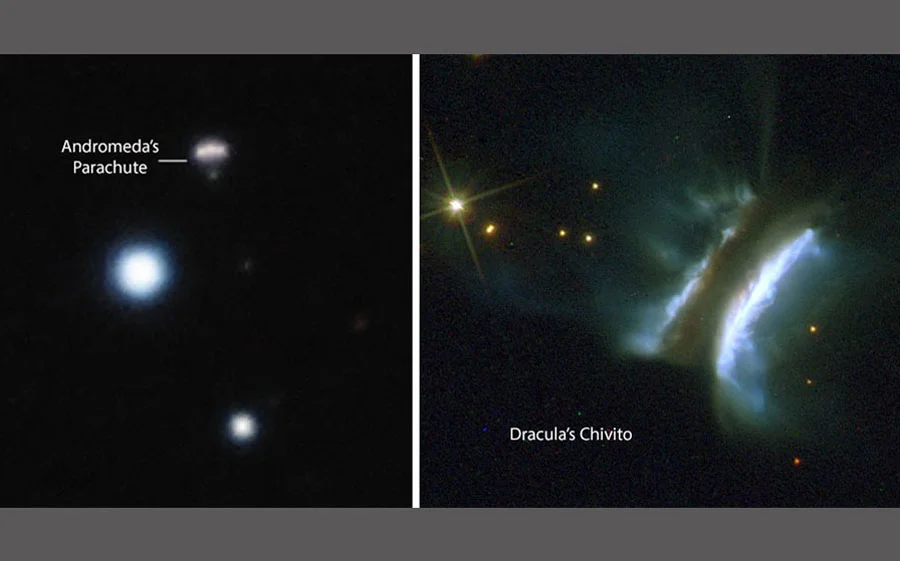
Left: Gary Imm; photo details: Celestron 11-inch EdgeHD telescope and ZWO ASI294MM Pro camera. Right: Hubble Space Telescope image processed by Meli thev
Humans are always making trouble. We push limits no matter the cost because our curiosity compels us to. Setting goals and meeting new challenges keeps us engaged and alive. I could stick to observing things that require modest efforts to see, like the bountiful bright nebulae, galaxies, and star clusters. Fat chance. From time to time, I need to look at stuff that strains my eyes for the effort. And if said object has a captivating name, I can’t resist!
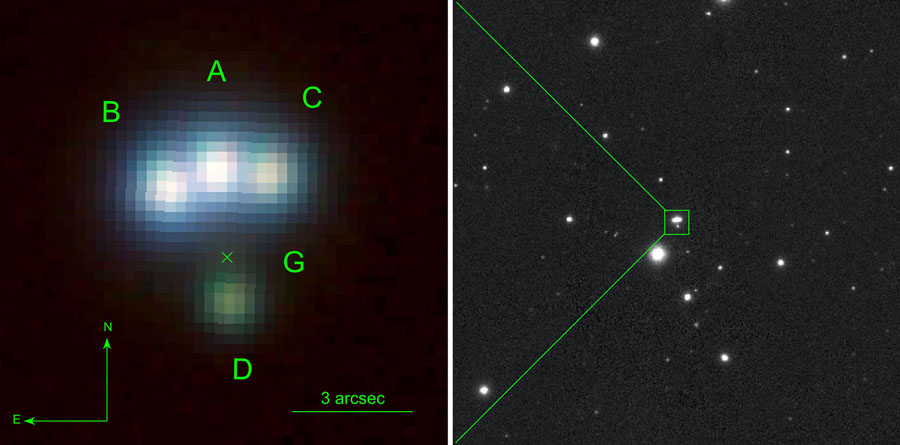
C. T. Berghea et al. from the 2017 paper Discovery of the first quadruple gravitationally lensed quasar
candidate with Pan-STARRS
This summer, I learned about two deep-sky objects that I had to observe as soon as I saw their names — Andromeda’s Parachute and Dracula’s Chivito. The former is a quadruple gravitationally lensed quasar discovered in 2017 and shaped like a tiny, descending parachute. Three of the images outline an inflated chute, and the fourth represents a capsule suspended below it. Kate Rubin (San Diego State University) and her team chose the name in their 2018 Astrophysical Journal paper to recognize the role of parachute systems in space missions. Formally, the object goes by the more sober moniker J014710+463040.
A massive intervening galaxy, too faint to appear in the image above, acts as a lens that distorts the fabric of spacetime, creating four images of a remote quasar some 11 billion light-years away — in light-travel time. When you add in the expansion of the universe since the light left the quasar, the object is closer to 18.9 billion light-years away! Rarely do observers get the privilege of seeing something across such a yawning chasm of space, a testament to the brightness boost imparted by the lensing process.
Dracula’s Chivito, one of the greatest-ever names for a deep-sky object, was penned by the authors in their 2024 discovery paper. Officially designated IRAS 23077+6707, the object is a protoplanetary disk viewed edge-on that resembles a hamburger. A dense “patty” of dust blocks the light from the fledgling sun. Light escaping above and below the disk scatters off neighboring dust to form the “bun.” Deep images reveal several nebular “fangs” extending above and below the lobes. The object resembles the tinier, fainter Gomez’s Hamburger, another infant solar system with a tasty name located in Sagittarius.
One of the authors grew up in Transylvania, Romania, home to Vlad the Impaler, who became the inspiration for the fictional Count Dracula, hence the fangs reference. Another grew up in Uruguay, where the chivito sandwich — a combination of grilled beef, mozzarella, ham, tomatoes, olives, and mayonnaise served on a bun — is the national dish.
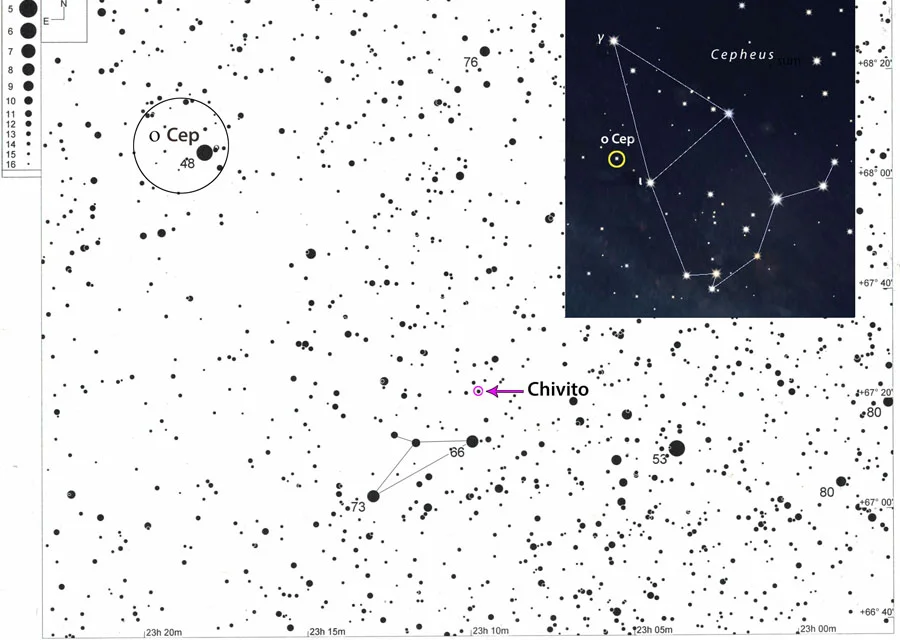
MegaStar with permission (main map); Stellarium (inset) with annotations by Bob King
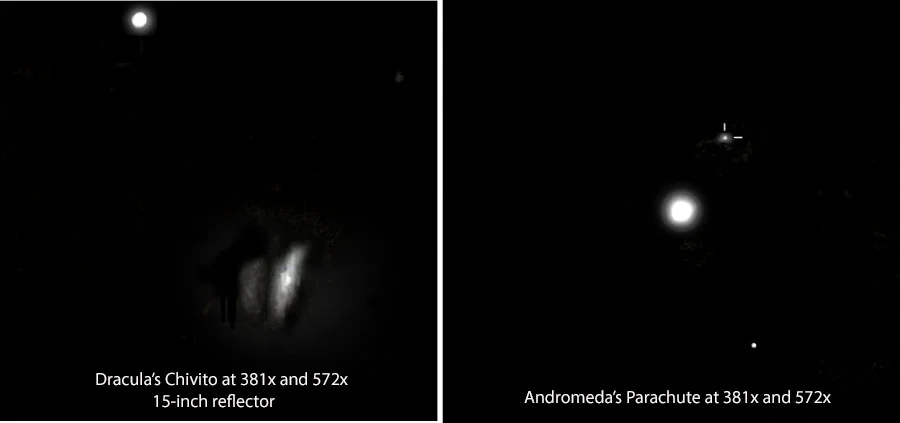
Fortunately for northern observers, both objects stand high in the sky from fall through mid-winter. I used a 15-inch (38-cm) Dobsonian for my observations, which commenced in the late summer. To get to the Chivito, start at 5th-magnitude Omicron (ο) Cephei and star-hop 1° southwest to a small triangle of faint stars. The slightly fuzzy-looking star above the figure’s western end expands into a small, bar-shaped nebula — the brighter western half of the bun — at magnifications of 200× or more. On the best nights it appeared slightly curved at the ends.
Although listed at magnitude 14.2 and 11″ in length, this part of the bun has a high surface brightness, so it looked more like magnitude 13.7 to me. The eastern section was considerably fainter and several arcseconds shorter. I glimpsed it only on a few occasions using averted vision and magnifications well above 300×. Yet seeing the eastern section was crucial. Paired with the brighter half, it revealed the dark emptiness sandwiched between the two halves of the bun. Within that inky gap I imagined embryonic starlight struggling to pierce the dense dust, like a baby chick pipping its egg.
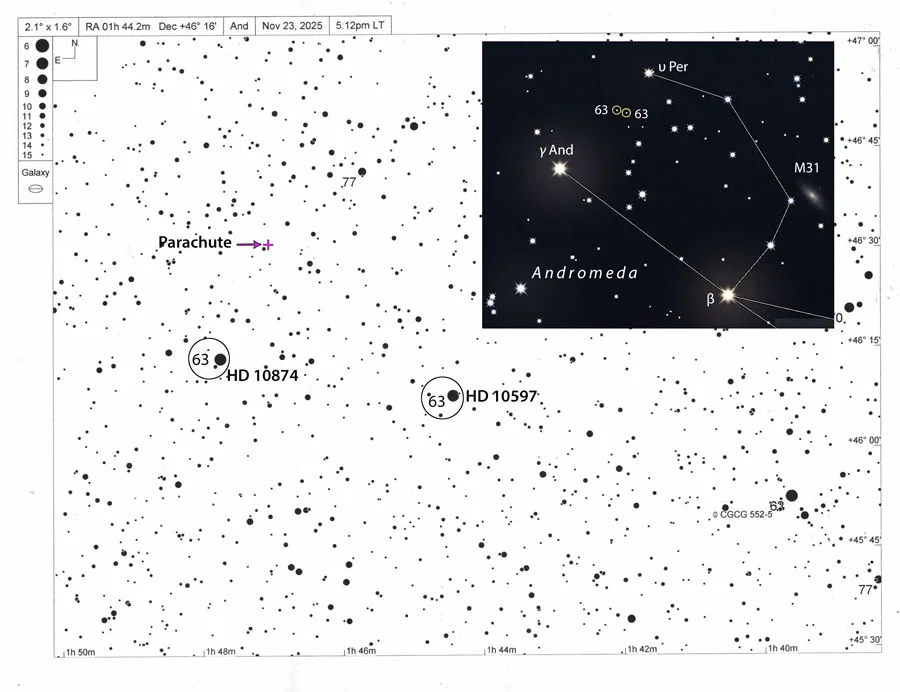
MegaStar with permission (main map); Stellarium (inset) with annotations by Bob King
If the sandwich required effort to piece together, the lensed quasar quartet proved even more demanding. To find it, I started at 3.6-magnitude Upsilon (υ) Persei and slid 4.9° northwest to a pair of 6th-magnitude stars, HD 10874 and HD 10597. Just 18.5′ northwest of the former, I centered on an 11.3-magnitude star and increased the magnification to 245×. Approximately 20″ northwest of this star I made out a faint, roughly 15.4-magnitude speck representing the combined light of the four lensed quasars. That was the easy part!
Bob King
I returned to the object on multiple nights, using magnifications of 381× and 572×, hoping to discern a second or third quasar. At best, I was able to tease out a slightly fuzzy, extended spot (indicative of unresolved multiple objects) inside of which I occasionally glimpsed a tiny, starlike kernel of light. This I took to be component A, the brightest of the quartet. I know that the Parachute will remain on my must-see list as I wait for an opportunity to view it in a larger instrument or under better seeing conditions. For now, I’m content with having primordial light fill my tired eyes with amazement — such was my reward for teetering at the edge.
