
Unlock the Editor’s Digest for free
Roula Khalaf, Editor of the FT, selects her favourite stories in this weekly newsletter.
Israel continued to pound Lebanon with a fierce wave of air strikes overnight, making it the heaviest 24 hours of bombing since it stepped up its campaign against militant group Hizbollah at the end of last month.
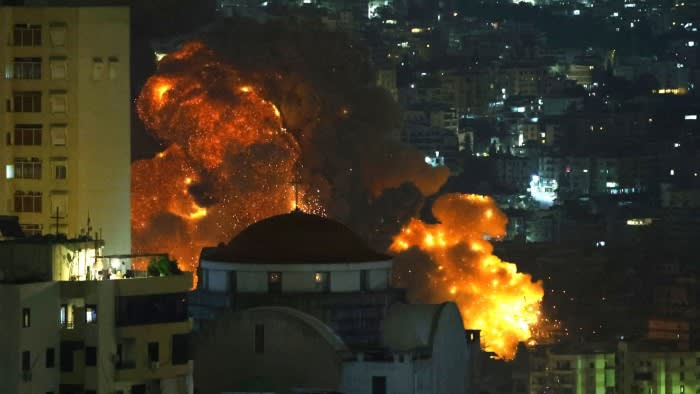
The bombardment lit up Beirut’s skyline on Sunday, as powerful blasts rocked the Lebanese capital throughout the night. Targets included a building near the road to Beirut’s airport, where the strikes set off huge fires. Smoke was still seen rising from the area in the morning.
The explosions began around midnight, after Israel’s military warned residents to evacuate neighbourhoods in Beirut’s southern suburbs, which Hizbollah dominates, including Haret Hreik and Choueifat. Another powerful explosion was heard on Sunday morning.
The intense bombing followed a day of sporadic air strikes and the constant buzz of reconnaissance drones, both of which have become almost routine for residents of the city.
Israel’s military says it is targeting sites linked to the militant group and said it had struck weapons storage facilities and other infrastructure linked to Hizbollah in Beirut overnight. It also said Hizbollah launched projectiles across the border, some of which were intercepted.
Hizbollah said it successfully struck a group of Israeli soldiers with a salvo of rockets. It is not possible to verify the battlefield claims on either side.
Israel has intensified its assault against Hizbollah over the past two weeks as it has shifted its focus from Gaza to the northern front. It has killed Hizbollah leader Hassan Nasrallah, launched air strikes across Lebanon and sent troops into Lebanon’s south for the first time in almost two decades.
More than 2,000 people have been killed in Lebanon in the conflict, the majority in the past two weeks, according to data from the Lebanese health ministry. Lebanon’s health ministry said 23 people were killed and 93 wounded in attacks throughout the country on Saturday.
More than 1.2mn people have also been displaced from their homes because of the fighting.
This includes about 375,000 people who fled to Syria in recent days, some of whom made the journey on foot. Israel bombed one of the roads leading up to a major crossing point, saying it was targeting Hizbollah’s supply routes from Syria.
Foreigners have also continued to flee Lebanon, with multiple nations chartering planes to help repatriate their citizens in recent days.
Israel on Saturday struck a Palestinian refugee camp in the northern city of Tripoli for the first time, targeting a Hamas commander. There were also indications that Israel was widening its offensive to include Hizbollah’s civil infrastructure.
Lebanese authorities said Israeli bombardment had killed 50 health workers in the past four days, as Israeli fighter jets continued to attack medical facilities, mosques and other buildings it says are used by Hizbollah militants.

The WHO’s director-general Tedros Adhanom Ghebreyesus warned that the capacity of Lebanon’s health system — already on the brink after five years of a dire economic crisis — was deteriorating and that the UN agency’s “medical supplies cannot be delivered due to the almost complete closure of Beirut’s airport”.
While Lebanon’s only airport remained open, most airlines have suspended flights in and out of the country because of the heavy bombardment in the nearby southern suburbs.
Israel has issued multiple evacuation orders in recent days, warning people in towns and villages across the south to move north. It has given similar orders in its war against Hamas in Gaza ahead of big offensives. The latest came on Sunday.
The escalation has pushed the Middle East closer to all-out war. The region is bracing for Israeli Prime Minister Benjamin Netanyahu’s response to an Iranian missile barrage fired at Israel on Tuesday.
Tehran said the missile attack was in response to the assassination of Nasrallah and the killing of Hamas’s political leader Ismail Haniyeh in Tehran in July.
Israel also carried out further strikes in Gaza overnight, including bombing a mosque and a school in Deir al-Balah. Palestinian health officials said 26 people had been killed and “dozens” injured in the strikes. The Israeli military said it had targeted Hamas militants using the sites to direct operations against its forces.
Israel also launched a new offensive in Jabalia in the north of the enclave, with warplanes carrying out a heavy bombardment of the area before it was encircled by ground forces. The military said it had launched the assault because militants had regrouped in the vicinity.
French President Emmanuel Macron on Saturday renewed his calls for a ceasefire in Gaza, saying weapons shipments to Israel for its campaign in the enclave should be suspended, and warning against further escalation in Lebanon.
“The Lebanese people must not in turn be sacrificed, Lebanon cannot become another Gaza,” he said in an interview with the France Inter radio station.
Netanyahu hit back, branding those supporting an arms embargo a “disgrace”. “Shame on them,” he said. “Israel will win with or without their support. But their shame will continue long after the war is won.”
