
 BBC
BBCWarning: Readers may find some of the details within this report upsetting
“Higher,” the little girl demands, her eyes bright with excitement. “Higher, higher.”
Zeina’s being pushed on a swing in a small playground in the suburbs of the northern Italian city of Padua.
A normal scene anywhere in the world.
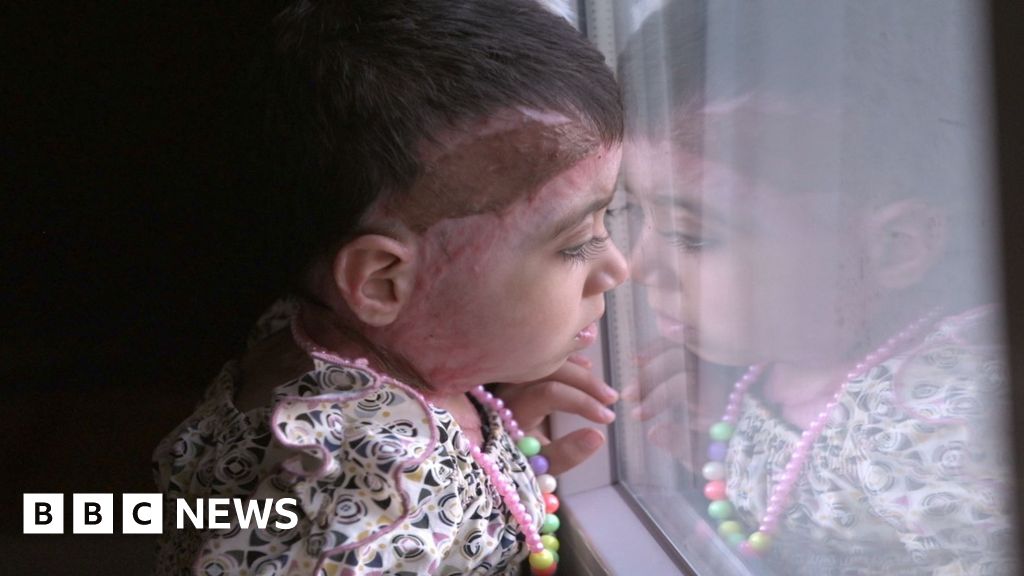
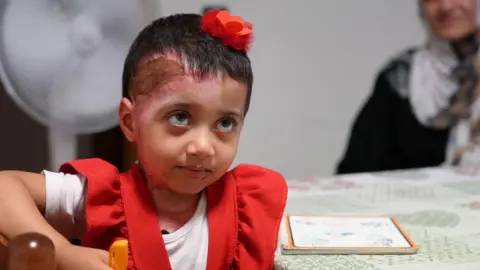
But Zeina, two, can’t move her head properly. And the right side of her face, neck and scalp are marked with deep, still angry, scars.
Right now, though, she’s safe and fed. And she feels like she’s flying.
Zeina is one of the 5,000 people who have been allowed to leave Gaza for specialist treatment abroad since the war broke out in the aftermath of the Hamas attacks on 7 October in southern Israel.
The World Health Organization says more than 22,000 Gazans have suffered life-changing injuries as a result of the conflict – but very few have been allowed to leave the strip since the Rafah border crossing with Egypt was closed in May.

“It was a day of nightmares,” says Zeina’s mother, Shaimaa, describing the moments leading up to her daughter’s injury as she was playing in their family’s tent in al-Mawasi, southern Gaza, on 17 March.
The family had already fled twice from their home in Khan Younis, first to Rafah and then to the sprawling “humanitarian zone” in al-Mawasi, where they thought they would be safe.
Zeina and her four-year-old sister Lana had been playing together, hugging and telling each other “I love you, I love you” – Shaimaa recalls – when there was a huge air strike nearby.
Zeina, terrified, ran clutching at her mother, who was holding a pot of boiling soup which spilled all over her daughter.
“Her face and skin were melting in front of me,” Shaimaa says. “I picked her up and went barefoot into the street.”
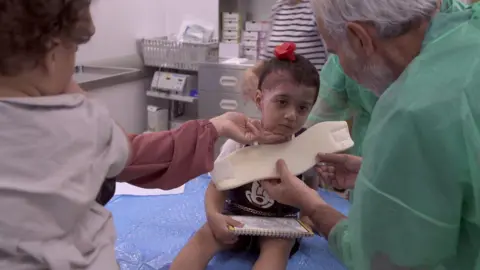
Medical services were stretched, she says, but Zeina was eventually treated by Red Cross doctors at Gaza’s European hospital, where she underwent a skin graft from her father’s leg, followed by a more successful graft from the skin on her own leg after she reached Egypt.
Earlier this month she was flown from Egypt to Italy to access more specialised treatment.
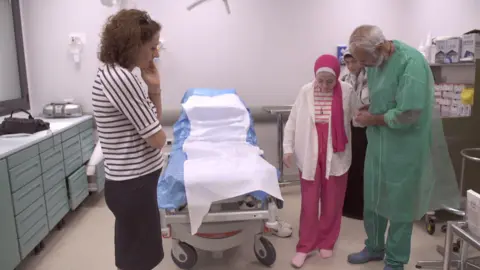
Zeina was joined by Alaa, a 17-year-old who was severely injured in an air strike on her home in Gaza City late last year. When the two girls met, they formed a bond straight away.
“I took to her immediately,” Alaa says. “She’s endured so much pain for such a small child. I’m older and sometimes the pain was too much for me. So what about her?”
Alaa was trapped for 16 hours under rubble and, when she was rescued, she discovered her father, a tailor, was dead. So too were her brothers, Nael, who was a university student, and Wael, a nurse.
Their bodies have never been recovered from the ruins of their four-storey building.
“I was awake the whole time under the rubble,” she tells me.
“I couldn’t breathe properly because of the weight on my chest and body. I couldn’t move. I was just thinking about the rest of my family and what had happened to them.”
As well as her father and brothers, she also lost her grandparents and an aunt. She says they had nothing to do with Hamas.
“I lost the people most precious to my heart,” she says. “I’m happy to be in Italy for treatment but inside I’m sad for Gaza and its people.”
In a statement to the BBC, the Israel Defense Forces has denied targeting civilians and says it takes “feasible precautions to mitigate civilian harm” in its operation to dismantle Hamas military capabilities.
More than 41,000 people have been killed in Gaza since the conflict began nearly a year ago, according to the Hamas-run health ministry.
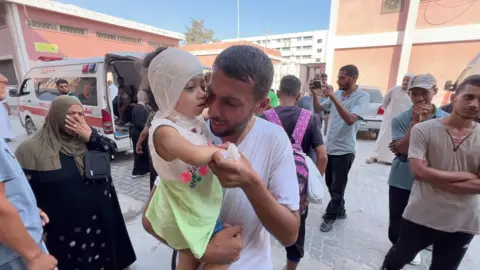
The World Health Organization has repeatedly called for “multiple medical evacuation corridors” for injured Palestinians. It says that only 219 patients have been allowed to leave since May.
Zeina and Alaa were evacuated thanks to the persistence of a British-based charity, Save a Child, and the US-based Kinder Relief. They worked for months to get them out – petitioning Israel, Egypt and the US state department for help.
“If I’m being honest, Zeina and Alaa are amongst the lucky ones who got out,” says Nadia Ali of Kinder Relief, who accompanied the girls from Egypt to Italy. “We have children who were referred to us who have died waiting to leave.”
It’s hard to speak of luck when you realise the repercussions of their injuries.
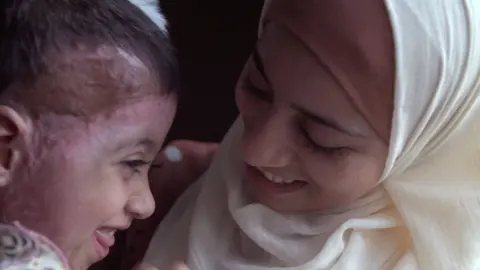
Months of painful physiotherapy lie ahead for both girls, followed by many rounds of surgery.
Zeina and Alaa are both under the care of one of Italy’s top burns specialists.
Dr Bruno Azzena is kind and gentle with them, but he has to break to them the most brutal of news – that the burns on Alaa’s legs are so deep that she will never walk normally again. And the hair on Zeina’s scarred scalp will not grow back.
Her mum, Shaimaa, is devastated. She had left Gaza hoping for a miracle.
Zeina has started to realise she is different from her sisters. And, when she asks Shaimaa to tie up her hair for her, like other girls, her mother doesn’t know what to do or say.
Looking after her girls alone – her husband wasn’t authorised for evacuation with them – is tough, physically and emotionally. But Shaimaa dotes on Zeina, calling her “princess,” hiding her tears – and her fears for the future – from her.
She is also grieving for her own mother who died of cancer which had spread, unchecked and untreated, through her body in the months after the war.
“The war has cost me so much,” she says. “Thank God we were able to leave. We left by a miracle. I hope that other injured Palestinians can leave for treatment. I always pray for God to protect them and the war to stop.”
