
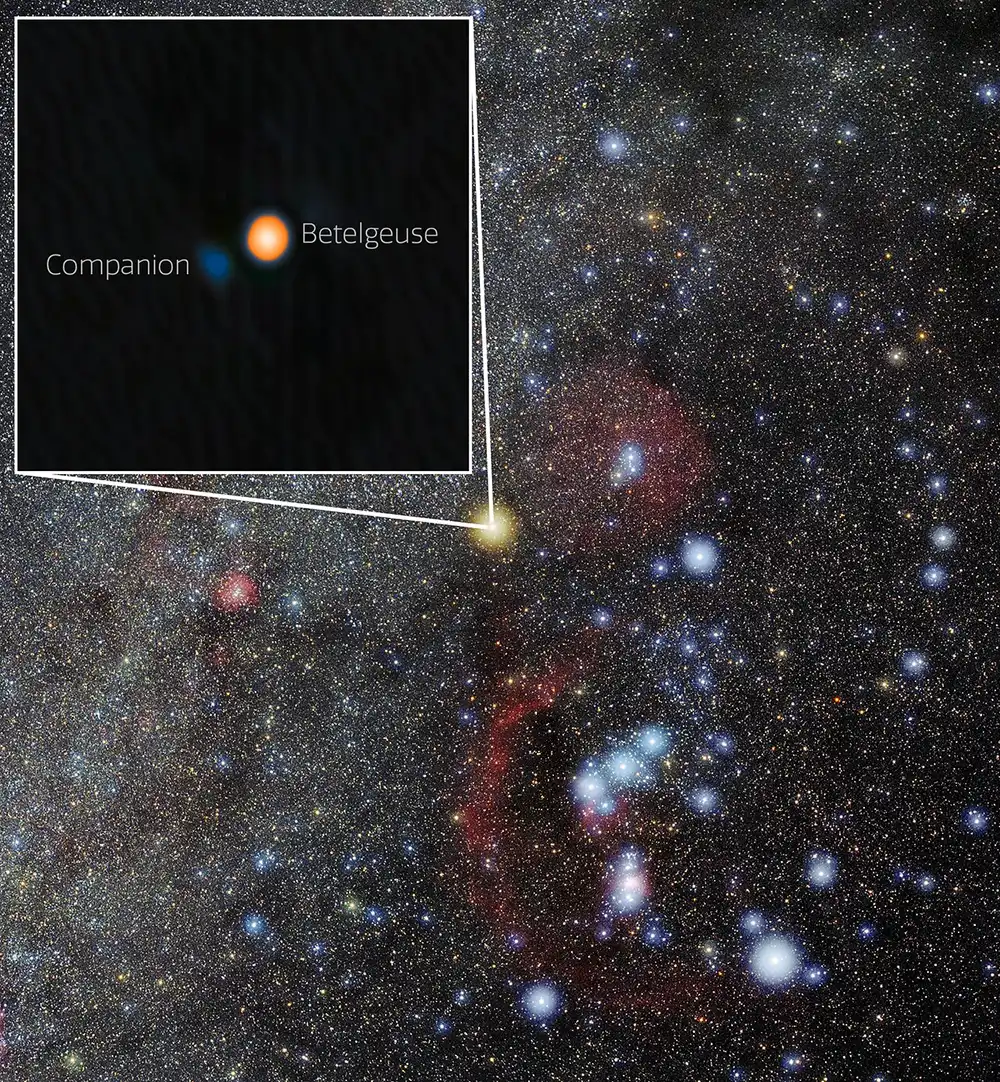
International Gemini Observatory/NOIRLab / NSF / AURA; Image Processing: M. Zamani (NSF NOIRLab)
Astronomers may have finally spotted a close companion to Betelgeuse, the bright red star at Orion’s shoulder. Long suspected, this elusive partner could help explain the supergiant’s recent brightness dips and hint at a turbulent future. That said, it’s still a highly tentative discovery.
The suspicion that Betelgeuse is not alone dates back more than a century, but it has never been confirmed. Last year, a team led by Morgan MacLeod (Center for Astrophysics, Harvard & Smithsonian) argued that a companion would help explain Betelgeuse’s position on and speed across the sky as well as its brightness. Yet this was a theoretical prediction, not observational evidence. In fact, there was doubt such a companion could ever be found after searches with the Hubble Space Telescope and Chandra X-ray Observatory came up empty.
Now a team led by Steve Howell (NASA Ames Research Center) claims to have found it. The team used the Gemini North telescope in Hawai‘i and a technique called speckle imaging, which uses ultra-short exposure times to cut through the blurring effects of Earth’s atmosphere.
“This detection was at the very extremes of what can be accomplished with Gemini in terms of high-angular resolution imaging, and it worked,” says Howell. “This now opens the door for other observational pursuits of a similar nature.”
The discovery is on a weak footing, however. Orbital motion has not been observed, meaning we need follow-up studies to confirm whether this object really circles Betelgeuse. Perhaps more tellingly, there’s a roughly 10% chance the companion isn’t there at all. That’s much more doubt than astronomers usually allow before announcing a discovery.
“It is certainly intriguing to consider the possibility that a companion is detected, but the fact of the matter is that the signal-to-noise of this effect is quoted to be 1.6,” says René Oudmaijer (Royal Observatory of Belgium), who was not involved in the research. “Such values are widely regarded as non-detections.”
If the companion does exist — and right now that remains a big “if” — what could we learn about it?
Based on the observations, the object appears six magnitudes fainter than Betelgeuse. Weighing in at 1.5 Suns, it’s likely a pre-main-sequence star — once it finishes amassing gas and turns on fusion in its core, it could become an A or B-type star.
The putative protostar orbits Betelgeuse at a distance of just 4 astronomical units, placing it inside Betelgeuse’s extended outer atmosphere. It would be the first time a stellar companion to a supergiant has been found this close in. But that intimacy is a death sentence. The twin threats of drag from Betelgeuse’s diffuse atmosphere and extreme tidal forces would see the companion spiral into Betelgeuse, perhaps in as little as 1,000 years — an astronomical heartbeat away.
Howell’s team speculates that the result could be an exotic object, perhaps resembling a Thorne–Żytkow star, where a dense stellar core becomes embedded in a bloated outer envelope. The collision between the object and Betelgeuse could lead to powerful eruptions of gas and dust, which would likely alter the brighter star’s appearance in the night sky and potentially shift its evolutionary path.
Seeing Betelgeuse as part of a tight binary could also reframe the Great Dimming of 2019–2020, when the star dramatically faded for several months. At the time, theories ranged from dust clouds to surface cooling. A close stellar companion stirring up Betelgeuse’s outer layers could be another plausible contributor.
Big question marks remain, for now. Howell’s team will seek to monitor Betelgeuse in the coming years for more concrete evidence of a star in tow. Astronomers have long warned that Betelgeuse is a ticking time bomb. The discovery of a close-in companion might just shorten the fuse.
