
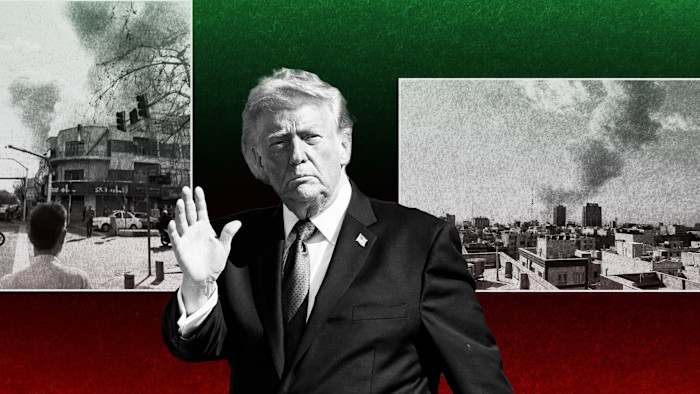
Just months ago, US President Donald Trump said Iran’s nuclear programme was “obliterated”. Just this week, he told the US Congress his preference was to “solve this problem via diplomacy”.
And just last night, he told reporters in Washington that while he “wasn’t thrilled” that Iran would not cave to his demands, the talks would continue.
Hours later, Israeli and American warplanes were bombing Tehran. “When we are finished, take over your government,” Trump told Iranians.
Rather than present new evidence to explain Operation Epic Fury, Trump rattled through complaints of successive US presidents: the threat posed by Iran to US interests, its record of bloody repression and its support for proxies in the region.
He also touched on Israeli Prime Minister Benjamin Netanyahu’s longstanding — and unproven — claim that Iran is secretly seeking to build a nuclear weapon, but provided no proof it was happening.
For those in the Middle East who supported diplomacy over war the timing was especially worrying — the second time in less than a year Iran has been attacked in the midst of talks over the future of its nuclear enrichment programme.
Badr Albusaidi, Oman’s foreign minister, who was mediating the negotiations between Iran and the US, said on Saturday he was “dismayed” by Israel and the US’s attack, telling Washington that “this is not your war”.
“Active and serious negotiations have yet again been undermined,” he said. “Neither the interests of the United States nor the cause of global peace are well served by this . . . I urge the United States not to get sucked in further.”
Netanyahu makes no secret of his close relationship with the US president, claiming he helped convince Trump to rip up the original 2015 Iran nuclear deal and thanking him for sending American B-2 bombers to attack Iran’s nuclear sites in June.
Israel’s motivations are clear: this was an opportunity to strike at a strategic adversary at a time when the US was both poised to attack and had built up a naval force that could simultaneously defend Israel.
An Israeli military official defended the attack to reporters, arguing that Iran had not abandoned its “destruction of Israel plan”, which rested on three pillars: the regime’s nuclear programme, missile arsenal and regional proxy militia network.

The official claimed that Israeli intelligence had seen a “sharp acceleration” in missile production, Tehran’s financial support to its proxies was ongoing and that Iran was seeking to “conceal and fortify” its nuclear programme.
After the US pulled out of the original nuclear deal during Trump’s first term, Iran started increasing its enrichment programme, building a stockpile of more than 400kg of uranium enriched close to weapons-grade.
While the fate of that stockpile is unclear, analysts and many intelligence officials do not believe Tehran has restarted enrichment since the June conflict, which severely damaged its nuclear programme.
“We have not seen any evidence that Iran is trying to reconstitute its nuclear weapons programme or enrich uranium,” said David Albright, a physicist and weapons expert who is the founder of the Institute for Science and International Security in Washington.
Albright said activity observed in satellite photos since the June war related mostly to recovery operations or hardening underground tunnel entrances, and the current consensus among experts is that Iran’s enrichment programme is largely on hold.

Israeli leaders have for years obsessed over the fear that their neighbours will mimic Israel’s own clandestine nuclear programme. The prime minister’s predecessors Menachem Begin and Ehud Olmert ordered the bombing of an Iraqi nuclear reactor in 1981 and a suspected Syrian one in 2009.
In 1984, when many of Iran’s nuclear scientists had fled the Islamic revolution and the country had barely any capacity to enrich uranium, the leftwing Israeli newspaper Ma’ariv declared that Iran’s “atomic bomb” had entered the final stages of production “with German assistance”, according to a copy of that front page archived at the National Library of Israel.
That Iran is weeks away from being able to build a bomb has been a Netanyahu refrain for decades. Trump’s lead negotiator Steve Witkoff claimed in recent days that Iran was “probably a week away from having industrial-grade bomb-making material”. But secretary of state Marco Rubio, however, said Iran was “not enriching [uranium] right now” even if it wanted to.
Iran does not deny that it does. As a signatory to the Nuclear Non-Proliferation Treaty, it has the right to enrich uranium for peaceful purposes so long as it allows unfettered access to international inspectors — something it started restricting after the US pulled out of the 2015 nuclear deal.
Israel, however, has refused to sign the same treaty and has since the 1960s continued a clandestine project that has produced plutonium-based warheads, according to the Federation of American Scientists.
As the US confrontation with Iran neared, Trump’s aides gave several other arguments for its necessity: Iran’s violent repression of recent protests, in which rights groups said thousands of people were killed; the political chant “Death to America”, and the possibility that Iran may soon create a missile capable of reaching the US.
While Iran possesses thousands of missiles capable of hitting US forces in the region — and has used them — creating an intercontinental ballistic missile requires technological leaps that the country, under heavy sanctions, is unlikely to have made in recent years, experts say.

An unclassified US Defense Intelligence Agency estimate from last year said it could be another decade before Iran could have the technology to build an ICBM that could reach the US.
For now, Iran considers its vast, mostly homegrown missile and drone arsenal to be its main deterrent against US and Israeli attacks. “Iran is a one-trick pony,” said Danny Citrinowicz of the Institute for National Security Studies in Tel Aviv.
Iran’s ballistic missile arsenal was depleted in the 12-day war with Israel last year. It fired roughly 550 medium- to long-range missiles, while many more were destroyed on the ground by Israeli air strikes.
And Citrinowicz said Iran’s arsenal was still far from where it was before that war. “They are returning back to where they were before [the war] but [are] not there yet.”

In his video message announcing the attacks, Trump cited “imminent threats” and “menacing activities” to explain the timing of the assault.
He then reached back to a series of defining events for the US in the region: the 1979 hostage crisis, when Iranian protesters took 52 American diplomats captive; Hizbollah’s 1983 bombing of the US Marines barracks in Beirut, which killed 241; and its backing of Shia militias that fought the US occupation of Iraq.
“We sought repeatedly to make a deal,” he said, sounding irritated. “We tried, they wanted to do it, they didn’t want to do it.
“Again, they wanted to do it, they didn’t want to do it — they don’t know what’s happening,” he said. “They just wanted to practise evil . . . and we can’t take it anymore.”
