
Image credit: © Dale Zanine – USA TODAY Sports
Last Tuesday, I decided to draft a team in an industry league–Tout Wars Mixed Draft (15-team)–and punt starting pitching. This might seem daffy or ill-conceived or any other pejorative adjective that might be bouncing around in your head right now but there were a few reasons I took the plunge:
This is the raison d’etre for this gambit and, in fact, the only reason it can work. Most Roto formats have a penalty built in if you fail to reach a certain number of innings (usually between 900-1100) where you lose some or all your ERA and WHIP points. Tout abolished this rule in 2020. The goal of this strategy is to clean up in saves, ERA, and WHIP and maximize your hitting points by spending more on hitting where you would have been drafting pitchers.
For as long as I can remember, Tout Wars has had weekly lineups, except for midweek activations/replacements for players being shifted to and from the injured list and the minor leagues. This year, the decision was made to change to midweek lineup changes (on Friday) for hitters. This wrinkle allows us far more opportunities to optimize our lineups based on seven-game schedules and platoon matchups. Carrying six hitters on my six-player reserve list would give me an edge on offense over teams with one or more pitchers on reserve.
Multiple people have tried this strategy (including me) in the Tout Wars AL- and NL-only leagues, but some believe it is too risky for mixed leagues. I also suspected that the heavy emphasis of NFBC meant that people weren’t as up on the Tout Wars rules as I am (and seeing and hearing some of the other coverage of Tout after the fact really emphasized that I was right about this).
The Plan
If you surrender two categories, you need to almost completely stick the landing in the other eight. This meant doing something I seldom do and establishing category targets. Using the recently completed LABR Mixed draft and reviewing a combination of The Ax and other projection models, this is what I came up with for offense:
Home Runs: 289
Runs: 995
RBI: 966
Steals: 177
Tout Wars uses OBP instead of AVG, so I looked at last year’s AVG and OBP versus the projected .256 AVG for LABR and came up with a .333 OBP. On base percentage is the one category you must zero in on during the draft, as it is the most difficult one to catch up on in-season.
Next, I took those same composite projections and devised a round-by-round road map of who I would draft at each position, with 2-3 backups every round, because drafts are lil’ unpredictable snowflakes. I used the ongoing Tout Wars Draft and Hold as a model to see who might realistically be available every time I picked.
I had the seventh pick in the draft (you can find the full results here).
Round 1: Kyle Tucker, OF
Roadmap: Tucker
If Jose Ramirez or Bobby Witt Jr. fell to No. 7 overall I would have taken either but once they were gone Tucker was the clear favorite because of the OBP format. I gave some consideration to Cal Raleigh, but his projected OBP was neutral or slightly negative at best.
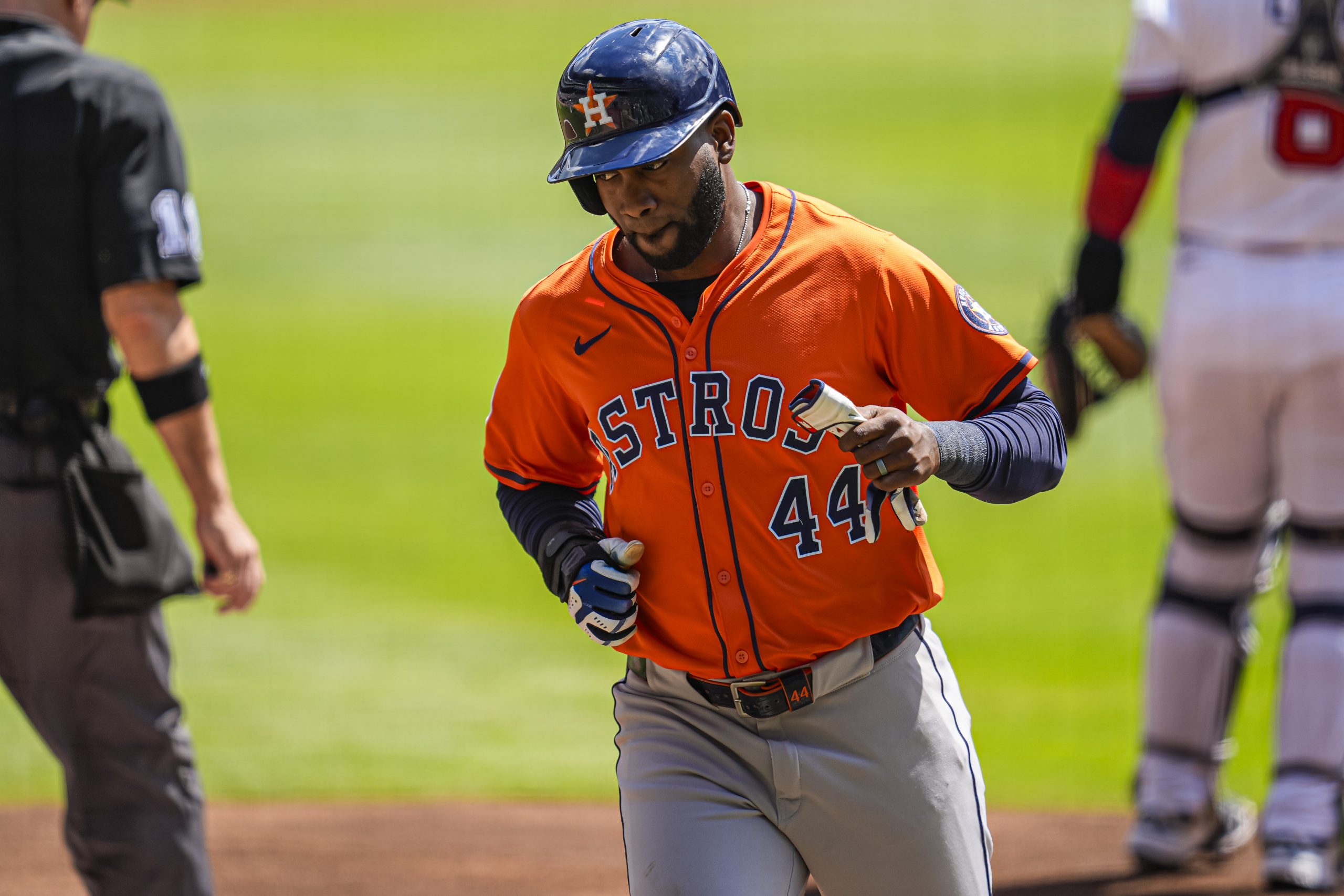
Round 2: Yordan Alvarez, OF
Roadmap: Alvarez
There is a strong case to be made that Alvarez was more essential to my draft plan than Tucker. One drawback with this plan to a draft over an auction is that I couldn’t simply pay whatever it took to get Aaron Judge or Juan Soto as my OBP anchor. Alvarez solves for this dilemma. Also, Tout uses a 15-game positional requirement, which makes Alvarez outfield eligible. My plan of cycling hitters in and out of my lineup would work best without a DH.
Round 3: Bryce Harper, 1B
Roadmap: Francisco Lindor, SS
The first snag of the draft came when Lindor and Trea Turner both went off the board earlier than they did in the Draft and Hold league. Rather than overreach for a speedy middle infielder this early, I went with the best player on the board in Harper–and another strong OBP option. This would allow me to take some “hits” against my OBP later.
Round 4: Andres Munoz, RP
Roadmap: Closer #1
I gave some consideration to drafting a closer a round earlier, but closers tend to fall somewhat in the industry (LABR/Tout) leagues compared to NFBC and believed I could obtain at least one of the “ace” stoppers a round later. Mason Miller and Edwin Diaz went in the third round followed by Jhoan Duran and Cade Smith, but I was more than fine with Munoz, who gives me a shot at 30 saves and a strong ERA/WHIP base.
Round 5: C.J. Abrams, SS
Roadmap: Closer #2
The roadmap was contingent upon one of David Bednar, Devin Williams, or Aroldis Chapman falling here and all three were gone. I also whiffed on a speedy shortstop in Round 3 and while Abrams is OBP negative he offers so much else in four other categories and I needed to start adding steals. Pete Crow-Armstrong went two picks earlier; if he fell this would have been an interesting choice (more quantitative stats but an even worse OBP hit).
Round 6: Christian Yelich, OF
Roadmap: Eugenio Suarez, 3B
The addition of Harper made corner infield (and, to a lesser degree, power) less of a priority so I pushed my seventh-round target up a round and grabbed a five-category contributor who was another OBP positive bat. Even with the regression the projections have baked in Yelich is a bargain in this format and like Alvarez his added outfield eligibility bumps his price up.
Round 7: Pete Fairbanks, RP
Roadmap: Yelich
There’s always a game of chicken going on in a draft and this is particularly true with closers. After Fairbanks there was only one closer taken in the next 24 picks so maybe I could have waited for another round and grabbed another bat. Fairbanks is fine, though, and I would have felt far worse about a closer run than missing out on a hitter in this part of the draft.
Round 8: Matt Chapman, 3B
Roadmap: Munetaka Murakami, 3B
This was the only time in the draft where I diverged from my roadmap not because the player was already taken or because something shifted in terms of category or positional needs. I opted for the safer player in Chapman who has a poorer projection than Murakami because there is a scenario where Murakami utterly tanks and has an OBP well below .300. Chapman is a solid bet for 25-30 home runs if he stays healthy and while I would have preferred Suarez the power to OBP tradeoff was worth it.
Round 9: Mike Trout, OF
Roadmap: Trout
Last year was Trout’s first season clearing 500 plate appearances since 2019. PECOTA has him at 472. I don’t know if I’m more worried about a major injury or Trout falling off the age cliff. This isn’t a bet on any kind of bounce back to Trout remotely resembling what he once was, just to him giving me a .350 OBP with power and mostly staying healthy.
Round 10: Gleyber Torres, 2B
Roadmap: Ivan Herrera, “catcher”
My plan was to draft Herrera, shift him to catcher after he gained eligibility (hopefully sometime in May at the latest) and draft a placeholder catcher very late. Instead, Herrera went one pick after Trout, and I didn’t see a catcher who had similar value. The result was that I moved Torres up one round. He is another strong OBP target who could really give me a boost if he bounces back to 20+ home runs and chips in a few more steals but is also a slight bargain even if he doesn’t.
Round 11: Ryan Walker, RP
Roadmap: Torres
I had no plan to draft a third closer; at the very least if I did so it was going to be a very late stab. But I remained confident in getting most of my offensive targets, had lost out on Herrera, so I took a third closer. Some of my motivation was trying to pad my saves totals but Tout is a trading league and Walker or Fairbanks could be moved if things go well for me in the category.
Round 12: Gabriel Moreno, C
Roadmap: Chandler Simpson, OF
My final four offensive targets, beginning with Simpson, all went at least a round later in the Tout Draft and Hold than I had them targeted in this draft, which gave me some breathing room in case things went south with one of my picks. Moreno is a productive, promising backstop who has never been able to stay on the field and never developed the moderate 15-20 home run power his more optimistic boosters were hoping for. Moreno will need to outdo as modest PA projection for my plan to work.
Round 13: Chandler Simpson, OF
Roadmap: Ceddanne Rafaela, 2B/OF
I don’t like taking one-category hitters in a mixed league but winning steals without damaging your OBP is tricky and Simpson was one of the few speedsters going here or later who is OBP neutral. This also isn’t a 20-30 steal play; this is someone who could steal 50+ easily. It also might end very badly and I acknowledge the risk.
Round 14: Ceddanne Rafaela, 2B/OF
Roadmap: Matt McLain, 2B
Some people love this guy (over at FanGraphs Jeff Zimmerman boldly predicts that Rafaela will be “a 30/30 bat and a Top 10 bat” while his colleague Paul Sporer looks into his crystal ball and sees a “20/50” season). I’ve never been on board and have significant concerns (his second half last season is a giant, flashing, neon warning light) but all I need is a 20/20 season and an OBP north of .300, which Fenway makes do-able.
Round 15: Jordan Beck, OF
Roadmap: Kyle Manzardo, 1B
Looking back, I’m not sure why I didn’t have Beck and McLain targeted instead of Rafaela/McLain. But it would have been irrelevant, as McLain went at the back end of the 13th round. Beck and McLain’s projections are eerily similar. Beck gets a significant boost because of the league’s 2x/week lineup rule change. He was a .308/.348/.466 hitter at Coors compared to a .204/.280/.355 hitter on the road; I’m going to pair him with one of the hitters listed below in my reserves and soak up all the Coors goodness.
Round 16: Kyle Manzardo, 1B
Roadmap: Ryan Jeffers, C
Manzardo was another part of my “get someone with stark platoon differentials” plan. He’ll go to my bench in half weeks where the Guardians face two or more lefties; he had a ludicrous .245/.326/.464 line with 22 home runs in 436 PA in 2025 against righthanders.
Round 17: Carson Kelly, C
Roadmap: n/a
Drafting a third closer cost me most at catcher. I still might have missed on Herrera, but I would have landed Jeffers, who went four picks after I took Manzardo. Even worse, Carter Jensen, Samuel Basallo and Tyler Stephenson all flew off the board before I picked Kelly. Most of the projected loss is in OBP; Kelly isn’t that far removed from Jeffers in the counting categories.
Reserve Hitters
18.264 Cedric Mullins Jr. OF
20.294 Joshua Lowe, OF
21.307, Colt Keith, 2B/3B/1B
22.324 Jordan Westburg, 2B/3B
23.337 Mark Vientos 3B
24.354 Ha-Seong Kim SS
My reserve list is a mishmash of more power/speed combinations, players with stark platoon splits and IL stashes. Tout has unlimited IL slots so unlike in NFBC formats there is no penalty for drafting players like Westburg and Kim. With Vientos I’m simply hoping for a bounce back; I’m not nearly as convinced as everyone else is that Brett Baty is demonstrably better and will automatically beat Vientos out as the starter.
The Rest of the Relievers
19.277 Robert Suarez
25.367 Adrian Morejon
26.384 Grant Taylor
27.397 Jason Adam
28.414 Tanner Scott
29.427 Phil Maton
You might wonder why I didn’t take shots at pitchers like Victor Vodnik, Kevin Ginkel, Clayton Beeter or many others who could potentially close. There are two reasons:
- These pitchers were mostly gone by the 25th round. To draft arms like this, I would have needed to opt for a weaker offensive bench.
- I not only need to ace saves but ERA and WHIP as well. Grabbing relievers with an ERA/WHIP projection in the 4.00/1.30 neighborhood increases my odds of not leading Tout in these categories.
It’s quite possible that any of the six non-closers I took get a few saves or even upend the current closer but that’s not why I drafted these arms. This contingent puts me well in front of every other team in ERA and WHIP projections … and gives me some wiggle room if Fairbanks and/or Walker aren’t elite in these categories.
I didn’t quite hit all my offensive category targets …
| Runs | Home Runs | RBI | Stolen Bases | OBP | |
| Target | 995 | 289 | 966 | 177 | .333 |
| Projected | 983 | 274 | 937 | 180 | .337 |
… but that’s OK. Projected standings assume a static lineup with 14 hitters and the team I built was designed to maximize the lineup change rule with six hitters on the bench all season long. I foresee having a tactical advantage on offense that incrementally won’t matter but will add up over the course of a 26-week season.
Thanks as always to Peter Kreutzer, Todd Zola (whose work during the draft and in-season makes this league run oh so smoothly), Jeff Erickson, Justin Mason, Ron Shandler, Brian Walton and Nick Pollack for all they do in keeping Tout Wars going strong after all these years.
Thank you for reading
This is a free article. If you enjoyed it, consider subscribing to Baseball Prospectus. Subscriptions support ongoing public baseball research and analysis in an increasingly proprietary environment.
