
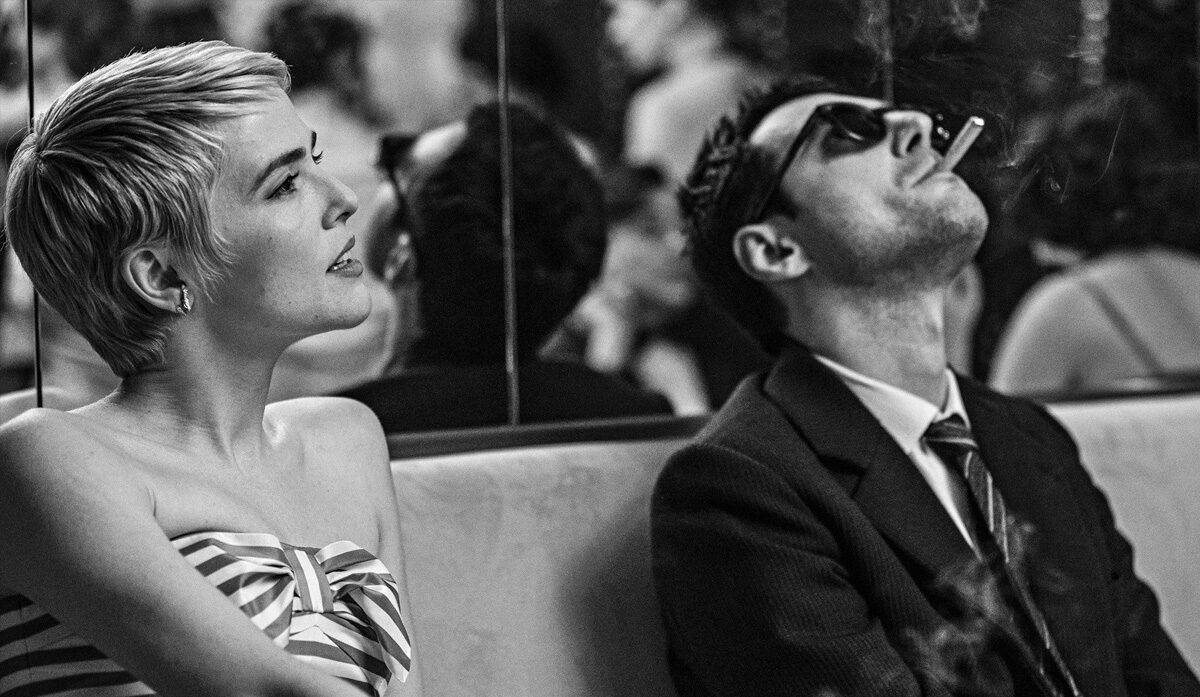
“Following the rules won’t get me where I want to go,” declares Jean-Luc Godard in Richard Linklater’s Nouvelle Vague – a line that doesn’t just define the man, but the movement he helped ignite. With this spirited black-and-white homage, Linklater dives headfirst into the messy, miraculous making of Breathless (1960), the film that detonated the French New Wave and rewrote the language of cinema. What unfolds is not just a biopic or a behind-the-scenes reenactment; it’s a cinephile’s dream. It’s a film about filmmaking that revels in spontaneity, celebrates rebellion, and honours the radical power of creative freedom.
Shot on 35mm and using a Cameflex camera like the one Godard used decades ago, Nouvelle Vague is itself a stylistic resurrection; jittery, choppy, and defiantly alive. Linklater doesn’t just replicate the aesthetic of the New Wave or Godard’s style of filmmaking – he channels its anarchic soul. The jump cuts, the handheld shots, the bursts of jazz, it all feels less like mimicry and more like a reincarnation. But this isn’t just a film that caters to the nostalgia of that moment in cinema history. It’s a knowing, sometimes humorous exploration of how cinematic legend was born from chaos, compromise, and no small amount of doubt.
Set in late-1950s Paris, the film introduces us to a restless, frustrated Godard (played with brooding charm by Guillaume Marbeck), the last of the Cahiers du Cinéma boys to make his directorial debut. While his friends François Truffaut, Claude Chabrol, and Éric Rohmer find festival glory, Godard is still scribbling in cafés and wrestling with his own ambitions. He watches The 400 Blows, wow, Cannes, and mutters, “What am I doing here?” But where others plan, Godard improvises. With a shrug and a manifesto’s worth of defiance, he pitches a low-budget gangster romance to producer Georges de Beauregard (Bruno Dreyfürst), ropes in a reluctant Truffaut (Adrien Rouyard) for the story, and casts American starlet Jean Seberg (a radiant Zoey Deutch) and amateur boxer Jean-Paul Belmondo (a spot-on Aubry Dullin) as his leads.
What follows is glorious disarray. Godard arrives on set with barely a script, sometimes with no ideas at all. He pauses production for inspiration, shoots on whims, and ignores the mounting anxiety of his crew, particularly cinematographer Raoul Coutard (Matthieu Penchinat) and script supervisor Suzanne Faye (Pauline Bell), who fear there may be no film at all. Used to the strict environment of Otto Preminger, Seberg is baffled by the lack of direction. “Utter madness,” she says. “Is it too late to quit?” And yet, somehow, from this chaos emerges Breathless, the film that would launch careers, scandalize critics, and cement Godard’s status as cinema’s enfant terrible.
What makes Nouvelle Vague so affecting is that Linklater, long a champion of cinematic experimentation himself, approaches the material not with hagiography but affection. This isn’t a tale of artistic genius delivered from on high. It’s a story of collaboration, conflict, frustration, and blind faith, while full of both exasperation and humour. Frustration that bears triumph.
Understanding the stakes requires some familiarity with the French New Wave itself. This revolutionary cinematic movement emerged in the late 1950s as a rebellion against the stuffy conventions of both Hollywood and the French “tradition of quality.” Led by critics-turned-directors like Godard, Truffaut, and Chabrol, and influenced by Italian Neorealism with the work of Roberto Rossellini (played by Laurent Mothe in the film), the New Wave embraced the raw, the spontaneous, and the personal. They shot on location, used natural light, worked with non-professional actors, and discarded traditional narrative structures in favour of emotional and philosophical immediacy. Jump cuts, long takes, characters breaking the fourth wall – these were not gimmicks, but declarations of artistic independence.
Breathless, in particular, changed everything. It tossed continuity editing out the window, played jazz with its structure, and made no apologies for its fragmented style. The film didn’t just depict rebellion – it was rebellion, against the medium itself. That Linklater’s film about its making also feels fragmented and jumpy, even incoherent at times, is no accident. It’s a formal tribute, a recreation of disorder, a mirror of the miracle that was Breathless.
Linklater, of course, is no stranger to youthful chaos. From Slacker to Boyhood, his career has been defined by the beauty of the everyday and the rebellion of form. In Nouvelle Vague, he channels this sensibility into something more reverent, but never stale. His Godard is flawed, egotistical, and maddening, but also magnetic – a man desperate not just to make a movie, but to make a statement.
One of the film’s quiet pleasures is the interplay between legendary New Wave figures before they became icons. There’s rivalry, camaraderie, and intellectual sparring. Cocteau is quoted as saying that cinema is “not a pastime but a priesthood,” and you feel that the characters understand that wholeheartedly in the alchemy of collaboration under one holy roof. You meet figures like Agnès Varda, Jacques Demy, and Jacques Rivette, mostly in passing, and are reminded that this was not one man’s movement but a collective lightning strike of ideas and ambition.
Without seeing Breathless, some viewers may find Nouvelle Vague’s chaotic style alienating. To watch one without having seen the other is like watching a making-of before seeing the film itself. It’s still engaging, perhaps, but disorganized. For those in the know, however, it’s a film that will make you appreciate Godard’s work even more.
Nouvelle Vague isn’t just about the making of a movie. It’s about the making of a movement. It’s about what happens when a generation of cinephiles decides to burn the rulebook and build something new from the ashes. And it’s about how, sometimes, the films that feel like disasters in the making end up rewriting the future of the medium. Godard wanted spontaneity. Linklater gives it to him, beautifully and irreverently. Nouvelle Vague doesn’t just honour a moment in cinematic history – it lives it.
Grade: A-
Follow us on MSN for more content like this.
Nouvelle Vague
This is the story of Godard making ”Breathless”, told in the style and spirit in which Godard made “Breathless”.
