
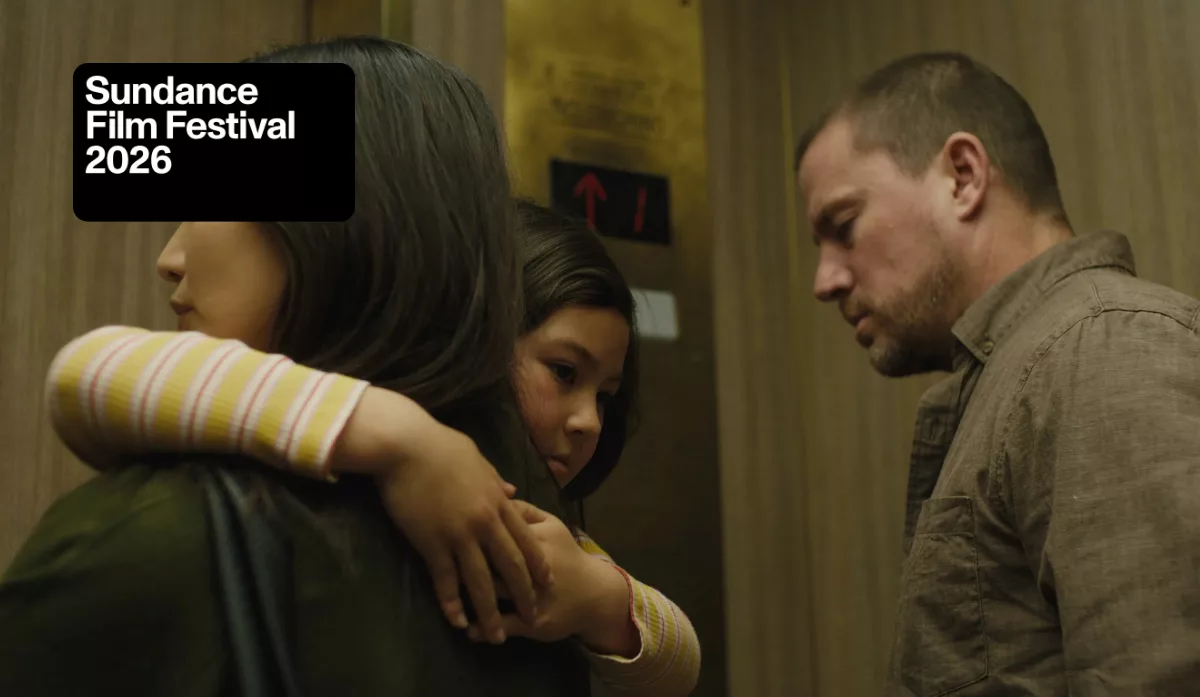
(TW: sexual assault) In Josephine, writer-director Beth de Araújo crafts a devastating and empathetic portrait of a childhood interrupted by the sudden, sharp intrusion of the world’s most jagged edges. The film begins with a ritual of safety: an early Sunday morning exercise and soccer session in Golden Gate Park. Damien (Channing Tatum) is the kind of father who wants to build his daughter into a fortress, teaching Josephine (Mason Reeves) to be unafraid, strong, and to know no boundaries to her own capabilities. It is a beautiful, warm dynamic that makes the ensuing fracture all the more harrowing.
While playing in the woods, a brief separation leads Josephine to witness a sexual assault. We see it because she sees it; the camera stays locked in her paralyzed, eight-year-old perspective, forcing us to grapple with the horrific weight of an image that no child’s mind is equipped to carry. When Damien finds her, he is initially unaware of the depth of what she has seen. The opening lesson to know no fear takes on a chilling new resonance as Josephine embarks on a journey where bravery is no longer a soccer drill but a desperate means of survival.
Josephine Review: Sundance Film Festival

Greta Zozula’s cinematography is essential in translating this internal collapse into a bold visual language. The film frequently employs slow motion and a spinning, disorienting camera to capture the scrambling nature of a traumatized brain. For Josephine, the perpetrator is no longer just “the man in the park”; he becomes a haunting, voiceless manifestation that violates her safe spaces, sitting in the corner of her bedroom like a ghost from a horror film.
The film is at its most intellectually piercing when it dissects the conflict between protection and truth. Damien tries to reassure Josephine that nothing bad will happen to her, but Claire (Gemma Chan), Josephine’s mother, argues that there is no certainty in the grim reality of being a woman in the world. This friction, the desire to maintain a safety blanket for a child versus the necessity of preparing them for a world that has already revealed its teeth, is the heart of the film’s drama.
As the titular lead, Reeves delivers an impactful performance that is nothing short of a revelation. She captures the way trauma manifests not just in tears, but in a sudden, violent acting out. Whether Josephine is eyeing a stranger in a store while clutching a toy gun or pulling a pencil from her backpack as a makeshift weapon, Reeves conveys the profound loss of a freedom that should have lasted years longer.
Tatum and Chan are equally compelling as parents who are fiercely devoted yet fundamentally ill-equipped for this specific upheaval. Tatum, in particular, finds a poignant vulnerability in Damien’s explosive frustration; he is a man who wants to protect his daughter from everything, only to realize he is scared and vulnerable himself. A visit from a detective sends the family into a tailspin, forcing Josephine to become the sole witness in a legal system that feels as violating as the crime itself.
Josephine does not offer easy catharsis. It understands that when the safety blanket is removed at such a young age, the family dynamic can never truly return to its original shape. However, the film’s conclusion marks a beginning, not of a return to normalcy, but of a shared healing process. It is a heavy, essential piece of cinema that investigates the resilience required to find one’s footing when the ground has permanently shifted.
Grade: A+
Follow us on MSN for more content like this.

Josephine
After eight-year-old Josephine accidentally witnesses a crime in Golden Gate Park, she begins to act out violently to protect herself. This emotional trauma leads to conflicts between her parents as they search for justice, and a way to feel safe again.
