
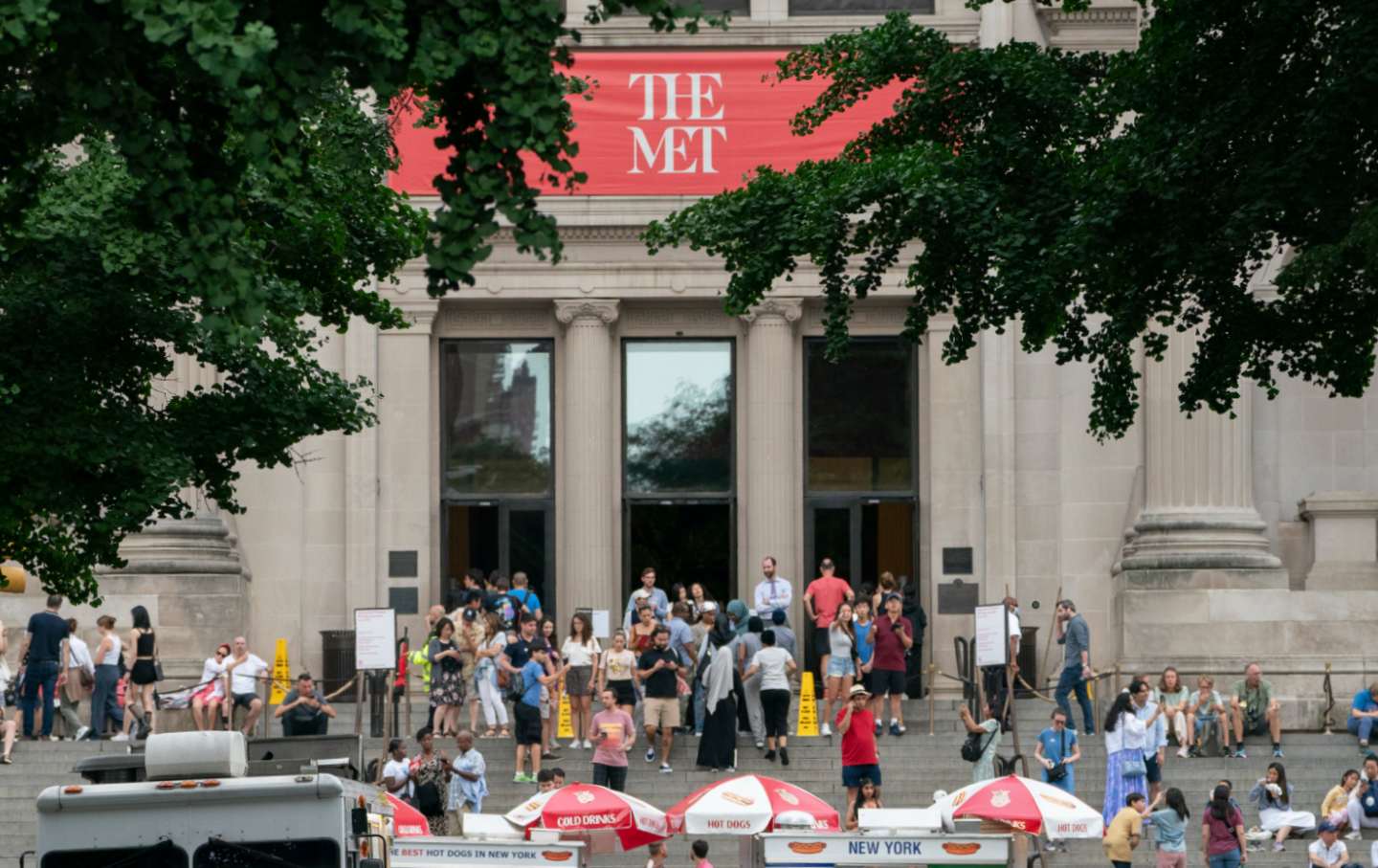
Why did the Metropolitan Museum remove the John Wilson banner that last autumn had been gracing its façade? That arresting image was made from a tiny portrait of the artist’s brother, expanded to monumental public proportions, that announced the Met’s “Witnessing Humanity” exhibit, a Wilson retrospective that continues through February 8. In the picture, the brother’s brow is steadfast, his gaze grave and alert, mouth and chin resolutely composed; perhaps no Black face has ever so effectively stared down the self-regard of Manhattan’s Museum Mile. Wilson, who died in 2015, had made the portrait in 1942 as a 20-year-old art student; “In my youth,” he once said, “the Black man was an invisible American.” For some weeks along the fanciest part of Fifth Avenue, this had not been the case.
In order to see Wilson’s intense brother now, you’ll have to venture inside the Met’s galleries 691–693, where that little picture is installed alongside over a hundred other Wilson paintings, sculptures, prints, and drawings. Wilson considered drawing to be the power source for all figurative art—a belief derived from his lifelong investigations into masterpieces from Asia, Africa, and the Americas as well as Europe. Over and over, whether in two dimensions or in three, and across a spectrum of media, Wilson the draughtsman demonstrated a line’s capacity to bear weight like a girder, or to allow, like a tightrope, an emotion to dance gracefully, almost weightlessly.
Wilson’s mark-making can provoke the viewer’s own fingertips to itch with the desire to touch, whether the mark is made with charcoal or litho ink or a clay cutter or a bristle brush loaded with paint. From the enclosing paternal shoulders of the sculpture Father and Child Reading, to the ink-and-chalk rendering of an activist’s fists flung heavenward in Oracle, Wilson’s line also creates texture.
“His drawings,” observes art historian Elisabeth Hodermarsky, “often appear to have the quality of clay or metal that has been scratched or rubbed aggressively.” In Black Soldier, a World War II–era painting of a father and husband about to be shipped across the ocean, every line feels like a live wire. The picture foregrounds the soldier’s wife and small son; the woman’s agitated contours—mouth clenched and hands locked in a protective vise-grip around her child’s face—communicate a tense silence that barely contains a volcano of outrage: that her husband is being made to fight for the freedoms of people in another country, while his own country denies those freedoms to him.
Born to a working-class Boston household of Guyanese immigrants who educated their seven children to be interrogators of the world at large, Wilson grew up reading Black newspapers like the New York Amsterdam News as well as Marcus Garvey’s Negro World, the only kind of publications regularly reporting on issues such as theft of wages from Black agricultural workers, race discrimination within the armed forces, and the domestic terror crimes routinely committed by lynch mobs. After his education at the School of the Museum of Fine Arts, Wilson won a fellowship to Paris, where he studied with Fernand Léger, an artist committed to liberating art from the parlors of the wealthy and letting it express large, shared ideas in the environments of working people. The air in Léger’s studio hummed with the accents of students from around the world whom their teacher urged to make public-facing art and to present their human subjects as companionably sharing the world on equal terms with trees, machines, clouds, and architecture. Years later, the mighty arms and neck of Wilson’s Steel Worker, rendered in deliberate slashes of pastel and gouache, would recall Léger’s exhortation to present humans, at work or at play, as authoritative participants in their contemporary environment.
After three years in France, Wilson and his new wife, Julie, the daughter of Eastern European immigrants, departed for a five-year sojourn in Mexico City. Yet because Jim Crow still reigned in the US, they had to travel in separate cars. Wilson thrilled to his new city’s massive commitment to high-quality public-sphere mural-making in schools, hospitals, marketplaces, and government buildings, the boldest of which were created by Los Tres Grandes: Diego Rivera, José Clemente Orozco, and David Alfaro Siqueiros. While there, Wilson created his own public mural—one that in his own country could have gotten him killed. The Incident depicts a Black mother clutching her infant while her husband keeps vigil by the window with a shotgun, as in the street outside a hooded mob of Klansmen have just lynched a Black man and are hoisting his body aloft, noose around his neck, like a trophy. While the mural itself no longer exists, the Met show features numerous studies for the work that viscerally communicate its horrific impact.
Current Issue
In his depiction of the most ordinary of private or public gestures—an infant sleeping peaceably in his father’s large hands, a laborer on a work crew brandishing a trowel to cement a wall—Wilson declared that he “was trying to make Black people become really visible, in a world that would only see us (when it bothered to look) as undeveloped.” This assertion of visibility is nowhere so striking in its expression as in the massive Eternal Presence, a seven-foot sculpted head rising out of a grassy sward in his home neighborhood of Roxbury (of which a bronze maquette is on display at the Met).
The head represents a goal Wilson relentlessly pursued throughout his long career: to make art that declares a Black presence while simultaneously aspiring to embrace all humankind, to ratify the existence of all ethnicities and genders. Deliberately made neither identifiably male nor female, the sculpture reads as Black but not only as Black: Eternal Presence acknowledges at once the sculpture of numerous cultures, including those of Benin in West Africa, Olmec in Mesoamerica, and Buddhist Asia. Every September, Eternal Presence’s Roxbury neighbors gather for the solemn duty of sculpture-cleansing: cloths and brushes in hand, some kneel at ground level while others scurry up ladders, participating in a ritual of both honoring and ownership.
The Wilson work with which most people are familiar stands in the Rotunda of the US Capitol—a bust of Martin Luther King Jr., conspicuous in its lack of great-man heroics or hagiographic otherworldliness. Instead, it tilts slightly, in undemonstrative humility, off-center: the gesture of a head engaged in thought. For years after the installation of the bust in the late 1980s, Wilson persisted in making two-dimensional versions of the King portrait—in drawings as well as in a variety of print techniques. As evidenced in the Met show, these drawings, etchings, and lithographs may be the most complex and thrilling images ever made of King; in them, he never looks conventionally heroic, resolute, or commanding. Instead, they capture the weight and intensity of the obligations King had assumed on behalf of millions of people without power. Like Jesus in the Garden of Gethsemane contemplating his death at the hands of ideological foes, the King in these images is seen reckoning with the burden he has undertaken—a burden within which undoubtedly roiled contradictions, second thoughts, and hesitations as well as firm commitment. It is only out of such cerebral and emotional turmoil that any gesture of world-shaking bravery can emerge; Wilson’s portraits bear breathtaking witness to the human cost of King’s outsize courage, and thereby to the vast scope of King’s achievement.
For decades, John Wilson was an instructor in the art school at Boston University. He taught among colleagues not one of whom possessed his range of mastery across the platforms of painting, drawing, sculpture, and printmaking, nor his deep firsthand knowledge of other cultures and languages. Yet while the people who hired him taught the prestigious advanced studio courses, Wilson was relegated to the humblest rung on the course ladder: teaching Basic Drawing to first-year students. How lucky were those 18-year-olds, who at such a young age got their sense of art’s job vastly expanded through the example of one singularly brilliant teacher, who’d devoted a lifetime to the urgent work he called “the business of looking.”
Over the past year you’ve read Nation writers like Elie Mystal, Kaveh Akbar, John Nichols, Joan Walsh, Bryce Covert, Dave Zirin, Jeet Heer, Michael T. Klare, Katha Pollitt, Amy Littlefield, Gregg Gonsalves, and Sasha Abramsky take on the Trump family’s corruption, set the record straight about Robert F. Kennedy Jr.’s catastrophic Make America Healthy Again movement, survey the fallout and human cost of the DOGE wrecking ball, anticipate the Supreme Court’s dangerous antidemocratic rulings, and amplify successful tactics of resistance on the streets and in Congress.
We publish these stories because when members of our communities are being abducted, household debt is climbing, and AI data centers are causing water and electricity shortages, we have a duty as journalists to do all we can to inform the public.
In 2026, our aim is to do more than ever before—but we need your support to make that happen.
Through December 31, a generous donor will match all donations up to $75,000. That means that your contribution will be doubled, dollar for dollar. If we hit the full match, we’ll be starting 2026 with $150,000 to invest in the stories that impact real people’s lives—the kinds of stories that billionaire-owned, corporate-backed outlets aren’t covering.
With your support, our team will publish major stories that the president and his allies won’t want you to read. We’ll cover the emerging military-tech industrial complex and matters of war, peace, and surveillance, as well as the affordability crisis, hunger, housing, healthcare, the environment, attacks on reproductive rights, and much more. At the same time, we’ll imagine alternatives to Trumpian rule and uplift efforts to create a better world, here and now.
While your gift has twice the impact, I’m asking you to support The Nation with a donation today. You’ll empower the journalists, editors, and fact-checkers best equipped to hold this authoritarian administration to account.
I hope you won’t miss this moment—donate to The Nation today.
Onward,
Katrina vanden Heuvel
Editor and publisher, The Nation
