
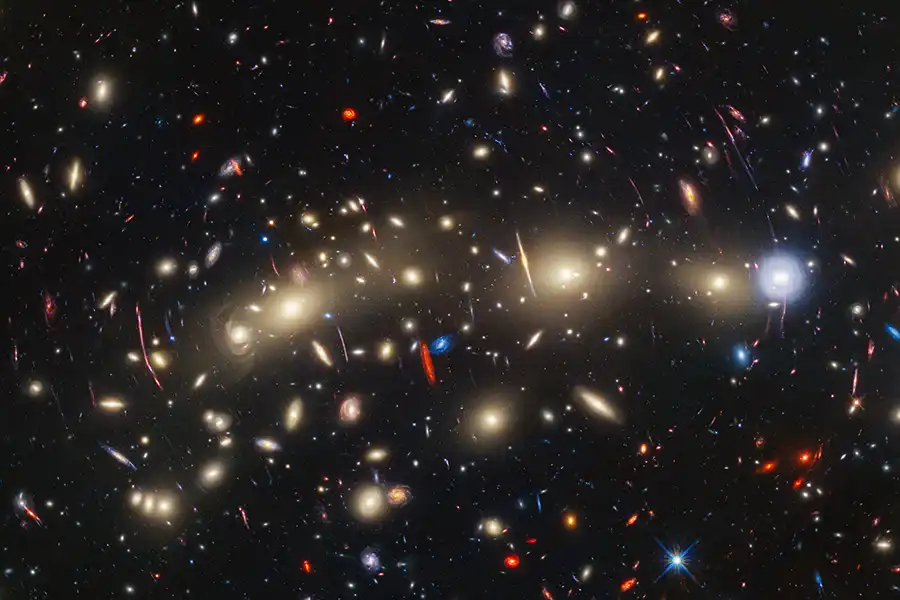
Image: NASA, ESA, CSA, STScI, Jose Diego (IFCA), Jordan D’Silva (UWA), Anton Koekemoer (STScI), Jake Summers (ASU), Rogier Windhorst (ASU), Haojing Yan (University of Missouri); Image Processing: Joseph DePasquale (STScI)
Using the James Webb Space Telescope, astronomers might have spotted some of the first stars to form after the Big Bang.
Just like humans, stars exist in multiple generations. This lineage comes down to the amount of elements heavier than hydrogen and helium they contain.
Immediately after the Big Bang, hydrogen and helium were the only two elements to exist in any sizeable quantity. So when the first stars formed — what astronomers refer to as Population III stars – they were made of only hydrogen and helium. When those massive stars died in supernovae, the explosions forged the heavier elements that became part of the next generation of stars, what astronomers term Population II stars. Then, when those stars perished, they enriched Population I stars such as the Sun with still more heavy elements.
Of all of these, Population III stars are particularly challenging to observe. Not only did they exist a long time ago, meaning they are incredibly far away, they also lived particularly short lives.
Now, a team led by Eli Visbal (The University of Toledo) has reported in the Astrophysical Journal Letters the discovery of potential Population III stars. The cluster they reside in, known as LAP1‑B, is possibly the core of a tiny, early galaxy. The universe was just 800 million years old when its light set off for Earth. The ancient cluster is visible in part because a foreground galaxy cluster — MACS J0416 — magnified the background stars’ light by a factor of 100.
Finding this early population of stars is important for more than understanding star formation. “They teach us about the earliest stages of galaxy formation and evolution,” says Visbal. “They may also constrain the particle nature of dark matter, since some proposed dark matter models impact where Population III stars first form.”
There have been claims of Population III stars before, but none have satisfied all three of the main theoretical predictions for how and where these stars should appear. “In the standard model of cosmology, Population III stars are expected to form in very small dark matter structures that serve as building blocks for larger galaxies,” Visbal says. LAP1‑B ticks that box. Also, the cluster’s spectrum is consistent with a total mass of about 1,000 Suns. “This is about the total mass of Population III clusters we see in numerical simulations,” he adds.
The third clue lies in the types of stars the cluster seems to contain. Theory predicts that Population III systems should be dominated by massive, short-lived stars, since hydrogen and helium gas can’t cool as easily, making it harder to fragment those early balls of gas into smaller, longer-lasting stars. The spectrum of LAP1-B matches the prediction, indicating a population weighted heavily toward the high-mass end.
Harley Katz (University of Oxford, UK), who was not involved in the research, agrees that these observations may be consistent with the trio of predictions regarding Population III stars. “Unfortunately, this does not necessarily mean this is a Pop III system,” he says. “Nevertheless… it is so far the closest we have come.”
One key issue is that LAP1-B’s spectrum shows weak emission lines that indicate the presence of heavier elements, known as metals, such as oxygen and possibly carbon. “The fact that we see any metal emission is worrying, as Pop III stars by definition form from metal-free gas,” Katz says. These signals could mean the system’s gas has been lightly enriched by the deaths of an earlier generation of massive stars.
Visbal concedes that we don’t know for sure. “Deeper observations, improved simulations, and additional similar sources would help to build confidence,” he says.
