
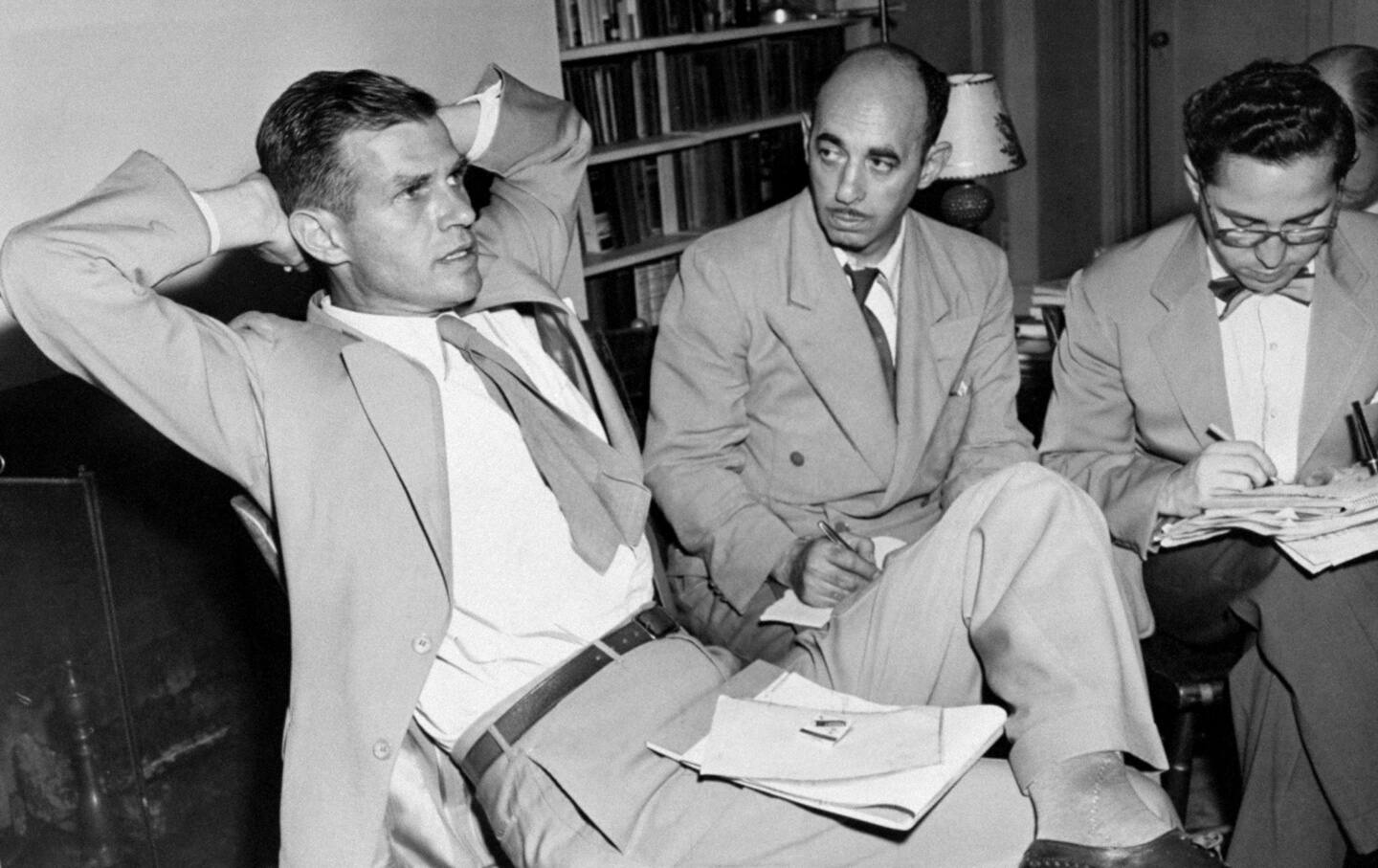
Jon Wiener: From The Nation Magazine, this is Start Making Sense. I’m Jon Wiener. Later in the show: 20 minutes without Trump: in 1948, Alger Hiss, a prominent New Deal Democrat, was charged with spying for the Soviets, and was eventually convicted. The conventional wisdom is that he was probably guilty. Now, Jeff Kisseloff says it’s not hard to show that Hiss was innocent; the hard part is figuring out who framed him. Jeff’s new book is “Rewriting Hisstory: A Fifty-Year Journey to Uncover the Truth About Alger Hiss” – we’ll speak with him later in the show. But first: From the Red Scare of the 1950s to Donald Trump – historian Beverely Gage will comment. That’s coming up – in a minute.
[BREAK]
Has there ever been anything in American history like Trump’s attack on the universities? Princeton President Chris Eisgruber, one of the first to refuse to submit to Trump’s demands, says what we are seeing is “the greatest threat to American universities since the Red Scare of the 1950s.” For comment on that, we turn to Beverly Gage. She teaches American history at Yale. Her book on J. Edgar Hoover, titled “G-Man,” received the Pulitzer Prize in Biography, the Bancroft Prize in American History, and the National Book Critics Circle Award for Biography. It was named the Best Book of the Year by The Washington Post, The Atlantic, The New Yorker, and The New York Times, we talked about it here – actually one of our best segments of the year. So it’s a pleasure to say, Beverly Gage, welcome back.
Beverly Gage: Well, it’s good to be back, Jon. I’m sorry for the occasion, but these things do become relevant again.
JW: Trump vowed during the campaign to do something about the “Marxist maniacs and radical left lunatics running our colleges and universities.” That does sound a lot like the Red Scare of the ’50s, something you know a lot about. But most people I talk to say what Trump is doing is not just the greatest threat since the Red Scare. They say it’s worse than the Red Scare.
Of course, most of what Trump is starting to do, the huge funding cuts in research, is being challenged in court, now with Harvard in the lead, and we don’t yet know how those cases will be resolved; but you’ve been thinking about the similarities and differences.
Of course, there’s lots of differences, but the similarities are stronger than I realized until I read your piece on this in The New Yorker, so let’s start there. How did the attack on the universities work in the ’50s? The confusing thing here is that the ’50s have been called the Age of Consensus, but that’s not what all these investigations suggest.
BG: There are a lot of similarities. And of course there are some big differences. The Red Scare of the 1950s did not go after universities as institutions in the same way. And of course, until the late 1950s, there wasn’t this kind of federal funding for universities, and so you had just a very different set of operations.
But I think the similarities are as interesting as the differences. Certainly, even though we are more than three decades out from the end of the Cold War, the language of anti-communism, of anti-socialism, of the Marxist lunatics running everything, secretly infiltrating all of our major institutions, in this case, including the FBI, according to Trump, which J. Edgar Hoover certainly would not have appreciated. That language has deep roots in the 20th century, of course, in a slightly different context.
Operationally, I think we see a lot of the same tools that were used in the Red Scares of the 20th century being trotted out again, everything from deportation as a mechanism for suppressing speech, attacks on federal workers, and, of course, this big accusation that universities — that are, then and now, mostly pretty moderate conservative institutions in lots of ways — are nonetheless being denounced as these hotbeds of wild-eyed radicalism.
JW: I think the biggest single difference in the attacks on the universities was that McCarthyism focused on individual professors and their past political activities. This was all about investigations of individuals who then were fired or forced to quit. The current attacks, of course, include students who are active in campus protests around the Gaza War, but also the DEI programs of the universities. This whole idea of bringing viewpoint diversity to academic departments, faculty members, and courses, which was part of the demands made of Harvard, they didn’t do that in the ’50s. I guess they didn’t really need viewpoint diversity in the ’50s. We’ve also seen attacks on trans athletes, something we didn’t have in the ’50s. The attack on the university today has a much broader set of targets. But one of the things that your New Yorker piece taught me was that I had forgotten about how big the attack on government employees was. This was a huge part of the Red Scare in the ’50s.
BG: A lot of the Red Scare really started with this targeting of federal workers. You’d had the New Deal, in which you’d had a big expansion of the government, and then World War II, when the size of the government really exploded. During that time, you did have Soviet infiltration and espionage operations going on. All of these things really combined when we got to the late ’40s to make up the first phase of the Red Scare, which was loyalty oaths for government workers, investigations of government workers –It’s worth noting both for their left-wing affiliations but also for their sexuality. We did, in the Red Scare, have a kind of variant on the attacks that you’re seeing now on trans people. At the time, it was on gay federal workers. That all really was underway, happening in an aggressive way, before Joe McCarthy was ever on the scene. It was both an attack on people’s political speech, but also, as now, an attempt to roll back liberalism, roll back the New Deal, force certain set of ideas out of public discourse in a definitive way.
JW: That is a really striking thing to me. If we look at the big picture, the greatest similarity between the firings of the Red Scare and the Trump budget cuts is the way they have used as a political weapon against the same opponent, the New Deal.
BG: It remains our reference point. It’s kind of the great romance of a certain kind of left. We’re still looking back to the New Deal. If you look not only at Trump’s anti-Marxist or anti-government agenda but quite literally his economic policy, a lot of that is trying to go back to some moment before the 1930s. It’s interesting that the New Deal remains such a reference point, because I had this shocking but obvious realization a few years ago that it was almost 100 years ago. It’s been almost a century since the New Deal but people still feel very strongly about it.
JW: You report on the extent of the investigation during the ’50s of federal employees: 26,000 federal workers were targeted by the FBI with in-depth investigations of their political past. I mean, it’s a huge number. Of course, it’s a lot less than the number of people who are facing firing right now, but at the time especially, it was a huge proportion of the federal workforce.
BG: It was a big part of the federal workforce. It was also new. The idea that federal workers were going to be subject to loyalty oaths, to background investigations, to security investigations, all of that was just being invented in this moment. There was a lot of opposition to it. It seemed dangerous to lots of people, but it nonetheless became federal policy in the midst of World War II and then the Cold War, and there are the people who were fired.
But I think one of the things that you really see in the federal workforce in the ’40s and ’50s, and the historian Landon Storrs has written about this very well, is that it had its intended effect of making everyone else shut up, put their heads down, not say anything, moderate their ideas, and hope that they, themselves, were not going to be fired.
JW: We’ve said Trump has targeted a lot more federal employees, a lot more people than existed in the ’40s and ’50s, but there’s one respect in which the Red Scare was a lot bigger than what Trump is doing, in that the purge of leftists in the ’50s was carried out not just by the federal government but by state governments and even municipal governments, which had their own investigations of their employees.
BG: That’s right. One of the things that was really interesting in writing about Hoover is that you saw all this activity at the federal level. Some of which was very open, things like congressional hearings, some of which was much more secret — surveillance, private investigations, civil service investigations, loyalty hearings. And then you had this enormous network of people in state government, in local government, who were working with the FBI and had their own red hunting squads – private business, the defense industry. Everybody is involved in this anti-communist network that comes into being very powerfully and very suddenly in just a few key years after World War II.
JW: Of course, there was the Hollywood blacklist. It began in 1947 with public hearings held by HUAC, but the blacklist itself was enforced not by the government but by the studios, private companies. Not only did they fire all the actors and directors and writers who had been members of the Communist Party, they also fired all those who refused to name names, who refused to get their friends in trouble. In order to get off the blacklist, to go back to work, not only did you have to name names – you also had to thank HUAC for giving you the opportunity to demonstrate your support for their work.
State governments had their own versions of HUAC. California was one. It was the same kind of thing, of people trying to make political careers in state politics by having aggressive investigations and exposing that state employees had been disloyal. And California wasn’t the only state with its own version of HUAC.
BG: Well into the 21st century, I don’t know if it’s still the case, every employee of the California University system had to take an anti-communist loyalty oath to the United States. That, too, was a product of this moment in the Red Scare.
JW: Of course, there’s one direct link between the Red Scare and Donald Trump – Roy Cohn.
BG: Roy Cohn is, when you peel back the layers, maybe the answer to it all. But right, Roy Cohn was Joe McCarthy’s right-hand man, counsel for the McCarthy Committee. He became a pretty prominent and pretty powerful right-wing attorney, but most of all, became this pugilist figure in New York politics in the latter part of the 20th century. He met a young Donald Trump. He explained to Donald Trump that the way you win is by fighting, and fighting, and fighting, and saying the things no one else will say and doing the things that no one else will do and worrying about the consequences later.
JW: The Red Scare worked on fear and intimidation. And then it sort of faded away. How did that happen?
BG: The Red Scare was most intensive from the late ’40s up till about 1954, so it faded away, yes, but lasted really – a pretty long time. That is almost a decade in which this was at the center of American politics, is one of the most important and significant things that the federal government is doing, and in which the American left is really on the ropes, totally embattled. The leadership of the Communist Party has been put in prison for speech crimes. The large organizations of the American left are sort of in hiding. Even the American Civil Liberties Union and the NAACP, these big organizations, are having internal fights about communism.
JW: And are purging their own members who have communist ties.
BG: Exactly. A lot of left liberal alliance, that was so important to the politics of the ’30s and ’40s, really is decimated in the ’50s and then has to be reinvented.
But to say that this lasted a long time and did a lot of damage is not to say that it lasted forever, because in fact, nothing in history really seems to last forever — so that’s often quite a comforting thought. It also means that your victories aren’t likely to last forever either.
But in this case, I think it was a combination of factors. Some of which had to do with the Cold War context and the end of the Korean War in particular; some of which had to do with the civil liberties movement that emerged during this period and that began to mount legal fights that were often not successful at first but ultimately began to have some success in the mid ’50s.
And then there’s also a way in which, after the first shock and the first blow, people start to organize, they start to question. They start to think, “Hey, this guy McCarthy seems like he’s pretty out of control, and maybe we’re not as scared of him as we were at one point.”
Finally, there are the famous Army-McCarthy hearings in 1954, which I think are really a case study in overreach, that McCarthy was so sure he could go after anyone, say anything about anyone, that he went too far, and he got quite a lot of pushback.
JW: In some ways, the key to the end of McCarthyism was the end of Joe McCarthy. He had come to personify this entire political movement, and because he was so, let us say, flawed, his fall brought down the whole thing. He’s a little like Trump, don’t you think?
BG: I do think that Trump is quite like McCarthy in his style. McCarthy liked to grab headlines, make the big hit. When people said, “Wait, I think that thing that you just said isn’t really true,” he would be onto the next thing, he would be targeting his enemies. He was a bully, he liked to intimidate people, and he thought that that would succeed forever. Of course, we know that it succeeded for a while and then it didn’t.
The big difference, of course, is that McCarthy was a senator, and the Republican president in the mid-’50s, Dwight Eisenhower, was a very different sort of leader. He did not like McCarthy, and he helped to orchestrate the Republican Party really to take McCarthy down, along with lots of other factors.
I don’t see that happening with Trump, who is, of course, much more powerful than McCarthy. We still have, I would say, some fractures within the Republican Party, but it’s a pretty unified juggernaut. But I think we can rest assured that that is not going to go on forever. The question is, what will the cracks be? What’s the real overreach? How long is this all going to take, and how much damage will be done in the meantime?
JW: In your piece on this in The New Yorker, you say that “Trump’s firings, federal inquiries, and acts of public humiliation have had some success, but may not be quite as effective as similar efforts in the ’50s were.” Why is that?
BG: In the ’50s, though you had figures like McCarthy or like J. Edgar Hoover, who were really pushing the anti-communist agenda, there was something like a consensus around the idea that communism was bad, that it should be purged from American life. You saw that among liberals, you saw that among conservatives, and you only had a very few people fighting back against that.
Now, I think, we have a much more divided situation. The sorts of things that Trump is doing — they have their constituency, but they are nothing like a consensus in American life. We also have very powerful civil society in the United States that has the ability to push back, and perhaps, most importantly, we have a history of civil liberties, activity, activism, law, that was just being invented in these earlier moments. While it can sometimes feel that, if you’re on the left right now, everything is against you, that’s true of the Supreme Court, and the Congress, and the President, but those are only a few of the tools that have ever been used to fight back, to make change in the United States.
JW: Beverly Gage – she wrote about the Red Scare of the ’50s and its similarities and differences from Trump’s attacks for The New Yorker. Bev, thanks for talking with us today.
BG: Thanks, Jon.
[BREAK]
Jon Wiener: Now it’s time for 20 minutes without Trump, a special feature of this broadcast. Return with us now to 1948 to the Alger Hiss case, one of the most sensational and politically significant spy stories of the 20th century. Now there’s a new book out that blows that case wide open. It’s called Rewriting Hisstory: A Fifty-Year Journey to Uncover the Truth About Alger Hiss. The author is Jeff Kisseloff. He’s a former newspaper reporter and editor who’s writing has appeared in The New York Times, The Nation, other places. He’s also the author of five books, including You Must Remember This: An Oral History of Manhattan from the 1890s to World War II. We reached him at home today in Tucson. Jeff Kisseloff, welcome to the program.
Jeff Kisseloff: Thanks for having me.
JW: Let me summarize the case briefly. Alger Hiss, a prominent New Deal liberal, was accused of being a Soviet spy by a confessed communist named Whitaker Chambers. Hiss denied it. He was charged with perjury for denying it, and eventually, he was convicted in a jury trial.
The Alger Hiss case is important for a couple of reasons. First of all, because he was a representative of the New Deal. If he had been a Soviet spy, then the Republicans were right about the Democrats being soft on communism.
The Hiss case is also important because it was the first step in Richard Nixon’s rise to power. Nixon was a member of Congress who served on the Un-American Activities Committee, the main force there supporting Chambers going after Hiss. It’s been said, “Richard Nixon: Hiss is your life.”
Historians have been debating the guilt or innocence of Alger Hiss ever since. The conventional wisdom today is that Hiss was probably guilty. But you say it’s not hard to show that Whitaker Chambers was lying, that Alger Hiss told the truth when he said he was not guilty of espionage. The hard part, you’ve said, is figuring out who faked the evidence that led to the conviction of Alger Hiss for perjury. So let’s go back to the beginning. What’s the key evidence that Hiss was not guilty?
JK: There was no motive. Really simple. They always said that he was a member of the Communist Party and that his wife was a communist too. He wasn’t. The Communist Party records show that he wasn’t. The big evidence they used against him was that he was supposedly a member of something called the International Juridical Association, which HUAC put on its list of subversive organizations. I got 120,000 unredacted FBI files that were sent to me a few years ago, and in there was one document, which I think was one of the most important that I have ever seen, which was an interview with Shad Polier, who was one of the people associated with the IGA. And it turned out that they brought Alger into this group because they were looking for liberals to come in, not communists, because they wanted to build up the readership. And that’s the only reason why he came in.
JW: We need to talk about the Pumpkin Papers, the most famous evidence in the case. If anybody remembers anything about the Hiss trial, it’s the Pumpkin Papers. Here’s the story. In 1948, Whitaker Chambers brought investigators from HUAC to a pumpkin patch outside his house in rural Maryland. He opened the top of one pumpkin that had been hollowed out. There, he had hidden what he said was microfilm of secret documents that Alger Hiss gave him to transmit to the Soviets. The Pumpkin Papers then became a key piece of physical evidence at the trial. Some called them “the star witnesses against Hiss.” One of the most interesting things in your book is the content of the pumpkin Papers. What were the secrets there that Whitaker Chambers said Alger Hiss gave him to transmit to the Soviets?
JK: Well, let’s see. There was one document about what color to paint fire extinguishers. And how do you fold a life raft from World War I? These came from the Bureau of Standards. Anybody could have gotten those. There were, I think 48, 58. I don’t have it in front of me, but all of these frames of pictures of documents out of which three documents went to Alger’s office and three were initialed by Alger. And they said that this was proof that he had given them to Chambers. But nobody bothered to think about this, right? If Alger was going to give a document to Chambers, a document that had been sitting on his desk, why initial it first when it could be seen afterward that he was the one who gave it? Why not just give him the document, get it back from Chambers, and then initial the document? And you can call Alger a lot of things, but I don’t think stupid is one of them.
JW: The Pumpkin Papers had been typed. They and other documents, Chambers said, Hiss gave him to transmit to the Soviets, were typed copies of official documents. Whitaker Chambers said that Alger Hiss’s wife, Priscilla, had copied them on her own typewriter at home. Manual typewriters left unique traces that could be identified. And the prosecutors argued in the trial that the typing on the Pumpkin Papers had been done on Priscilla Hiss’s typewriter. So the typewriter was a key piece of evidence. And you’ve done a lot of work on the typewriter.
JK: We went down to the house on 30th Street where Priscilla supposedly typed these documents, and the house was about the width of Kareem Abdul-Jabbar’s wingspan. And it turned out from the defense files that they talked to the people who lived on either side, they talked to the people who lived across the street. Nobody ever heard any typing. They heard the piano playing. They heard Alger in the bathroom in the morning, but no typing. And so, what the government said was that letters that Priscilla Hiss had typed in the 1930s, the typing of those letters matched the typing of the documents, and that was the key.
So anyway, what I did was I took a tape recorder and I put it two rooms away from me with a lot of insulation in between and then typed on the machine. And then I went to see if I could hear the machine being typed. And on the tape recorder, it was clear as day. So I had no doubt that anybody would’ve heard this thing. And then you have to ask yourself, why would the Russians permit such risky activity? This stuff could have been microfilmed, of course. But would they allow such a high place spy to be typing five nights, six nights a week, where everybody could hear, and somebody was going to ask questions? Nobody ever did. because nobody ever heard it. Because she didn’t type the documents.
JW: What’s your view of the typewriter?
JK: I believe the typewriter was a typewriter that was manufactured too late, about 1929 – 230099, according to the Woodstock records – was manufactured mid-summer 1929. The company that bought the typewriter which was owned by Priscilla’s father, bought the typewriter in 1927, which would’ve been a much earlier serial number.
And one of the reasons why I was able to figure this out was the defense hired a fellow named Dan Norman to look at the machine, and he found in comparison to other typewriters that the solder on certain keys were dripping all over the typebar. And the government’s answer was, well, all machines were like this. And so I went out and bought 20 Woodstock typewriters, which were sitting in my garage, and I had somebody photograph all of the typebars on those typewriters and compare them to 230099 to see if Dan Norman was telling the truth. And he absolutely was telling the truth. I mean, there was no question about it.
JW: So none of the other 20 Woodstock typewriters had solder dripping from the keys, which the one presented in the trial did. That meant some of the keys had been changed – presumably to match Priscilla Hiss’s. So your view is that the typewriter that Priscilla Hiss used to type her personal letters was not the same typewriter that typed the documents that were presented in trial, that it seems as if the typewriter presented in trial was a forgery.
JK: That’s correct.
JW: Years after the conviction, the government released the Venona Papers. These were transcripts that military intelligence held at the highest level of secret classification, of intercepted Soviet documents from the end of World War II that the United States was able to decipher some of them. And there were a couple of pages that said the Soviets had a spy in the American delegation at Yalta, where Alger Hiss had been part of the American delegation. He was a spy who had the code name, Ales, A-L-E-S. I’ve also heard it pronounced A-les. and written in the margin of this document; it says, “probably Alger Hiss.” This made headlines in 1995 when it came out, “probably Alger Hiss.” What is your understanding of the Venona Papers naming “probably Alger Hiss”?
JK: Well, that was a guess that somebody just advanced after seeing the papers. Just one person. I have a claim to fame. I was the first civilian ever to see Venona back in 1977 when the FBI documents were given to us. Lo and behold, there was the Venona translation – and Alger was standing right next to me when I saw it.
JW: One of the things the Venona Papers said was that the Soviets gave Ales an award for his loyal service to them.
JK: That’s right. And I remember asking Alger about this, and he just looked at me like, “You’re out of your mind.” I don’t remember what he said, but the reason why we got that document was that J. Edgar Hoover did not believe it. And for two and a half years, the FBI investigated this and finally determined, after George Kennan, who was no fan of Alger, said there was no way that they were going to give him an award. And Kathleen Harriman said the same thing. Both had been at Yalta with Alger. They said, “Forget it. It’s not true.” That’s when J. Edgar Hoover closed the investigation.
JW: So the evidence that Hiss was not guilty: he had no motive, he wasn’t a communist, he wasn’t even a leftist. The documents seem like they were never typed in the apartment where the Hisses were living.
So if Hiss was innocent, then who faked the evidence that led to his conviction? And you have a method. You use the same approach that we know detectives use in trying to solve crimes. You focus on three things: Who had the motive, the means, and the opportunity. This search for who faked the evidence took you a long time.
There’re some obvious suspects. I would say number one is — how about Richard Nixon? He certainly had the motive. His whole career depended on Hiss being guilty.
JK: That’s correct. But the conspiracy to convict Alger of a crime goes back actually to 1941 when he was set up twice by two men with fake paper, fake typing, using basically the same technique that we saw in 1948. And so, while Richard Nixon definitely had the motive, he, to some extent, had the means, these two guys were after Alger over about 10 years—
JW: And that’s ten years before Nixon went to work on the Alger Hiss case.
JK: — and they tried over and over and over again, not only to destroy his career, but almost to destroy him.
JW: So if you think it wasn’t Richard Nixon, what about J. Edgar Hoover and the FBI, they certainly had a lot of technical capability to do things like forge typewriters. Why don’t you think it was J. Edgar Hoover and the FBI?
JK: One of the things that the defense did back in the ’70s later on, would talk to some ex-FBI agents. And they all said a couple of things that if they tried to do this, there would be one agent who would object and who wouldn’t stay quiet about it. Now, the FBI played a prominent role in the case. They made sure that Alger Hiss was convicted, and they did this by intimidating witnesses. They did this by preparing Whitaker Chambers and Esther Chambers for trial just over and over again, going over their testimony. And they destroyed several defense witnesses who had great credibility, but who were ruined as witnesses. So their whole point was to make sure there was a conviction. But I believe that the typewriter was handed to them. I don’t think that they knew it was out there. In fact, there’s a document in which when the defense comes up with 230099, J. Edgar Hoover says, “I don’t think that was a typewriter.”
JW: So it wasn’t Richard Nixon, it wasn’t J. Edgar Hoover and the FBI. It was these two other guys who’d been, shall we say, obsessed with Alger Hiss, focused on destroying Alger Hiss for a long time. Who were they?
JK: One of them was Ben Mandel, who as a Communist Party member, went by the name of Burt Miller. He worked on The Daily Worker and his coworker was Whitaker Chambers. For some reason, he had an obsession with going after Alger that goes back to, oh, about 1940, 1941. They were very angry about the New Deal liberalism, that really got them. And Ben Mandel and J.B. Matthews when they were at HUAC, submitted over 1,000 names of subversives in the New Deal to Francis Biddle, said that they should be fired. I think Biddle found one name of person who should be reassigned, but that was really the beginning. And from 1941 through 1948, Ben Mandel tried everything he possibly could to destroy Alger, and there was no way that they were going to stop in 1948. In fact, Ben Mandel outlined the plan for the hearings in the summer of 1948, which was specifically designed to win the election in November.
JW: So Mandel and his associates had the motive, the opportunity. What about the means? How did the prosecution forge the typewriter?
JK: I think I stated this right in the beginning. We’re not going to see a receipt that says, “one forged typewriter.” It turned out that they could do this fairly easily. During World War II, typewriter forgery was commonly used. The FBI had the ability to do it. The British had the ability to do it. It wasn’t that difficult. The British used a couple of criminals up in Toronto to forge their notes. I just don’t think it was that difficult. It just didn’t have to be perfect. They just needed to do it enough to convince a jury. And I talked to one of the jurors. You could have convinced her of anything frankly, if it had to do with Alger being a communist or his wife being a communist.
JW: Last question, your motive. You spent 50 years on this case. What does this case mean to you personally?
JK: Well, it could mean that I’m very slow, actually.
JW: You did write five other books during this period, so—
JK: It’s a tough question. It is a political case, and the politics were important to me. And I think the case showed that what happens when the full force of government is brought down on one person, what it could do and how it could destroy people and I think we’re seeing that today. And it also shows what happens when a small group of people are determined to have an impact on this government in what I think are the wrong way, how they can do that.
But it also was personal. I was raised to believe that injustice needs to be addressed and corrected. And once I became convinced that Alger was innocent, this was an injustice that I needed to do something about, and I was going to see this to the end. It was a really difficult process, but I was determined that I address a wrong, and I think I have. It took a long time. It just seemed like this was the right thing to do once I determined what had happened.
JW: Jeff Kisseloff — his new book is Rewriting Hisstory: A Fifty-Year Journey to Uncover the Truth About Alger Hiss. Jeff, thank you for your 50 years of work on this, and thanks for talking with us today.
JK: Thank you very much.
