
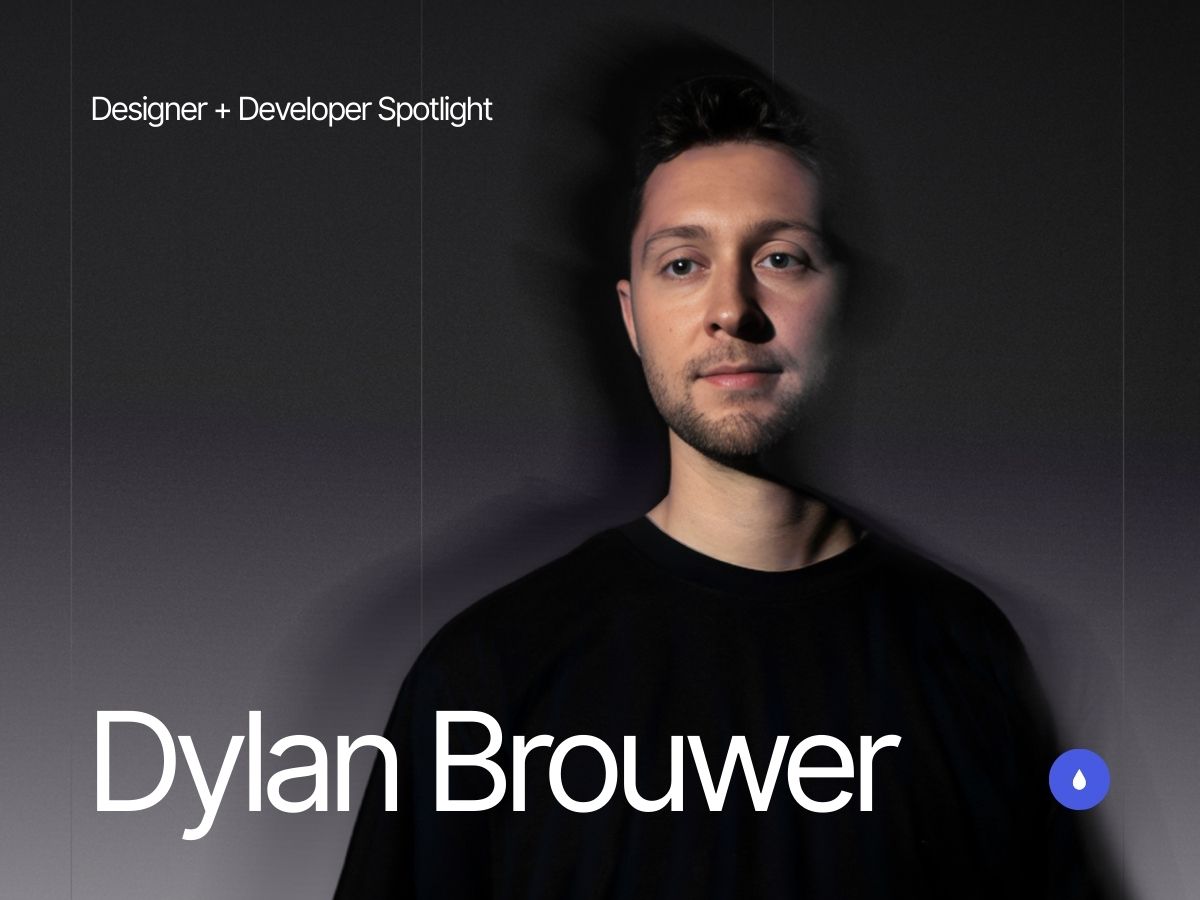
Hi! I’m Dylan Brouwer, a Dutch digital designer and Webflow developer working at the intersection of brand design, UX, and motion. I help brands and creative teams craft expressive websites that feel bold, intuitive, and built to stand out.
While I work mostly in no-code (Webflow is my playground), I’ve always been excited by the overlap between design and development. What really lights me up is how today’s tools let designers like me bring interactive experiences to life, without needing to write everything from scratch.
A few years ago, I never imagined I’d be able to build the kind of expressive, animated, interaction-rich sites I create today. Sure, I’m not your classic “technical dev,” but with Webflow, some front-end fundamentals, a bit of ChatGPT, and resources like Osmo Supply in my toolkit, I can get surprisingly far. And honestly, that feels pretty awesome.
It’s also a bit surreal (and kind of funny) to be featured in a Designer & Developer Spotlight. For a long time, I didn’t even consider myself a developer. Codrops has been a huge source of inspiration for me throughout my journey, so it’s a real honor to share my work here.
Portfolio ©Design by Dylan
- Type: Personal portfolio
- Tech: Webflow, GSAP (ScrollTrigger), Spline, Osmo Supply
- Collab: Alexis Sejourne (Creative Developer)
- Website: https://www.dylanbrouwer.design/
Your own portfolio is always the hardest, right? You want it to impress fellow designers, feel like you, and still work for potential clients who just want to get a sense of what you do. My new site is an attempt to balance those things, bold visuals, smooth interactions, and enough breathing room to make the UX feel calm and intuitive.
The most complex piece was the homepage hero: I wanted to show a looping showreel video inside a rotating 3D display mockup, with both elements responding to scroll. That turned out to be a lot trickier than expected.
I first generated a rotating mockup video using Midjourney and turned it into an image sequence animated with GSAP ScrollTrigger. Then, with the help of Alexis Sejourne, we created a clip-path mask for the embedded video that matched the mockup’s screen and synced perfectly with the scroll animation. Getting that scroll sync to feel fluid was a technical puzzle, but the end result really brings the page to life.
This project taught me how to design with purpose, not just to impress, but to communicate. My past portfolios leaned too much on the experience side, but this time I focused on clarity and flow, designing something expressive, but not overwhelming.
Palmer Dinnerware
- Type: Product website / interactive experience
- Studio: Created at UNCOMMON
- Tech: Webflow, GSAP, Vanilla JS
- Collab: Alexis Sejourne (Creative Developer)
- Website: https://www.palmer-dinnerware.com/
At UNCOMMON, we reimagined the website for Palmer Dinnerware as a digital canvas rather than a traditional e‑commerce catalog, a space where visitors could explore the full collection in a tactile, immersive way. Instead of clicking through pages, users scroll or drag through a visual showcase that brings the craftsmanship of each piece to life.
The concept was simple but ambitious: make the website feel like an experience, not just a shop. You can filter products by color, shape, or size directly within the canvas, or switch to a structured grid view. Dive deeper into a collection, and you’re guided through a curated, horizontal scroll lookbook designed to evoke mood and storytelling.
The biggest challenge was bringing this interactivity to life, especially balancing scroll, drag, and click interactions seamlessly. Motion played a key role: GSAP’s Flip plugin gave us buttery-smooth transitions and a sense of physicality that matched Palmer’s brand. On the technical side, Alexis Sejourne jumped in to help bring the homepage experience together, especially in syncing the drag and scroll behavior with the real-time filtering of plates across the canvas. His expertise was crucial in making everything feel fluid and intuitive without compromising performance.
Building this with Webflow and custom JavaScript was a great exercise in pushing no-code to its limits while keeping performance and UX top of mind. It’s one of those rare projects where design, dev, and concept all clicked perfectly.
Dolsten & Co.
Dolsten & Co. is a new AI-first creative studio with a bold identity, and we wanted their website to feel just as alive and expressive. The standout feature? A looping 3D flower animation that starts as a preloader and then transitions seamlessly into the homepage hero, reacting subtly to scroll for added depth and motion.
That animation was the core technical challenge. Working with Yan Paul Dubbelman, who created the stunning 3D flower, we used two transparent-background videos: one for the preloader, and another for the idle animation. Using a GSAP timeline, we synced them perfectly so the transition felt seamless, while also layering in scroll-based rotation for added interactivity.
What makes this project special is not just the result, but the speed: we went from design to development in just two weeks. It was a great reminder that with the right focus, team, and tools, you can bring a high-quality, interactive site to life, even on a tight timeline.
Mythic Codex
- Type: Experimental Website (Awwwards Masterclass Project)
- Tech: Webflow, GSAP, WebGL
- Guided by: Niccolò Miranda (Awwwards Masterclass)
- Website: https://mythic-codex.webflow.io/
Mythic Codex was the result of a 10-week creative deep dive during Niccolò Miranda’s Awwwards Masterclass, a course that pushed my limits like no project before.
From picking a story-driven theme, crafting a unique visual direction, and designing a full UI to implementing custom code, animations, and even a WebGL interaction, this project was a full-stack creative challenge. It was the first time I touched WebGL, and that part alone was intense. The technical complexity was real, but it also opened a new door: learning how to code alongside ChatGPT, debug live issues, and approach technical problems with curiosity instead of fear.
Beyond the tech, what stuck with me most was the creative discipline it demanded. Niccolò’s process taught me how to think more conceptually, how to translate abstract ideas into tangible interactions, and how to keep the why behind the design front and center, even when things get complex.
This project really expanded my idea of what’s possible within Webflow when combined with code, and it marked a shift in how I approach storytelling through digital experiences.
Wrapping Up
After almost 10 years working in-house (mostly in design-led roles) I finally made the leap to go full-time freelance. I’ve been freelancing on the side for a few years, but this year felt like the right moment to go all in.
Right now, my biggest challenge (and motivation) is shaping this next chapter: finding the right collaborations, pushing my skills further, and building a creative career on my own terms. I recently started working with Future Three Studio on an exciting redesign for Aardvark Book Club (Canada), plus a super fun website for Pizza Amici, a pizza food truck company (Netherlands). And there’s more in the pipeline. I’m full of energy and can’t wait to see what this year brings.
If you want to follow along, check out my work and updates on Instagram and Linkedin. Let’s go!
