
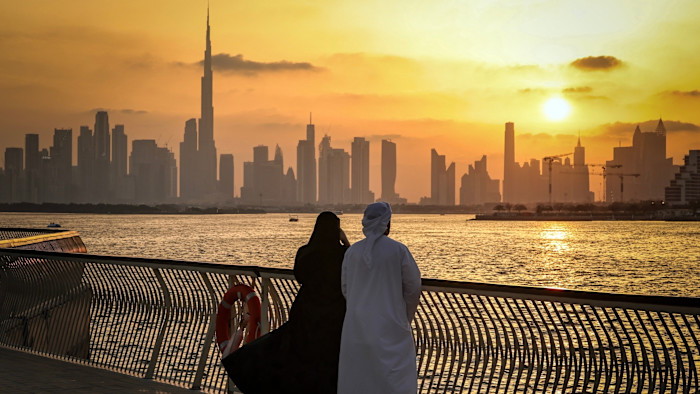
Donald Trump’s two-week ceasefire with Iran brought a sense of relief to the streets of Dubai on Wednesday, its stock market soaring and thoroughfares busier than during the last six weeks of the Islamic republic’s daily missile barrages.
Anwar Gargash, diplomatic adviser to the president, sought to claim that the United Arab Emirates had emerged triumphant from a war it had tried to avoid, “safeguarding sovereignty” against “brutal aggression”.
But, despite hopes that the reopening of the Strait of Hormuz could ease Iran’s chokehold on oil and gas exports and halt further cycles of escalatory attacks on infrastructure, there will be wariness about what comes next.
A ceasefire that does not guarantee an end to Iranian aggression has long been a bad scenario for the UAE and the Gulf. On Wednesday, the Saudi oil pipeline linking the Gulf to the Red Sea was attacked and the UAE defence ministry said “blatant” Iran had launched 52 missiles and drones since the truce. Kuwait and Qatar also said they were attacked from Iran.
Emile Hokayem, of the International Institute for Strategic Studies, said the truce could generate as much long-term anxiety as short-term reprieve for the Gulf states.
“The causes of conflict are still alive, there is no trust-building process and the war has been inconclusive,” he said. “Having avoided the worst, at least for now, the danger is no one has the stamina or courage to think about what it takes to reach a stable equilibrium.”
Since the first days of the war, Emirati officials have fretted about the prospect of Trump losing interest in denuding the Islamic republic’s missiles and drone capacity as the global economic pain mounted.
Now, the president has declared military victory despite Iran’s continued ability to threaten its neighbours.
Depending on the outcome of negotiations between the US and Iran, the Gulf will have to contend with a wounded, intact regime in Tehran that has proven its ability to wreak havoc on the regional economy.
The daily attacks on military and civilian infrastructure in the UAE — far more than received by other US regional allies — laid bare the precarious position of the Arab world’s second-largest economy, which diversified away from oil and gas into logistics, tourism and finance.
Rebuilding trust in this economic model, which was founded on its now punctured halo of security and depended on the free flow of people and goods, will be a difficult task.
“This taught us in the UAE all a lesson. Things happened that will not be easily forgotten,” said a banker based in Dubai. “In terms of investments in the region and collaborations, we’ll see how those evolve, but things will have changed without a doubt.”
The fragile ceasefire meant Trump stepped back from his threat to bomb Iran’s power plants, which had stoked fears among Gulf states that this would provoke an escalation in Iran’s attacks on their own infrastructure.
Negotiations over what Trump described as Iran’s “workable” 10-point plan for a permanent end to the conflict, however, will have to tackle seemingly intractable issues such as lifting of sanctions on the Islamic republic, the withdrawal of US forces from regional bases and what happens to the Strait of Hormuz.
Iran has indicated it will continue to demand shipping companies pay tolls to send oil tankers through the strait, with Trump himself on Wednesday saying the US was “thinking” of setting up a “joint venture” with Tehran to charge tolls.
Saudi Arabia, which has been increasingly dragged into Iran’s crosshairs in recent weeks, welcomed the ceasefire agreement but said the strait must be kept open “without any restrictions”, according to a foreign ministry statement.
And on Saturday, Gargash warned that the UAE would not accept the strait being “held hostage by one country” and warned that an “end to this conflict” should not create “continuous instability”.

The UAE had assumed a more hawkish posture on Iran in recent weeks, with some officials privately promoting tougher US military action to reopen the strait by force.
Iranian strikes on civilian energy and industrial infrastructure caused significant damage, including at a large aluminium smelter in Abu Dhabi that could take up to a year to repair.
Amjad Taha, a hawkish Emirati social media commentator, called the ceasefire a “betrayal”. “Trump will regret it,” he said in a post on X. “YOU DON’T TRUST TERRORISTS OR NEGOTIATE WITH THEM.”
Abdulkhaleq Abdulla, a Dubai-based political scientist, said the war had nonetheless left the Islamic republic “weaker than any time in the last four decades — we are dealing with an exhausted, defeated Iran”.
The UAE had also proved its ability to deal with the realisation of long-feared Iranian missile and drone threats thanks to its air defences, he said.
“We will have to find out what kind of Iran evolves,” he said, adding: “The ultimate goal of bringing an end to the regime didn’t happen during the war, but could happen afterwards.”
Throughout the war Emirati officials have been urging the US to reflect their position in any negotiated settlement to the conflict, demanding guarantees that Iran would not be able to disrupt daily life as it has done remorselessly over the past six weeks.
Abu Dhabi now has little choice but to hope the fickle US president’s statement that he was “also representing” the countries of the Middle East in negotiations with Iran will include a full account of their demands of non-belligerence from Tehran.
Other Gulf states, such as Oman and Qatar, have been prioritising diplomacy and cautioning against military action as a solution to the conflict.
Ali Shihabi, a commentator close to the Saudi royal court, said the deal was a “net positive” because Iran’s decision to agree to the truce suggested it did not want to “bring the whole Gulf down with it”.
“Trump attacking infrastructure would have been a very negative development which would have exposed the Gulf,” he said.
But allowing Iran to retain any form of control over the strait would be a “red line”, said Shihabi. “The priority has to be unimpeded access through the strait.”
