
The ruler of a dying empire inflicts mindless militarism on Venezuela and Chicago.
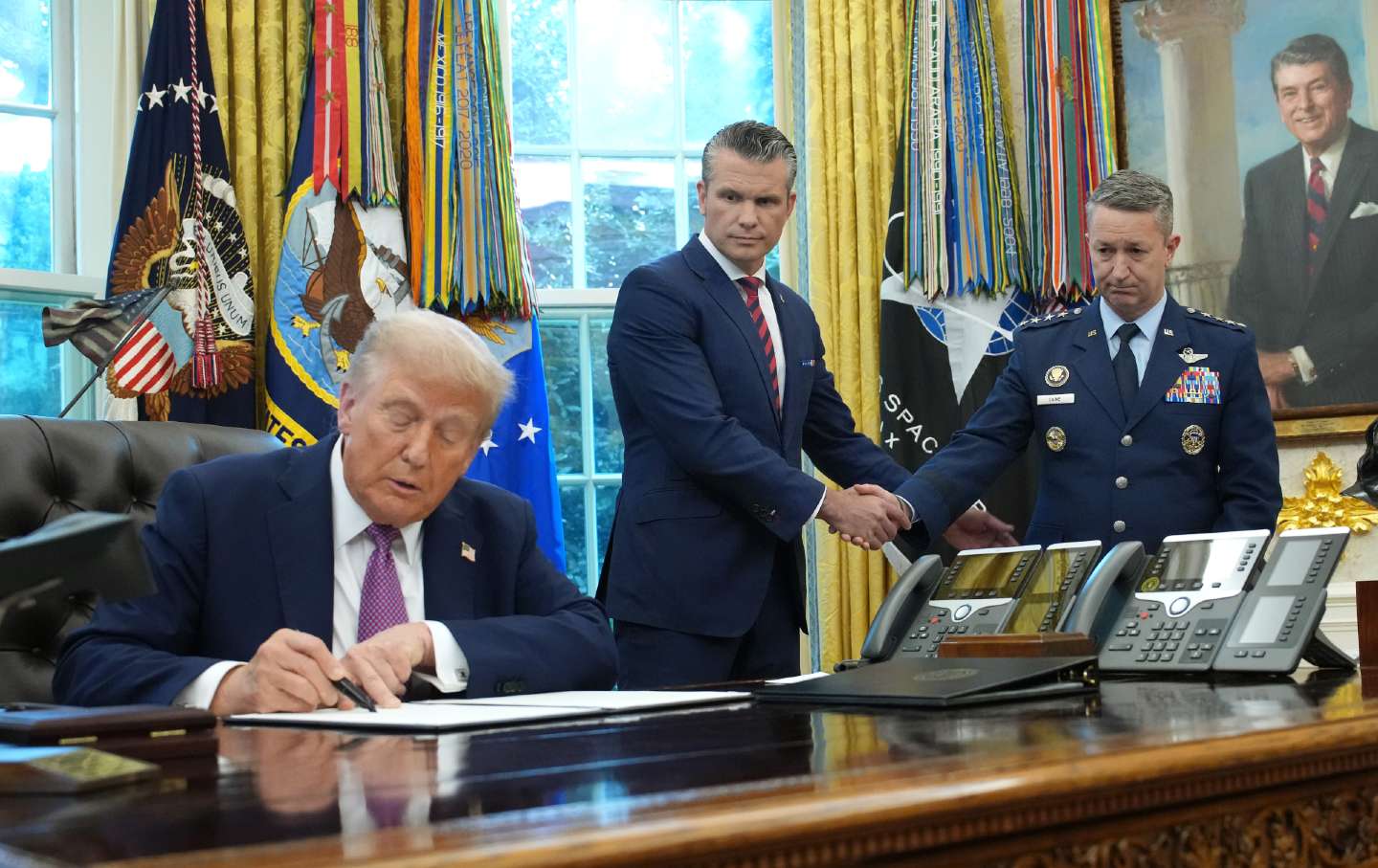
President Donald Trump signs an executive order renaming the Department of Defense as the Department of War as Defense Secretary Pete Hegseth (C) and Chairman of the Joint Chiefs of Staff Air Force Gen. Dan Caine shake hands, in the Oval Office of the White House on September 5, 2025, in Washington, DC.
(Kevin Dietsch / Getty Images)
Donald Trump’s jokes are never just jokes. However crude and nasty his attempts at humor might be, they offer a more accurate picture of his actual politics than his official statements. On Wednesday, Trump posted on Truth Social, a platform he founded and owns, an AI-generated image fusing a famous scene from the film Apocalypse Now (1979) with the president’s current threats to send the National Guard into Chicago. In the movie, Lt. Col. Bill Kilgore (memorably played by Robert Duvall) leads a psychopathic helicopter attack on a Vietnamese village. Kilgore thrills in the slaughter of civilians, saying, “I love the smell of napalm in the morning.” In Trump’s post, the president’s face is superimposed on Kilgore’s body, while helicopters napalm America’s third-largest city. Riffing on Kilgore’s words, the caption reads, “I love the smell of deportations in the morning…”
The post also alludes to the fact that Trump had recently asserted his executive authority in a dubious manner to rename the Department of Defense as the Department of War: “Chicago about to find out why it’s called the Department of WAR.”
Asked by reporters on Sunday about the post, Trump took the coward’s path of disavowal, saying he was not going to “war” with Chicago but simply working to “clean up our cities.” This official denial is much less honest than the Truth Social post, which accurately depicts the libidinal pleasure Trump and his most rabid followers take in the prospect of sending troops to crush domestic foes. The MAGA movement is suffused with rage against the multiracial urban United States, which is seen as an alien threat to the real America, so Trump is deploying the National Guard to bolster his immigration crackdown in cities such as Los Angeles and Washington, DC—with Chicago apparently next.
Current Issue
In Chicago, Trump will meet some resistance from residents as well as politicians. Mayor Brandon Johnson rightly condemned Trump for using immigration enforcement as a pretext to create a “personal militarized force,” and Illinois Governor J.B. Pritzker described Trump as a “wannabe dictator.”
Trump’s deployment of the military at home is blowback from the imperial overreach carried out by presidents of both parties since the dawn of the Cold War in 1945. The imperial presidency is an outgrowth of the larger project of upholding American global hegemony, which started as a mid-century response to the alleged threat of communism and only intensified after 9/11 and the putative War on Terror.
What sets Trump apart from most mainstream politicians is that he is candid about the fact that the project of American global hegemony is faltering, as the empire has repeatedly failed over the last five decades to impose its will on a recalcitrant nations. Since 2016, Trump has cynically been casting himself as a politician willing to end the forever wars. But in practice, Trump has simply transformed them from long wars into a series of scattershot incursions around the world and at home.
When Trump signed an executive order on Friday decreeing that the Department of Defense will go back to being the Department of War (the name it held before 1947), both the president and Defense Secretary Pete Hegseth acknowledged that the United States has not been able to win a major war in 80 years. Hegseth told reporters, “From the Department of War to the Department of Defense in 1947. We haven’t won a major war since…whether it’s the Korean War or the Vietnam War, or our generation of Iraq and Afghanistan.” Trump echoed this sentiment by saying that the United States has not “fought to win” since World War II. Aside from the examples cited by Hegseth, we can also see evidence of American imperial decline in Europe (where Russia is clearly on path to secure its major goals in Ukraine) and the Middle East (where America’s ally Israel is conducting a colonial slaughter in Gaza that has become a forever war without clear rational or plausible endgame). The United States and its allies retain the power to inflict vast violence all over the world, but that doesn’t give them the ability to win anything resembling compliance or a world friendly to American interests.
Trump and Hegseth seem to understand that the United States is trapped in a pattern of failure and decline, but they have a simplistic view of the cause of this problem. They see it as simply a matter of willpower, as if it can be addressed by adopting more macho rhetoric (Trump posting about “the Department of WAR”) and picking easy-to-win fights against small targets.
Paralleling the show of force in American cities has been a flexing of old-fashioned gunboat diplomacy elsewhere in the Western Hemisphere. On Tuesday, the US military bombed a Venezuelan speedboat, allegedly carrying drugs, killing 11 on board. The White House has provided only the flimsiest legal rational for the bombing, which is likely in violation of internatiodnal law. Because of congressional surrender of war-making power to the imperial presidency, Trump has a wide variety of military resources he can deploy at will, including Special Forces, which have been used in the War on Terror to commit assassinations all over the world. Democratic congressional leaders Chuck Schumer and Hakeem Jeffries have been, as is their wont on all serious issues, silent about Trump’s threats to Venezuela.
On Friday, The New York Times reported that in 2019 Trump ordered a secret incursion into North Korea by Navy SEALs to plant a listening devise. The mission was botched and led to the killing of two or three civilians, fishermen whose only crime was being in the way of the SEALs. Trump never told Congress about this violent attack on a foreign country. The Biden administration revealed it to a few members of Congress in 2021, and the public is learning about it only now. Once again, the abdication of constitutional responsibility by Congress is enabling atrocities.
All these events—the troops in American cities, the attack on the Venezuelan boat, the failed North Korean mission—show a common pattern that can be seen Trump’s larger foreign policy. Unlike President George W. Bush, Trump does not seem to have an appetite for large wars pitting the American military against conventional foes and involving the holding of extensive territory. Rather, reverting to an older form of imperialism, Trump is a fan of quick commando raids and shows of force.
In 1898 John Hay, serving as secretary of state in the administration of William McKinley (one of Trump’s favorite presidents), described the Spanish American War as a “splendid little war.” Writing in The New Yorker in 1986, the foreign policy analyst William Pfaff offered an ironic gloss on Hay’s notorious phrase:
Wars can be both enjoyable and profitable, and the United States has found the wars it has conducted in Latin America to be, for the most part, both…. The intervention in the Dominican Republican in 1965, and the attack in Grenada more recently, provided for many Americans a reassuring contrast to the dismal and humiliating engagement in Vietnam.
But, as Pfaff goes on to note, these “splendid little wars” often have disastrous long-term consequences that are far more important than the brief jolt of jingoistic pleasure they initially deliver. The Spanish American War led to the United States making de facto colonies of Cuba and the Philippines, a dire story that still poisons its relations with those countries in different ways.
Popular
“swipe left below to view more authors”Swipe →
In his 1995 study In the Shadow of War, the historian Michael S. Sherry offers a similar analysis of how “splendid little wars” both serve to salve the wounded ego of the American elite while also unleashing short-term and long-term damage on the world. Sherry notes that in the 15 years after the fall of Saigon, “Presidents repeatedly put American forces in harm’s way—largely or wholly on their own initiative, despite the War Powers Act and Vietnam’s presumed lessons about obtaining national consent—but always in arenas on the periphery of great power conflict, where nuclear confrontation or serious conventional combat was unlikely, and where the stakes for the United States were limited, often largely symbolic.” These military interventions “revealed nostalgia for a presumably bygone era of American muscle, reluctance to employ that power in a serious way, and bewilderment about its utility.”
In light of the 30 years of history since Sherry wrote those words, we can see that the “splendid little war” has been the norm since 1975 with presidents of both parties willing to make occasional incursions into places such as Grenada, Panama, Serbia, Libya, and North Korea. The major anomaly has been George W. Bush’s decision to launch two large wars that required invasions and occupations that lasted many years.
Trump’s innovation is that he is applying the strategy of “splendid little wars” to the homeland. This too is a mark of an empire in decline: Finding that it can’t subdue other nations, the government of the United States is trying its hand at domestic bullying. These new little wars are unlikely to be successful. An army that couldn’t defeat the North Koreans, the Vietnamese, the Iraqis, and the Afghans is unlikely to cow the citizens of Chicago. The danger is that these splendid little wars can metastasize into big serious wars, including domestic strife turning into a civil war.
Donald Trump wants us to accept the current state of affairs without making a scene. He wants us to believe that if we resist, he will harass us, sue us, and cut funding for those we care about; he may sic ICE, the FBI, or the National Guard on us.
We’re sorry to disappoint, but the fact is this: The Nation won’t back down to an authoritarian regime. Not now, not ever.
Day after day, week after week, we will continue to publish truly independent journalism that exposes the Trump administration for what it is and develops ways to gum up its machinery of repression.
We do this through exceptional coverage of war and peace, the labor movement, the climate emergency, reproductive justice, AI, corruption, crypto, and much more.
Our award-winning writers, including Elie Mystal, Mohammed Mhawish, Chris Lehmann, Joan Walsh, John Nichols, Jeet Heer, Kate Wagner, Kaveh Akbar, John Ganz, Zephyr Teachout, Viet Thanh Nguyen, Kali Holloway, Gregg Gonsalves, Amy Littlefield, Michael T. Klare, and Dave Zirin, instigate ideas and fuel progressive movements across the country.
With no corporate interests or billionaire owners behind us, we need your help to fund this journalism. The most powerful way you can contribute is with a recurring donation that lets us know you’re behind us for the long fight ahead.
We need to add 100 new sustaining donors to The Nation this September. If you step up with a monthly contribution of $10 or more, you’ll receive a one-of-a-kind Nation pin to recognize your invaluable support for the free press.
Onward,
Katrina vanden Heuvel
Editor and Publisher, The Nation
More from
Jeet Heer 
What was it about Buckley that made him so attractive to liberals—and what was it about liberals that caused them to be attracted to conservative figures like Buckley in the first…
The problem of gerontocracy includes the donor class.
Even the Danes are getting angry. The Danes!
Trump’s former national security adviser is a very hateable figure. But he still needs defending from the president’s lawlessness.

The disgraced former governor is repeatedly proving just how similar he is to the disgraced current president.
No one can trust the United States when a fickle man-child controls its foreign policy.
