

ESO / K. Ohnaka et al.
Astronomers might have seen a red supergiant star — one of the largest stars known — transform into a yellow hypergiant. If confirmed, it would be the most dramatic change ever witnessed in such a star.
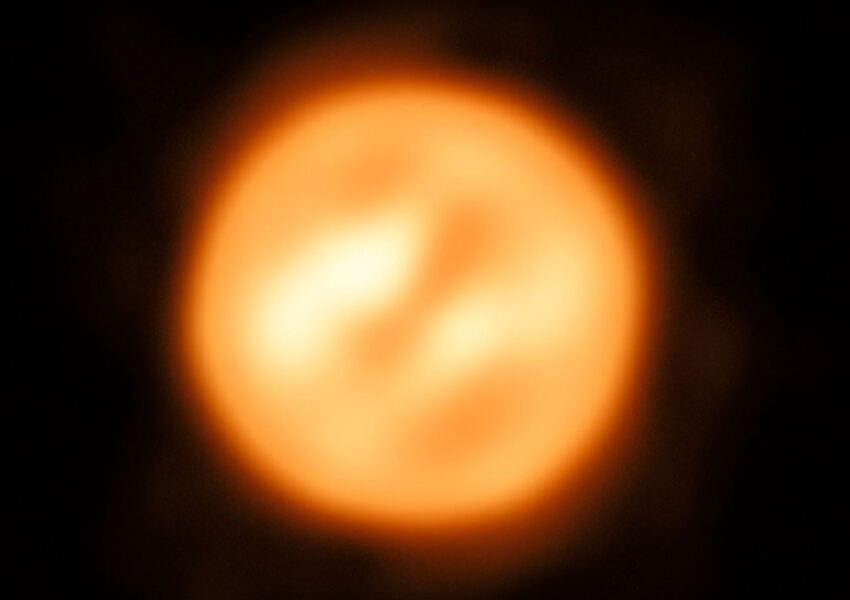
Before the biggest stars die, they puff up into behemoths. Our own Sun spans more than 1 million kilometers (600,000 miles), but red supergiants can inflate to more than 1 billion kilometers across before going supernova. If you placed this red supergiant, dubbed WOH G64, in the center of our solar system, its outer edge would lie beyond the orbit of Jupiter.
Located in the Large Magellanic Cloud, WOH G64 has fascinated astronomers for decades. Not only for its size, but also for its exceptional luminosity and prodigious mass-loss rate, as powerful winds carry material away from the star. More than a decade ago, the star began a series of dramatic changes, first dimming before suddenly brightening, then fading again.
“As a PhD student, I struggled to interpret the star’s extreme changes,” says Gonzalo Muñoz Sánchez (National Observatory Athens, Greece). Gonzalo Muñoz’s team scoured through more than three decades’ worth of data from six all-sky surveys to try and get to the bottom of WOH G64’s wild behaviour. The results are published in Nature Astronomy.
“When we first saw the data, we thought we were observing a different star,” says Muñoz Sánchez, reflecting on just how much the star has changed.
The changes began in 2011, when the star started to dim. Then, in 2013 and 2014, WOH G64 not only recovered its initial brightness but significantly exceeded it. Its surface temperature rose by more than 1000°C, turning the star from red to yellow as a result. The star shrank as it heated up, deflating from 1,500 times the Sun’s radius to just 800 solar radii.
“The star’s spectral features also shifted dramatically,” Muñoz Sánchez says. Titanium oxide features disappeared, and strong features that can only occur in rarefied gas, so-called forbidden emission lines, emerged. Altogether, the changes suggest a profound shift in the star’s outer layers. For example, the forbidden lines might come from ejected material that is now glowing.
Then, in 2025, the star began to fade once more to less than half its brightness, dropping by roughly two magnitudes in less than a year.
ESO / K. Ohnaka
Muñoz Sánchez now thinks this behavior can be explained if WOH G64 belongs to a binary system. There are two possible scenarios: The first is that the system was embedded in a common envelope that mimicked a red supergiant. The partial ejection of this envelope then revealed the two stars.
Alternatively, the primary star may have previously undergone an exceptional eruptive episode, lasting more than 30 years. Now, it’s returning to a state that’s quieter even as it’s hotter, with fewer wind-dominated eruptions.
“Both possibilities are extremely rare,” says Muñoz Sánchez. “Witnessing either unfold on human timescales is nearly unprecedented.”
The stakes extend beyond a single, unusual star. For years, astronomers have wrestled with a so-called “red supergiant problem.” Observations of stars before they go supernova — the progenitors — have failed to turn up the most luminous red supergiants. One proposed solution is that such stars evolve back toward hotter (yellow-er) states before they explode. If that’s what is happening here, WOH G64 may offer a rare, real-time glimpse of that elusive transition.
“The observations showing that the object changed from a very cool red supergiant into a much hotter object are very compelling,” says René Oudmaijer (Royal Observatory of Belgium), who was not involved in the research. However, Oudmaijer also warns that the interpretation mostly hinges on the idea that WOH G64 has a companion. “The evidence they present to infer that the system is a binary is limited,” he says.
Jacco van Loon (Keele University, UK) is also sceptical. In January, van Loon published his own observations of WOH G64 with Keiichi Ohnaka (Universidad Andres Bello, Chile). The pair found that the molecular absorption spectrum of the red supergiant has returned in recent years. “So, unlike the authors of this paper, we are reluctant to speak of a transition to a yellow hypergiant,” van Loon says.
“We all agree that we are witnessing an unprecedented spectacle,” he added, “and therefore are unsure of what exactly is going on. We’re all looking forward to new observations that might offer us new clues.”
