
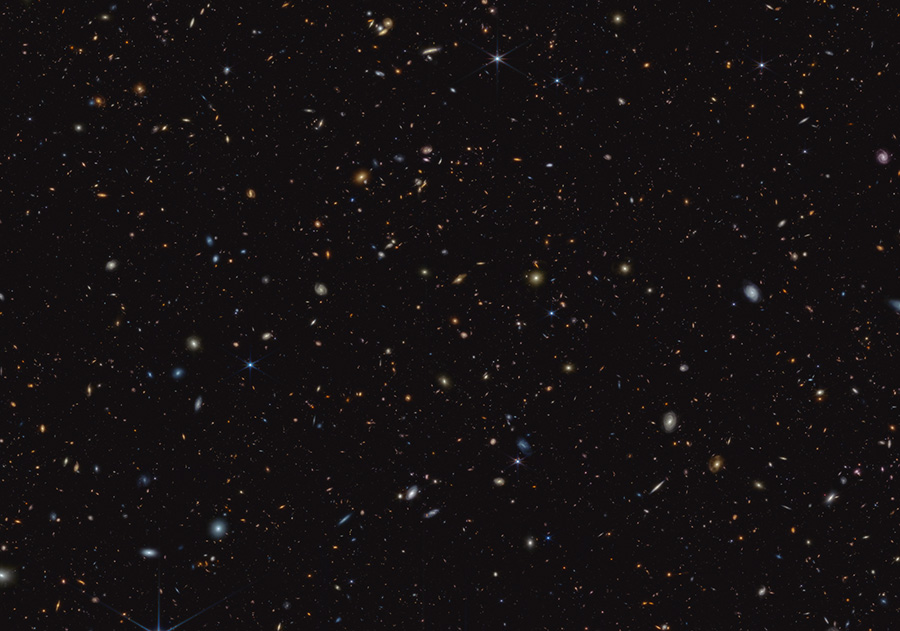
NASA / ESA / CSA / Brant Robertson (UC Santa Cruz) / Ben Johnson (CfA) / Sandro Tacchella (Cambridge) / Marcia Rieke (University of Arizona) / Daniel Eisenstein (CfA); Image processing Alyssa Pagan (STScI)
Astronomers have always wanted more observing time — but now they’ve found an ingenious way around it.
Using a new artificial intelligence network named ASTERIS, a team of astronomers and computer scientists has found a way to effectively increase images’ exposure time, by beating down background noise to reveal fainter features.
For a proof of concept, ASTERIS has already more than doubled the number of distant galaxies detected in a set of images taken by the James Webb Space Telescope. Published in Science, the results are also available on the astronomy arXiv.
Signal vs. Noise
Here’s how it works. In almost any astronomical image, faint celestial sources outnumber brighter ones. And in any such image, noise will obscure the faintest, most numerous sources from view.
Astronomers already have ways of dealing with noise. One of them is simply to look for a longer time, stacking exposures into a single deep image. But even those methods have their limits, one of them being just how expensive it is to take long exposures of the night sky — especially with a telescope like Webb.
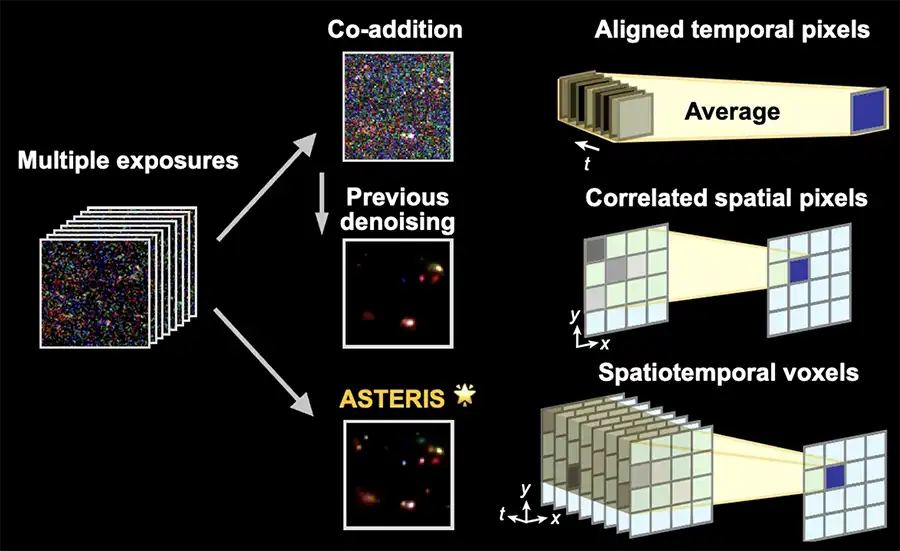
Enter ASTERIS. Technically speaking, it’s an astronomical self-supervised transformer-based denoising network, and it’s designed to remove noise from an image. It removes so much noise, in fact, that it can detect celestial sources roughly 2.5 times fainter — a full magnitude deeper than before.

Yuduo Guo
The network learns what noise is in a self-supervised way. That is, no researcher is telling it exactly what features constitute noise. Human researchers do provide the data it’s training on, but it’s teaching itself what noise is.
Given 16 exposures of the same field, the network splits those images into two sets. Both sets contain the same celestial targets, but with different background noise. Comparing the two sets teaches the network what noise is.
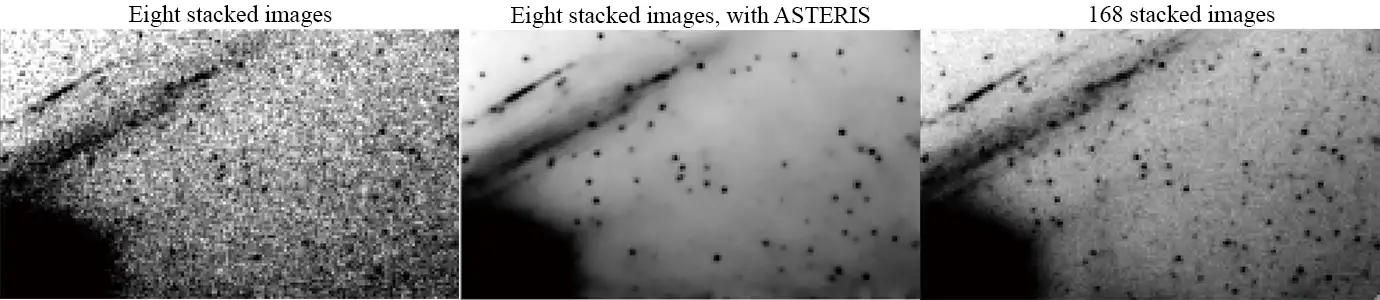
Once trained, ASTERIS can identify features in eight input exposures that would otherwise take 168 exposures to reveal. For example, the AI needs less than two hours of Webb’s time to identify the same features that, before, would have taken more than a day and a half.
Yuduo Guo
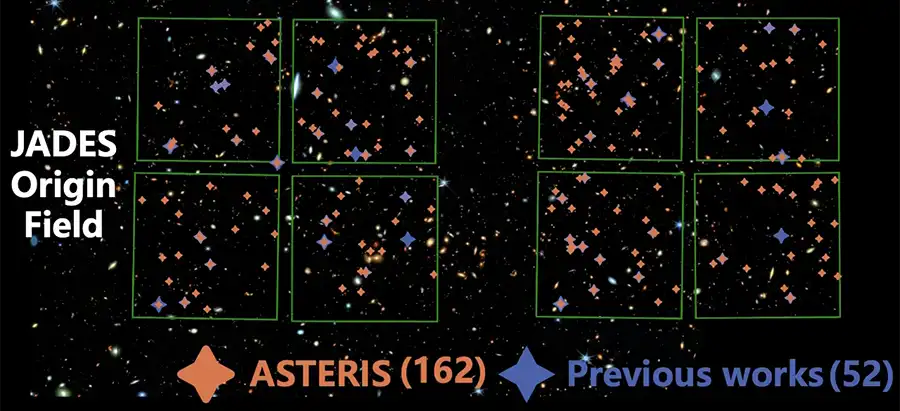
The crystal-clear images that ASTERIS serves — compared against real, deep images for reference — shows that the network isn’t just finding fluff. It’s detecting real features that were hidden in the noise. As a proof of concept, the researchers applied ASTERIS to images from the JWST Advanced Deep Survey (JADES), turning up 162 candidate early galaxies, tripling the number previously found in these images.
ASTERIS is “unlocking faint sources in terabytes of existing data without additional telescope time,” says team member Zheng Cai (Tsinghua University, China).
An Issue of Trust
But can researchers trust that these galaxies are real? There’s always a chance that ASTERIS will identify a galaxy that’s not really there, known as a false positive. Indeed, such false positives, sometimes called hallucinations, are a trait for which AI has become infamous.
But there’s always been a trade-off when detecting faint signals, regardless whether AI is involved, says computer scientist Jaakko Lehtinen (Aalto University, Finland). He’s responsible for the previous state-of-the-art denoising AI, known as Noise2Noise, upon which ASTERIS improves.
“The less you can tolerate false positives, the more true positives you will miss,” he says. “Conversely, the more trigger happy you set your detector, the more false positives you will get.”
Testing while constructing the network showed that ASTERIS has a false positive rate of 10%: “If ASTERIS finds 10 new distant galaxies at this 1-magnitude deeper limit, nine are expected to be real and one may be a false positive,” Cai explains.
Yuduo Guo et al. / Science 2026
“The authors have done a great job in allaying fears of ‘hallucinated’ false positives,” Lehtinen explains. First, they “inject” fake signals to see if ASTERIS can pick them up. Then, they train the network on less data than what’s actually available to see how it does.
But the real test comes with real data. The team, led by Yuduo Guo (Tsinghua University, China), tried multiple ways to verify what ASTERIS found in Webb images. For example, Webb carries 14 wavelength filters, and galaxies that really are distant should disappear when viewed through shorter-wavelength filters. The hydrogen gas that pervades the universe absorbs that light on its way to us. So any galaxy that “drops out” of those shorter-wavelength images but still appears in longer-wavelength images is reliably distant.
A small fraction of sources found in the shorter exposures can also be confirmed against deep reference images, when available from Webb’s archive. And visual inspection can rule out imaging artifacts, like the bright spots that an errant cosmic ray can leave behind.
Cai says that the 162 JADES galaxies include all of the previously confirmed early galaxies. Of the new galaxy candidates, 75%, or about 82, passed the team’s validation. (That number is lower than the predicted 90% because the test against real-world data is more stringent — it has to be for scientific use.) The result more than doubles the number of galaxies from the universe’s first 500 million years found within this JADES field.
Yuduo Guo
The team is planning to move forward, applying ASTERIS to additional data from both Webb as well as the 8.2-meter Subaru Telescope in Hawai’i. With the network’s design published, other teams are likely to verify the results independently.
“To me, what’s cool here is a solid, smart application and extension of earlier ideas to an important new domain, rather than a never-before-seen technological leap,” Lehtinen says. “That makes me trust the results more, too.”
While Lehtinen acknowledges that he’s not an astronomer, he adds that if he were in the field, “I would definitely be taking a close look. It [ASTERIS] might well be ready for prime time.”
