
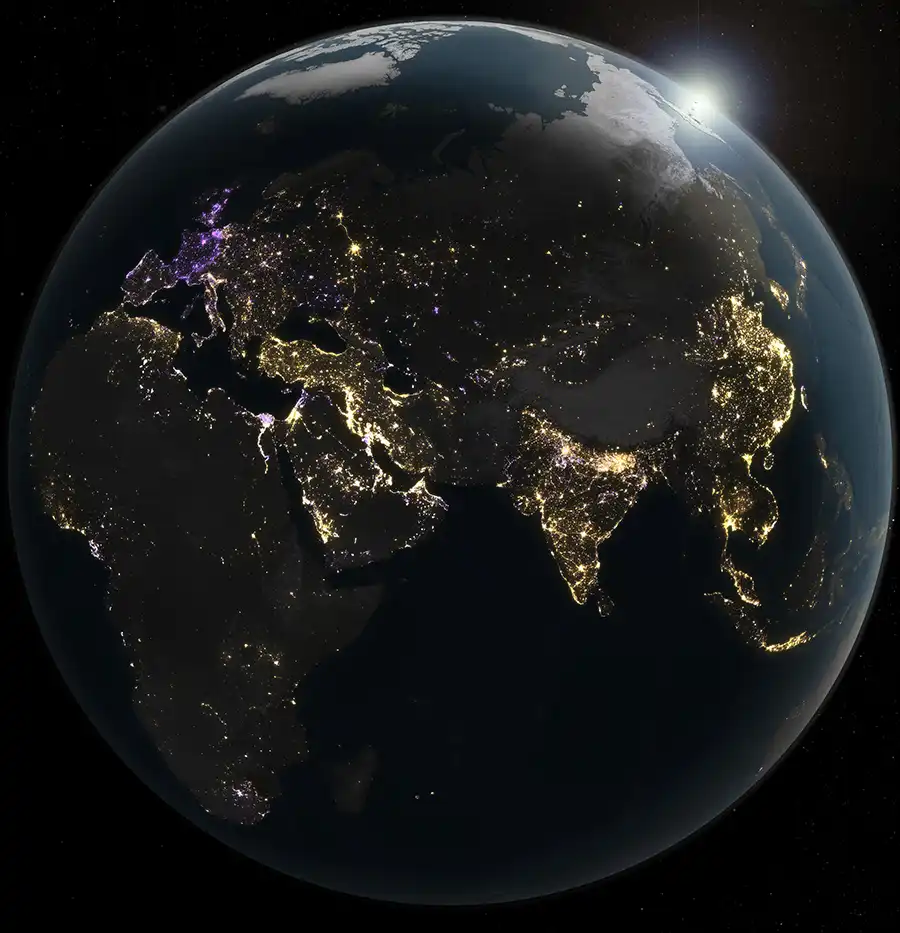
Michala Garrison / NASA Earth Observatory
A new study confirms: Humanity’s night lights have brightened significantly over the past decade. And they’re doing so with increasing changeability from night to night. But skygazers have cause for hope, as a few countries have managed to buck the trend, dimming their contribution to our night sky’s glow. Those examples might show dark-sky advocates a path forward.
Tian Li, Zhe Zhu (both at University of Connecticut), and colleagues have taken a new approach to the study of NASA’s “Black Marble” data, characterizing not just a time-averaged view of humans’ increasing use of light at night, but a granular, night-by-night look that shows how nighttime lights are changing.
The upshot: The world’s light pollution is still increasing, with an uptick of 16% from 2014 to 2022. But the nightly view shows more than that. “The Black Marble of Earth is not merely growing brighter,” the researchers write in Nature. “It is pulsing with intensifying volatility, echoing the amplifying heartbeat of human activity.” Yet those same data could help advocates for darker skies focus their efforts.
What Is Light Pollution? And How Do We Measure It?
Artificial light at night harms wildlife — from sea turtles to fireflies and pollinator insects to frogs — and has ill effects on human health, too. What’s more, it drowns out the starry sky, so fewer and fewer humans can view the Milky Way as our ancestors did.
Yet we depend on light at night, too, to safely continue activities of daily life after dark. Understanding and balancing those competing needs is key to protecting our dark, starry skies, and that’s what motivates studies like this one. Before digging into the results, though, first a note on the data:
The team is measuring light at green to red wavelengths that’s scattered upward toward a space-based sensor named Day/Night Band, which flies aboard the Suomi National Polar-orbiting Partnership satellite. That dataset has its limits. The sensor sees only light emitted after midnight, and it can’t see blue-white light. Some new, energy-efficient LEDs emit light primarily at those wavelengths and humans are far more sensitive to such lights.
Also, the skyglow we see from the ground comes primarily from light emitted sideways, rather than scattered directly upwards. Because of these differences in wavelength and direction, citizen scientists on the ground are seeing skyglow increasing at a much faster rate — by 7–10% per year — than satellites do.
Changing Lights at Night
While the satellite may not be seeing the entire picture, it’s certainly seeing a part of it. For the first time, Li and Zhu’s team has shown how nighttime lights are changing on a nightly basis across the globe. By analyzing 1.16 million daily images from the Black Marble dataset, taken between 2014 and 2022, the team found that the world at night is both brightening and dimming in gradual and abrupt ways alike.
Looking at the world patch-by-patch, the team finds that 2.05 million square kilometers of land was subject to abrupt changes, and 19.04 million square kilometers was changing more gradually. (That latter number is roughly twice the area of the United States.)
“Although there has been a total increase of 16% worldwide, that does not mean that lighting is increasing everywhere,” explains team member Christopher Kyba (Ruhr University Bochum, Germany). “In areas where lighting increased, we found global emissions rose by 34%. This was offset by an 18% decrease in emissions from other areas.”
Overall, the world is brightening, as people continue to expand their cities, construct new infrastructure, and light new areas that were once dark. Such changes can be gradual, but they can be quick too, like when the electricity turns on in a rural area. In the U.S., most abrupt changes in nighttime lights came from gas flaring, when companies burn natural gas during oil extraction. Gas flaring shuts off when extraction ends at one site and turns on when it begins in another.
Sudden, widespread dimming can happen, too: Rolling blackouts in South Africa or widespread infrastructure decay in Venezuela have dimmed lights in those regions repeatedly over the past decade.
Lights can also dim for less apocalyptic reasons, via initiatives to control the amount of wasted light. France reduced its light output by a third since 2014, for example, after instituting national light-pollution legislation. For example, most municipalities there turn their lights off after midnight. The UK and the Netherlands both reduced their output by a fifth over the same period; Spain and Italy also dimmed their lights, though to a lesser extent. These changes come from broad mandates on both the national and European Union-wide level.
The study shows that most changes in brightness are coming from developing nations. India, for example, brightened by more than 30% from 2014 to 2022, largely due to urbanization and economic development. The U.S., over the same period, brightened by only 0.7%. But it’s worth noting that developed countries are still brighter than their developing counterparts: In 2022, the U.S. was still emitting three times India’s light at night.
Course of Action
John Barentine (Dark Sky Consulting), who was not involved in the Nature study, emphasizes that despite patches of dimming lights, the world is brightening on large spatial scales. That has implications for those interested in protecting dark, starry skies.
“Since artificial light at night is a pollutant that effortlessly crosses jurisdictional boundaries,” Barentine says, “village-by-village light pollution abatement plans are very limited in what they can achieve beyond hyperlocal effects.”
“[A] key take-away is that in order to be successful in reducing light pollution, we have to organize on larger spatial scales,” he adds, offering the EU Nature Restoration Regulation as a point of reference. “An increasingly top-down approach is called for.”
