February is often the coldest month of the year for northerners, but the Sun is telling a different story. The December solstice came and went several weeks ago, and you can already notice that the days are getting longer, with earlier sunrises and later sunsets. The celestial geometry is changing too, as the Sun races northward among the stars by about 1° every 3 days. But the stars of winter are still firmly in control of the nighttime firmament.
Note where the Sun sets and, once twilight envelops you, wheel around to the left until you’re looking in nearly the opposite direction. The night sky’s most dazzling star is Sirius, down near the southeastern horizon. Also known as the Dog Star, Sirius appears so bright partly because it is bright, outshining the Sun by 25 times, and partly because it’s relatively close by, only 8½ light-years away.
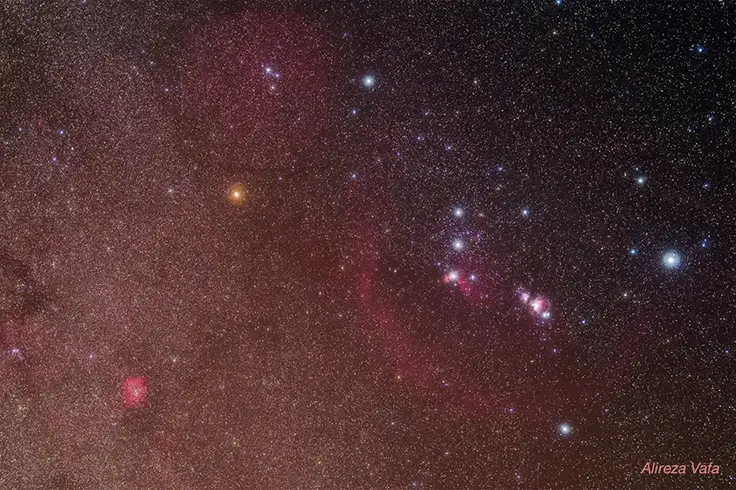
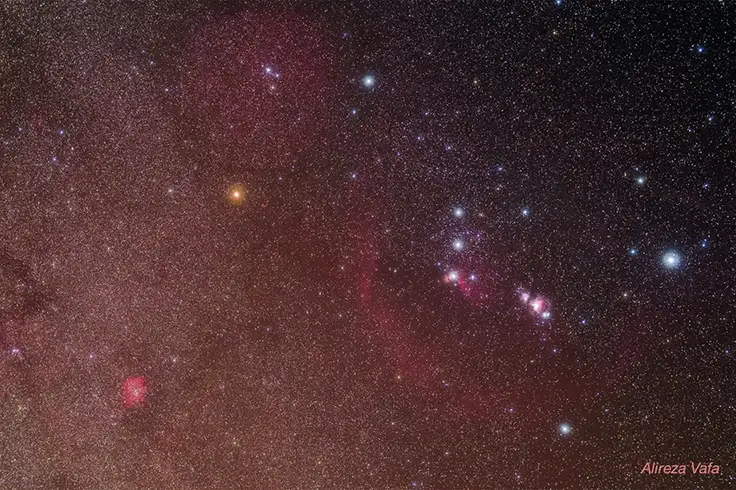
Above Sirius is the distinctive pattern of Orion, the Hunter, the quintessential constellation of winter — or of summer, I suppose, if you live in Australia. Orion is unmistakable, even if you suffer from lots of light pollution, with three stars in a tight diagonal row marking his belt, surrounded by a tall boxy quartet of bright stars to frame his torso. Do you know the names of the bright stars on either side of the Belt? Get the Sky Tour podcast to find out!
Alireza Vafa
As you look around this part of the sky, you’ll notice a bunch of bright stars. All these bright winter stars are no accident. They’re located near the central plane of our Milky Way galaxy. Now, maybe you think of the Milky Way as that subtle gauzy band that arcs across the sky in July or August. At that time of year we’re looking toward the center of our galaxy, in the constellation Sagittarius.
However, at this time of year we’re looking outward along the plane. The region of our spiral galaxy closest to us in that direction is called the Local or Orion Arm, and it’s chock full of bright nearby stars.
For most of us, this “winter Milky Way” isn’t all that obvious. But if you traveled south of the equator to, say, Australia or South America, at this time of year you’d see Orion riding high in the sky, leading a parade of bright stars down a softly glowing stellar river that starts with Capella in the north, then extends past Orion and Sirius southward all the way to Crux, the Southern Cross, and to Alpha and Beta Centauri:
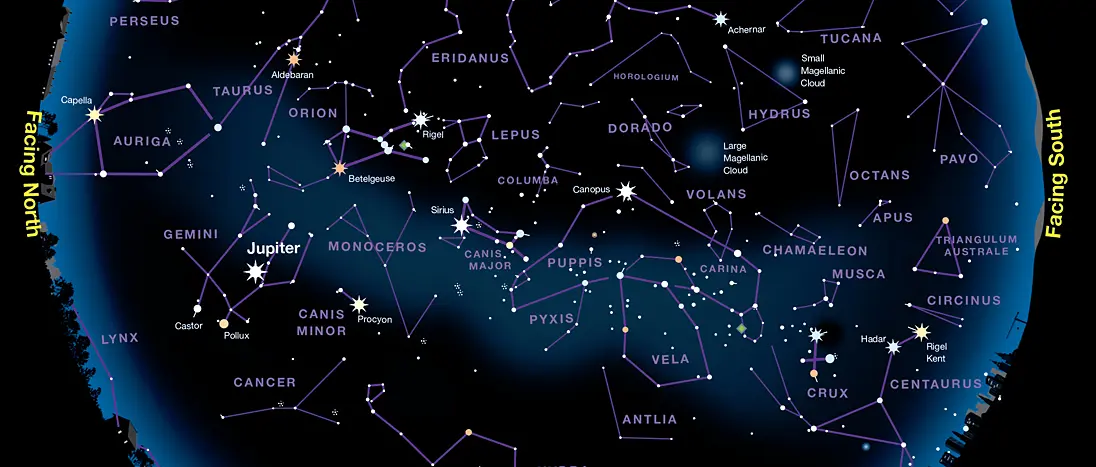
Sky & Telescope
It’s an exciting month to be out stargazing. So bundle up, head outside, and take our fun and educational Sky Tour astronomy podcast with you to help you navigate your way around the night sky.