
In 2020, right in the middle of the COVID pandemic, a project came to us that was born, quite literally, from the need to reinvent a business. At a time when international travel dropped by around 75%, Spain Collection saw an opportunity in a market that would take years to recover: focusing on exclusive travel experiences in Spain and Portugal for a high–net-worth audience, especially in the US, who had been less affected economically. The idea was clear: offer trips to those who would be able to afford them more easily after the pandemic. But not just any trips.
That’s where we came in. The first version of the Spain Collection website was a challenge that helped us define how we understand digital design today and how we want our projects to be: taking care of every detail, telling strong visual stories, and creating experiences that are not only beautiful, but memorable. All that work meant that this first version of Spain Collection gained significant recognition in the industry and received several national and international awards.
Five years later: evolving the business into a more ambitious ecosystem
There’s nothing more rewarding for a studio like ours than seeing a business you’ve watched grow come back to your door and, once again, give you the chance to be part of a project that was, at the time, pivotal for Dgrees®.
In its first version, the Spain Collection offered luxury trips and experiences with a hedonistic, highly emotional approach, stepping away from the traditional “travel agency” model and moving into a much more aspirational territory.
Adaptation and integration of new services and sections
Over time, Spain Collection evolved, and new needs began to appear. Today, they design proposals that range from tailor-made trips to exceptional stays, dream weddings, and VIP experiences that include collaborations with artists, Michelin-starred chefs, or fashion designers.
That evolution led us to rethink the entire design from a more strategic perspective, with a bigger challenge: keeping the essence of the brand while improving the digital experience and integrating their 100+ experiences with the new services. Now, their offering is structured around two main lines that need to coexist within the same digital ecosystem:
- Luxury trips and stays in Spain and Portugal.
- Highly exclusive weddings and VIP experiences, with an extremely high level of service and personalization.
With this context in mind, the challenge was to continue reflecting the spirit of the brand through a distinctive visual style, closer to the editorial world—like fashion or luxury accessories—and far from the usual travel website patterns. At the same time, we needed to improve the user experience so we could add these new services, connect them with the existing ones, and keep the focus clear.
Research & strategy: audience and project premises
Spain Collection’s audience is quite diverse in terms of age. However, there’s a clear common denominator: they are high-net-worth users, most likely familiar with new technologies, fashion, luxury accessories, exclusive hotels, and high-end products. That led us to three non-negotiable principles for the web experience:
- Make navigation easy
We needed to cover a wide age range, with users who have very different levels of digital literacy. The website had to be easy to understand from the very first scroll. - A luxury editorial look & feel
The look & feel had to connect with the world of high-end fashion, jewelry, and lifestyle magazines: carefully composed layouts, a typeface with character, highly curated photography, and a feeling of an “editorial piece” rather than a travel catalog. - Memorable, but subtle interactions
We wanted to add “wow” moments through animations, microinteractions, and visual details that reinforced the perception of exclusivity, while avoiding intrusiveness and minimizing the risk of distraction from what really matters.
From the client’s side, there were also two clear requirements:
- A robust, scalable, and easy-to-update management system, so the Spain Collection team could maintain and grow the content independently.
- A way to correlate experiences, so a single trip could appear coherently in different sections (trips, stays, VIP) depending on the context and the user’s needs.
Design & look and feel: crafting the experience for an “experience designer”
From the start, our visual references were very clear. The client already had a strong selection of photos and videos, with a bold, striking visual style that you can see from the very first moment on the homepage, combining color photography with black and white. On top of that, many of the initial ideas came from worlds closer to fashion, which made their intentions obvious from day one: move away from the typical travel website and reinforce their role as an actual “experience designer.”
The idea for us was simple: if they design unique experiences for their clients, we needed to design an equally well-crafted experience for their users.
How we approached it
We defined a design system based on:
- A proportional grid that maintains visual consistency at any resolution and allows us to reorder and combine blocks without losing coherence.
- Elegant compositions with generous white space, giving the layout room to breathe, reducing cognitive load, and making reading easier.
- Carefully curated photography and video that don’t just show destinations, but convey atmospheres and emotions, making the site feel almost like a magazine.
- Subtle animation and interaction details, always with smooth, controlled motion to reinforce the sense of luxury.
- A clear visual language: typographic hierarchy, rhythm between sections, and a balance between restraint and character.
- A simple yet sophisticated user experience, guiding users through the journey toward what really matters and making content easy to access through familiar navigation patterns (submenus, filters, modals, etc.).
The Design
We created a consistent modular design with more than 50 fully flexible components, conceived so they can be combined in different ways without compromising the design.
“Vanity” Section
This section was created to organize VIP experiences, offering a more curated catalog focused on highly exclusive services provided by the brand’s ambassadors, including artists, Michelin-starred chefs, and fashion designers.

“Escapes” Section
One of the new standout services was this section, where we showcased the catalog of exclusive villas and hotels. In terms of design and navigation, it worked in the same way as the “Collections” section, but we added a more aspirational hero to generate quick engagement and set it apart.
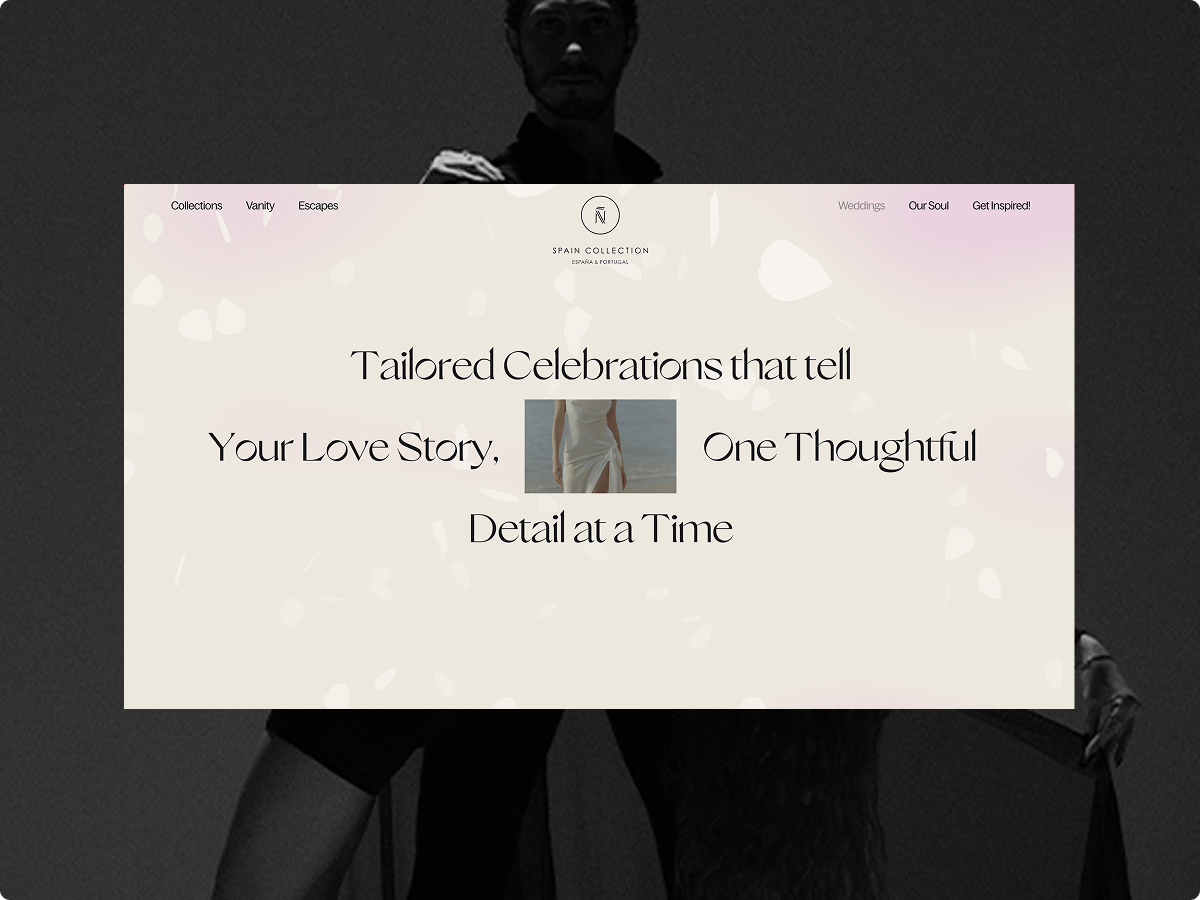
“Weddings” Section
This section differed significantly from the rest of the services and required its own look and feel and structure. Among other decisions, we wanted to differentiate it by giving it a distinct color style and adding some interactive elements (which we explain further below) that added a more innovative and romantic touch.
Typography: Solare
A key element was choosing Solare as a distinctive asset. It’s a contemporary, elegant, and sober typeface, very much aligned with the luxury universe and still relatively uncommon, which helped us reinforce Spain Collection’s identity as something genuinely exclusive.

Photography as a key pillar
The client’s image library was extensive and high-quality. Many of the photos came directly from their partners or VIP ambassadors. Even so, we carried out a refined selection process across more than 3,000 images, looking for those that fit best and retouching what was needed in terms of tone, light, contrast, and framing. The result is a curated selection and editing effort that feeds the entire site with over 2,000 photographs.
User experience: organizing 100+ experiences, VIP itineraries, villa getaways, and dream weddings without losing focus
We were working with a brand that was adding new services to its catalog of experiences—seemingly different at first, but in many ways connected. None of the experiences shown on the website are meant to be purchased individually; instead, they act as an emotional and aspirational showcase, a catalog of travel ideas for the client. In that sense, the idea of a more editorial, magazine-style concept was always present.
The challenge here was to move users away from the idea that these experiences could be booked directly through the site and to reinforce the perception that they are part of something bigger. At the same time, new services like stays, VIP experiences, or weddings, while they could complement those trips, did need to feel like stand-alone proposals, which made the concept even trickier to communicate.
The solution we found for organizing 100+ experiences was to structure them so that:
- They were accessible from different entry points across the site.
- They could be filtered based on different needs (destination, type of trip, style, etc.).
- Travel experiences and VIP experiences were clearly differentiated.
Content architecture and site structure
From a structural point of view, we organized the content through smart segmentation and strong connections between sections:
- The Home, Collections, and Vanity pages feed into one another.
- Each block is designed to guide the user toward the most relevant experiences depending on the context.
- Navigation and CTAs are designed to create a clear path toward inquiry or information requests, using a modal that doesn’t take you away from the page you’re on.
“Collections” Section
In this section, we grouped all experiences into a single catalog that allows users to access them easily through multiple entry points, depending on their intent:
- Users can start by filtering directly by Spain or Portugal via a highly visual submenu.
- Once they’ve chosen a country, they can filter by destination or by type of trip.
- Within each collection, a specific sub-navigation makes it easy to quickly find the desired type of experience or destination.
This way, users don’t face an endless catalog, but rather a guided and segmented structure that helps them get to what they’re looking for. And because the catalog is large, we designed a navigation pattern based on interactive modals that allows them to:
- View trip detail pages without leaving the current section.
- Move quickly between related experiences.
- Easily share a specific experience.
- Land directly on any experience page from the browser without having to navigate from the homepage.
Taken together, this system of filters, modals, and URLs makes all experiences easier to access without overwhelming the user and maintains a constant sense of control throughout the journey.
Tech stack
To support all this complexity, we needed a solid but, above all, flexible technical foundation.
On a technical level, the project is built on:
- A WordPress backend as the core of the project.
- ACF Flexible Content, which allows us to work with modular content blocks without breaking the design.
- A modern build setup with Webpack and NPM, helping us keep the codebase organized and optimized.
- Sass + PostCSS for styles, allowing us to scale the visual system without losing consistency.
- On the interaction layer, we combined TaxiJS for page transitions, GSAP for animations, and Lenis Scroll for a smoother, more controlled scrolling experience.
CMS: WordPress and Modular System
On the CMS side, we implemented a modular system based on WordPress and ACF Flexible Content that allows the Spain Collection team to update and scale the site in a simple, agile, and fully independent way.
This allows us to:
- Build pages from reusable blocks (content modules, galleries, sliders, text + image blocks, etc.).
- Give the Spain Collection team full control over content updates without risking visual consistency.
- Easily connect experiences with different sections, so a single trip can appear under trips, stays, or VIP experiences without duplicating content.
In practice, the site is ready to grow: new experiences, new categories, or even entirely new sections can be added without having to rethink the entire structure.
WebGL, Three.js, and Blender for the “Petal Rain” in the Weddings Section
In a few very specific areas, such as the Weddings section, we wanted to go one step further to convey that sense of luxury and attention to detail. Using WebGL and Three.js, we created a “petal rain” background for the section that follows the scroll and reacts to mouse movement, with the goal of expressing delicacy, organic motion, depth, and an almost dreamlike atmosphere, very much aligned with Spain Collection’s idea of a wedding. Thanks to this combination, we were able to create an interactive 3D scene that works as a living background without relying on pre-rendered video, adding an extra sensory layer to the experience without compromising navigation or performance.
First Steps
At the beginning, we experimented with petals that simply fell and rotated along a single vector axis, but the result felt too flat, not very organic, and didn’t create the sensation we were aiming for.
So we iterated through other options until we arrived at the final solution, built around:
A 3D scene in Three.js with a perspective camera (THREE.PerspectiveCamera) to represent depth in a more natural way.
A soft gradient background that evolves over time using a WebGL shader based on a Perlin-like noise field, enriched with an interactive 3D petal rain that responds to mouse movement and reinforces the feeling of immersion.
Technical process
- We defined three layers of petal rain at different distances from the camera, each with a parameterized number of petals (for example, 50 in the far plane, 70 in the middle, and 20 in the near one) to enhance the sense of depth.
- We modeled four different petal shapes in Blender and loaded them into the scene; a random function assigns one of these models to each instance, enriching the visual variety.
- We used a THREE.Raycaster to cast a ray and intersect the three layers and, from those intersection points, apply repulsion forces to the petals so they react to user movement.
- We implemented a “respawn” logic: when a petal crosses certain boundaries, it reappears on the opposite side so it can be reused without continuously creating new instances.

In the end, this wasn’t about showing off with technology, but about using it in a way that serves the concept and the creative idea behind it, adding tangible value and reinforcing the message without compromising the content.
The final challenge: taking care of the project’s visual legacy
Keeping a website like Spain Collection at the right level depends, to a large extent, on its visual content. It’s not enough to have a solid initial design; you need to be very careful with every photo that gets uploaded so it matches the context, the tone, and the visual universe we’ve defined.
When you deliver a project with such a high level of customization and give the client full independence, there’s always a risk: that the people managing it, either due to a lack of time or simply a lack of knowledge, won’t be able to care for the content with the same attention the design requires.
Part of our job is also that: educating, training, and giving the client the right tools so they can stay consistent with the design we hand over. To do that, we focused especially on:
- Explaining why certain visual decisions are important.
- Helping the Spain Collection team with their first steps in the CMS.
- Defining basic criteria to maintain consistency in photography and content.
At Dgrees®, we believe our responsibility doesn’t end at launch. We review each project from time to time to make sure the “legacy” we leave behind is still alive, that the site doesn’t lose consistency over time, and that the design ages naturally.
