
November 15, 2025
Take it from me: A crossword clue can be debated with the kind of fervor normally reserved for corporatist propaganda and outright racism.
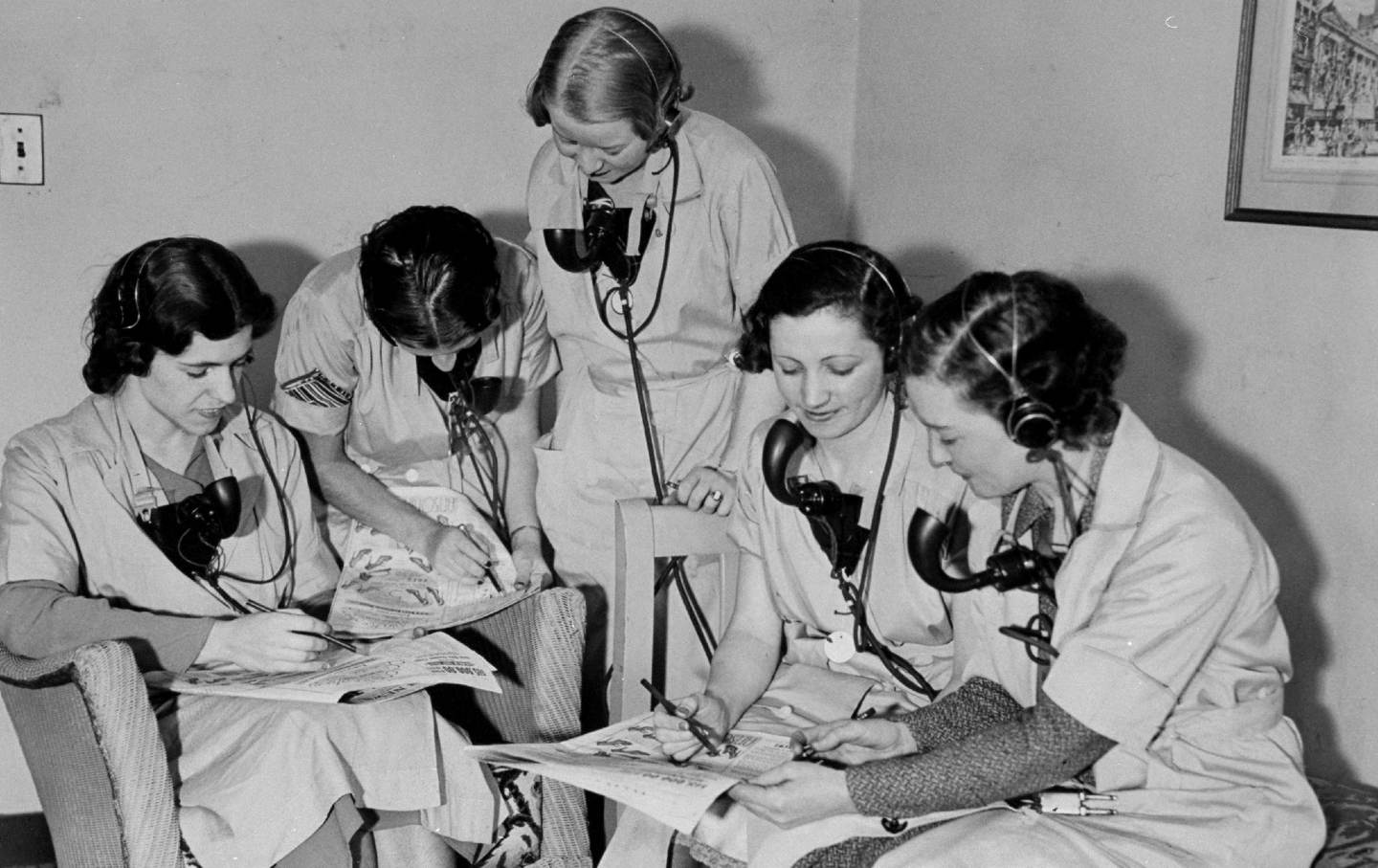
Hello girls at the New Yorker Hotel work on Daily News Crossword Puzzle Contest.
(Larry Froeber / NY Daily News Archive / Getty Images)
In 2009, the year I turned 18, I was a summer intern to Will Shortz, NPR’s “Puzzlemaster” and longtime editor of the New York Times crossword puzzle. For an aspiring cruciverbalist, this was a dream job. In the mornings, I’d wake up at my childhood home in Midwood, Brooklyn, take the Q to the 4 to Grand Central, then Metro-North to Westchester, an almost two-hour pilgrimage to Shortz’s home in a tidy hamlet aptly called Pleasantville. The stations, once you’re out of the Bronx, oscillate between wrought-iron names and marshmallow ones: Valhalla, Mount Pleasant, Hawthorne, Pleasantville. I was an outer-borough kid, son of a public school teacher and a waitress; I smirked at the fact that Mount Pleasant, not Valhalla, was a suburban cemetery, a cul-de-sac in extremis; up here, words could only mean so much.
If it was raining or fiercely cold, Shortz would pick me up, but usually I’d walk from the Pleasantville station to Great Oak Lane, in the middle of which sat Shortz’s heaving Tudor-style home. Outside, the structure’s black half-timbered detailing and light-gray stucco looked like a cozy, agreeable crossword: bowed by suburban breeze, gracefully aged. Inside, his house was part museum, part Elks lodge, all wood panels and rafters and leaning towers of Sudoku books. Glass cases teemed with puzzle knickknacks from centuries past. There were crossword cuff links from the craze of the 1920s. There was an oddly beautiful bracelet made up of enamel five-by-five crosswords connected by sterling silver links. The clock in the second-floor office was a crossword; the hour and minute hands, you might have guessed, were pencils.
Shortz was the first adult I met who worked from home. He’d greet me at the front door donning crossword print sweatpants, confirming in two visual languages that my workday would be gimmicky but relaxed. I typed up e-mail correspondence he dictated, getting faster and faster at keying the dreamed-of “Crosswords—Yes!” subject line to lucky submitters. I typeset and formatted puzzles in the Times’s proprietary system, thrilled I could, pinky finger on the Backspace key, disappear a lavishly serifed letter in that iconic font, a fairytale ogre lugging a magic eraser.
Every Friday, before proceeding to the study, he’d test his NPR Weekend Edition quiz on me in the living room, toughening it up for on-air contestants if I got the answers too readily. Upstairs, he’d let me suggest new clues for publication, for pop culture entries in particular, due to my age. I once ventured, successfully, a new clue for LEIA: “Film character known for her buns.” When, that June, a woman with a voice identical to my grandma Emma’s left a boiling voicemail on Shortz’s phone—she’d taken offense to the entry JEWFRO in a Joel Fagliano Monday puzzle, offering a thicket of unreason I’ve forgotten the specific thorns of—I, a nice Jewish boy just like Joel, advised that there was no need to respond; the entry, I assured Shortz, was fine, unnoteworthy. It made no sense to me, at the time, to make such a ruckus over a game. In hindsight, I would realize there was much more latent importance and hidden points-of-view in crosswords than I could imagine as a teen.
Occasionally we had visitors. Ellen Ripstein, a celebrated speed-solver and 2001 American Crossword Puzzle Tournament champion, would deliver a crate of paper submissions—a hundred or so manila envelopes mailed to the Times’s office in midtown—to Shortz’s home every week. Paula Gamache, a constructor—the term for a maker of crossword puzzles—who lived in nearby Rye, came by here and there to help with correspondence. Gamache was legendary in puzzle circles for stamping SKINNY BITCH—“Saucily titled best-selling diet book”—at 1-Across in a 2008 Times Saturday, eliciting whispers of “You can do that?” from constructors, and no doubt a mixtape’s worth of miffed voicemails on Shortz’s machine. A no-nonsense derivatives trader in her 50s, Gamache seemed to relish sending the dreaded “Sorry, but this theme didn’t excite Will” rejection e-mails, and her nonexcitement at Shortz’s nonexcitement excited me. This was Shortz’s stock rejection line, sharpened to initialism (TDEME—theme didn’t excite me enough); once, a constructor on the receiving end of one too many TDEMEs grumbled that she ought to include a few pills of Viagra in the envelope with her next submission.
Current Issue
But mostly, Shortz and I worked alone. If we needed to verify the spelling of a song title, he would heft a Billboard Encyclopedia of Music from the shelf, while I, much more quickly, would google it. If we needed a new puzzle to edit, he padded to the study’s closet, unlatched a creaking door, pawed through shelves, and took a puzzle off the shelf seemingly at random. I thought I might take advantage of this by mentioning how many young constructors now attended Brown University, where I ran a Puzzle Club. The Times had run a special week of puzzles the previous year, and had one ready for the coming September—in 2008, “Teen Puzzlemaker Week,” and soon in 2009, “Half-Century Puzzle Week,” in which every constructor had been contributing puzzles to the Times for 50 years or more—so I proposed “Brown University Puzzlemaker Week.” It had less pomp and circumstance than a string of wunderkinder or accomplished veterans, but Shortz liked the idea.
In 2010, when it ran, I couldn’t believe it. Our club was profiled on NPR, in the Times and The Chronicle of Higher Education, but more importantly, we were invited to an episode of The Martha Stewart Show focused on puzzles. During a commercial break, we asked Stewart if she was a solver. “Well, I did a lot of crosswords when I was in prison,” she said, winking.
Throughout the summer, Shortz flickered between an avuncular image and a brotherly one. I wasn’t easily intimidated by larger-than-life figures, and Shortz’s sturdy, Midwestern folksiness discouraged it. Anyway, working-class city kids tend to flinch at demands for genuflection. The environment offered, or we projected, a sense that survival required a leery competence, one correlated with age, responsibility: riding the subway alone, knowing which strangers to talk to, and so on. But fluency with highbrow media—of which the Times puzzle was exemplum—could act like a cultural fake ID. I knew Shakespeare quotes because of the crossword; I knew words like INURE and ARIA and TOILE because of the crossword; I knew who ASTA was, what an EPEE did, which colors resembled ECRU or OCHER. Solving the crossword meant I knew, or knew of, what my friends’ fancy Manhattan parents knew; writing the crossword only raised my index of precociousness—every metropolitan parent, part bouncer and part admissions officer, keeps a mental list of impressive kids and their odd hobbies. It was, though I couldn’t have articulated this at the time, the cheapest method I saw for tapping into the glamour of the adult world, a faux-worldliness that gave me a rite, however wobbly or elitist, of passing.
We were a study in contrasts, Shortz and I—the outer-borough kid stepping quickly, as if out of necessity, into adulthood; the adult who’d crafted a job—a life!—centered on a slice of childlike play. There were hints of a willed arrested development: He ate like a latchkey kid; lunches were a can of Campbell’s Soup and packaged chicken patties. (I’d grown up with an immigrant mom who cooked ornate, multicourse Mediterranean dinners and a dad with an adventurous palate, and devoured Shortz’s fallout shelter meals with something like reverse exoticism.) As we ate, he’d put on vinyls of his favorite bands, with his most beloved being Green Day. He liked all the 1990s and 2000s alt rock mohawked rebels. One day, I twiddled my thumbs as Shortz took phone calls with accountants, real estate agents, and other men who wore suits in daylight; as far as I could tell, he was all but liquidating his puzzle fortune—the millions amassed through crossword, KenKen, and Sudoku books, his winsome caricature on their covers—to purchase a warehouse in Pleasantville, and turn it into a local table tennis club. (Shortz, a devoted and talented player, drove to nearby towns like Tarrytown every night after editing to get in a few hours of competition.) Double the play—spend down your game-gotten riches so you can more easily play another game: It sounded like the fever dream of a 5-year-old, by turns earnestly utopian and head-scratching, and by summer’s end, I couldn’t tell if that was a good or bad thing.
By March 2022 I was 31 years-old, a regular contributor to The New Yorker’s puzzle page, and a far cry from Will Shortz’s basement. I had a Saturday puzzle in the Times that included the answer THONG SONG. My original clue, “Sisqó #1 hit with the lyric ‘Ooh that dress so scandalous,’” was changed by the editors to “2000 Sisqó hit with a rhyming title,” presumably hoping those who didn’t know the song could now, given they had some letters from the crossings, infer the remaining ones. Three weeks later, at the first in-person American Cross-word Puzzle Tournament in three years, I was at the lobby reception desk when Peter Gordon came up to me with a bone to pick. Gordon, a longtime editor and prolific constructor, said, in his Great Neck, Long Island, accent, “‘Thong’ and ‘song’ don’t rhyme!” That was news to me, but luckily the crossword community counts among its ranks many linguists (not to mention pedants); a few group chats and audio recordings later and the Great Thong-Song Divergence of 2022 was confirmed. The going hypothesis by the linguists was, not unlike the Northeast Corridor’s resistance to the Cot-Caught merger, the frequency of the words was at play: more common words (like “song”) are more resistant to vowel shifts, but less common words (“thong”; but say it more often, why not) lack this pressure, and so the Long Island vowels have freer rein: “thahng sawng,” in the unrhyming dialect. If linguistic micro-communities could shake their fists at the accuracy of this kind of clue, surely they’d shake two when the stakes were higher still.
It wasn’t so. In 2015, I published a puzzle cowritten with a cross-word construction class I teach at the Jewish Association Serving the Aging. The grid had ANWAR in it, which has nearly always been clued by way of former Egyptian president Anwar Sadat. That’s how we’d clued it in the submission, but when we looked in the paper, the clue had been changed by the Times to “___ al- Awlaki, terrorist targeted in a 2011 American drone strike.” It was a perfect storm, featuring many of the reasons crossword-making would come to be politicized: First, if anything violates the crossword “Breakfast Test” (an injunction to avoid “death, disease, war and taxes” by the Times’ inaugural puzzle editor, Margaret Farrar), surely it’s extrajudicial murder. The students in my class who’d worked as civil liberties attorneys were horrified—as was the ACLU—at this first drone killing of the Obama era. It seemed strange, too, to call the drone strike American (as opposed to “U.S. drone strike,” as if personifying it), while neglecting to mention that al-Awlaki himself was American, born in Las Cruces, New Mexico. Whether or not al-Awlaki (who’d never killed anyone himself but indeed spread and organized anti-American sentiment) was a terrorist, was also hotly debated at the time. I don’t like the inflationary use of the term “terrorist.” I’m against killing terror suspects, even more so absent due process, and yet here was a puzzle with my name on it, all but claiming, since this was a clue in the country’s premier crossword, that facts were facts, and thus they were unremarkable. Literally so: A few people reached out to me saying they imagined the clue wasn’t mine, but the fracas, such as it was, was confined to a subculture debating internal norms.
Popular
“swipe left below to view more authors”Swipe →
Just a few years later, with hundreds of thousands of additional New York Times Games subscribers, the public would involve itself in these clue politics. In 2022, Lynn Lempel, known as “Queen of the Mondays” for her uncanny ability to make engaging and witty Monday puzzles (the easiest of the Times’ offerings to solve, but for many the most difficult to make), published a puzzle with the entry CLEAN COAL. This, per Vice News, caused a “mini-scandal.” The clue read “Greener energy source.” “Clean coal is not a ‘greener energy source,’” tweeted Molly Fisch-Friedman, a senior manager of survey research at the communications outfit Climate Nexus. “Do better.” The Sierra Club fired off a few fist-shaking tweets, huffing that they “[a]pplied this rage into today’s Wordle instead, which was difficult but featured no fossil fuel industry greenwashing.” Sara Hastings-Simon, a University of Calgary physicist and Times crossword aficionado, told reporters there was “such a violent reaction” to the crossword clue because promises of “clean coal” have been used as “this delay tactic, as a way to say we don’t need to do anything else” to address climate change. “The fact that that filtered down to something like the New York Times crossword puzzle is an example of how these approaches by industry are ultimately successful at influencing our discussions and approach toward climate.” Those are fighting words—is there another discernible straight line, however faint, connecting dirty-energy lobbying to crossword clues?
Fisch-Friedman noted at least “how easy it is for misinformation to spread.” The puzzle is famous for reflecting the biases of the paper it appears in; the same bigwigs pushing anodyne climate copy hired the puzzle editors too. In the same way that one would never have seen the entry CLEAN COAL decades ago, crossword clues serve as a micro-historiography—a barometer for not only how specific language won’t be clued, as with the stubbornness around INDIA, but also the allowable band for how it can be clued. As a bouquet of supposedly neatly trimmed facts, the crossword could demonstrate how those facts were always subject to recontextualization, as with the case of the entry MAU MAU’s clues in outlets like the Times. Now understood as an anticolonial uprising against British rule, the Mau Mau (also called the Kenya Land and Freedom Army) were tarred as violent extremists by the foreign correspondents of the time. The crossword followed suit: Clues in the 1950s and ’60s denigrate the movement as “African menace,” “Kenyan terrorists,” or “Dreaded name in Kenya.” A few decades later, clues began to mention “rebellion” and call the rebels a “phenomenon.” It wasn’t until 2013 that the clues spoke any modicum of truth to power, when the MAU MAU, as they’re currently treated in history books, were clued as “Fighters for Kenyan independence. ”Their first appearance in the puzzle was in 1953—that’s 60 years of misclassification, spilling over from Times international coverage into its own miniature almanac—the crossword.
Much happens too, between writing and editing of crosswords. The clue “Greener energy source” wasn’t Lempel’s, and those politics aren’t hers, either. When Lempel submitted the puzzle, the original clue for CLEAN COAL read “Dubious term for a greener energy source.” Lempel had a back-and-forth with the editors, sending an e-mail explaining, “If you Google ‘clean coal,’ there seem to be alot of questions as to whether it’s actually clean. That’s why I used the qualifier and I wonder if it should stay in there.” The Times replied that Shortz “still finds the clue better as it is without any hedging.” After the puzzle ran, the response was so forceful that it led to that rarest of things, a crossword correction:
The clue for 47 Across in the Monday puzzle implied incorrectly that coal is a viable source of clean energy. While it is possible to capture and sequester some of the greenhouse gas emissions and other pollutants from coal- fired power plants, the technology has never been used on a large scale because of its high cost.
For those couple of days, a crossword clue was being talked about with a fervor normally reserved for corporatist propaganda or outright racism. What’s more, longtime crossword solvers were learning that Lempel wasn’t exactly to blame. It was an editorial choice, and recognition was dawning that Lempel’s original clue calling clean coal “dubious” was just as much an editorial position as extracting that context from the final clue. “There’s been more politics in puzzles lately,” Lempel would later say, “about what people should include in puzzles and what people shouldn’t include and the way clues should be directed.… I don’t disagree with a lot of that. But it’s a puzzle, you know.”
I don’t know, not really. I might know how to narrate my own stumbling through a life in puzzles, that at the outset making crosswords felt about as political as shuffling around Lego blocks, that as a high school kid, I thought part of the puzzle’s appeal was how it simultaneously held language at bay (treating the letter more as construction material than a unit of meaning) while meaning proliferated (in puns; in newly gathered knowledge). I know that if I first made puzzles for myself, the first people I tried to impress were other constructors and the then-nascent blog scene, that because the blogger Rex Parker (Michael Sharp, a literature professor at Binghamton, who reviews the Times puzzle every day) liked The Simpsons as much as I did; I was delighted to debut the answer NED FLANDERS in a grid, even more delighted when he thrilled to it. I know that as the puzzle became more politicized—a shift I had a hand in shaping—the proliferation of new norms didn’t always make sense to me, that the “Do no harm” ethic seemed admirable but often contradictory or inarticulable. Puzzles were to exclude the names of celebrities accused of sexual assault, but many of history’s greatest monsters were OK; it would be bad manners to exile REAGAN, IDI AMIN, STALIN from the grid but CHRIS PRATT might need to go for his associations with Hillsong Church. (Just him; never mind the countless other celebrities also affiliated.)
The instinct here was to treat the puzzle as a cultural force; what went in it approached endorsement. And if the puzzle was a release from real life, any reminder of the political world outside was an invasion; we had our solvers to think of. This too was a kindness taken revealingly far: I once heard an editor would reject a puzzle with the answer SHOOTING GUARD because that first word might remind a solver of the ongoing crisis of mass shootings. This is an editorial stance difficult to evenly apply (is CANCER OK? Clued as the zodiac sign? Why is IED okay? Because those deaths happen far away?), but it also presumes to know the solver’s reaction in advance, a move that can go quickly from caring to infantilizing, its own version of taking away someone’s language (in: “not” + fant: “speaking”).
I know in weaker moments when I’ve tested that refrain—“It’s just a puzzle, you know”—with newer constructors, their fiery rejoinders have made me not ashamed, but envious. I know every time I’ve published an article saluting the efforts of more politically minded puzzlers, the far right has seized on it (“Oh, so now the crossword puzzle needs to be woke!?”), as good a proof as any that it’s not just a puzzle. (In Vienna in 1925, crosswords had to be submitted to government censors: “The measure has been promulgated because . . . a Legitimist [royalist] newspaper published a crossword puzzle with the solution: ‘Long Live Otto.’”) I know that as a young crossword writer I wanted to make politics, not puzzles, my job, and I have; I know that among the people I admire most in the crossword world are those who left strenuous, overtly altruistic jobs (as lawyers for LGBTQ+ rights, as teachers, as therapists) for full-time roles as puzzle editors—not because I think puzzles are more or less moral than those industries, but because I sense in these people a decision to finally make good on their desires. What could be more moral than that?

